con Posidonia Dive
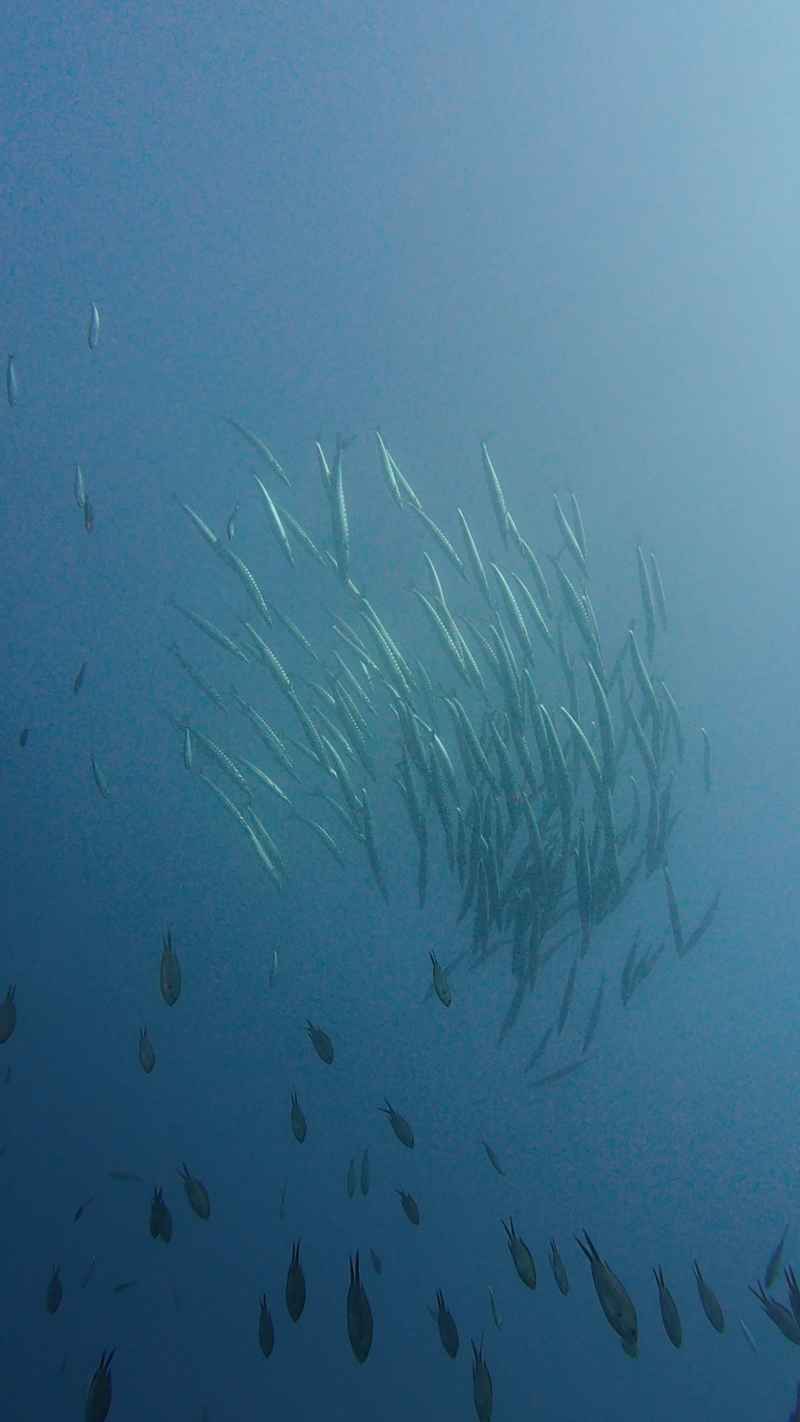
Tight barracuda school circling near anchor
No current, good viz, sunny day. With the waters warmed up to 20-23 degrees, the ridge was covered by sea snot, or moco like the locals call it. "Moco" is a cottony, jelly-like goo released by microscopic algae. When the water warms up in spring and there's plenty of light, these algae grow super fast and produce a sticky mucus that blankets everything: rocks, other algae, the seagrass. It lasts a few weeks and then clears up on its own. It's not pollution or an invasive species; it's a natural Mediterranean event that happens every year. Scientifically called benthic mucilaginous aggregate (BMA). It's not a single species. BMA are caused by five filamentous macroalgae: free-living forms of two brown algae, Acinetospora crinita and Tribonema marinum, and three fast-growing benthic chrysophytes - Nematochrysopsis marina, Chrysonephos lewisii, and Chrysophaeum taylorii. The mix varies site to site and even within a bloom. In any case, it was everywhere, especially on the shallower depths of 16-20m. We took the north-east route on the coast side and spent some time on the sandy/posidonia fields part - all the typical fish: combers, wrasses, one small moray - that one diver harassed out of its hole by touching its tail - Please do not touch marine life! Natalia spotted a few nudis, nice schools of mojarras, and as the highlight of the dive, a really tight circling school of barracudas near the anchor.
Una app gratuita para buceadores que quieren llevar un buen registro de su tiempo bajo el agua.
Registra cada detalle
Profundidad, duración, condiciones, equipo, compañero, notas — todo en un solo lugar. Importa desde Suunto y otros ordenadores de buceo.
Registra la vida marina
Registra los avistamientos de especies en cada inmersión. Crea un catálogo personal de todo lo que has visto bajo el agua.
Tu perfil público de buceo
Comparte tu historial de inmersiones, estadísticas y experiencias con una página de perfil que tú controlas.
