
Diving in Finnish Quarries
Finland's flooded freshwater quarries and old mines, run as club-leased dive parks: intro depths through ice diving to world-class mine caves at Ojamo.
Last updated April 2026
Overview
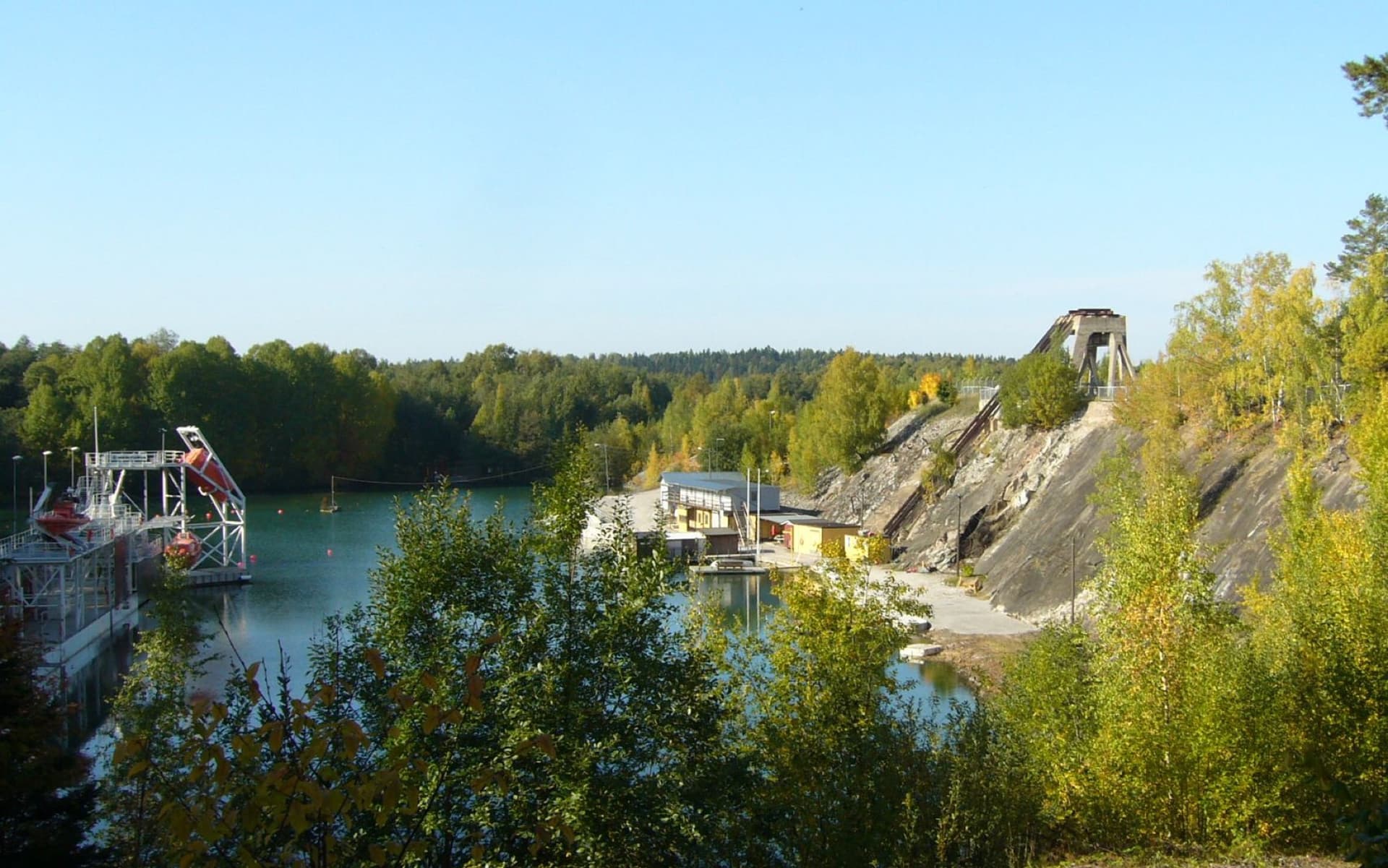
Finland's freshwater dive scene runs through flooded former rock quarries and one limestone mine, used as club-organised dive parks. The activity range is the defining feature: from intro and training depths at Hilloisten louhos in southwest Finland to the 138 m worked level of Ojamon kaivos at Lohja, named in the Sukeltajaliitto magazine as the only Finnish equivalent of Norway's Plurdalen. In between sit the progression sites: the Vakka-Suomi granite cluster (Hilloisten louhos, Uhlun kaivos), the federation-listed Paakkilan avolouhos at Tuusniemi (asbestos quarry around 30 m, tunnel at 28 m), Kaatialan louhos at Kuortane, and the steep-sided Iso-Melkutin lake at Loppi on the same lessee-club model. The genre runs year-round in two parallel modes: open-water in summer with 14-22 °C surface and clear 20-30 m visibility at the granite quarries, and under-ice in winter (January-March) on 30-40 cm of pack ice. Below the summer thermocline, water sits 3-8 °C all year, the opposite gradient from the Baltic.
Access is via a member Finnish dive club holding lessee rights, not commercial booking. Each working site is jointly rented by a network of dive associations that take on gate keys, on-site rules and landowner communication; outside-club access is generally not granted, and most sites have tightened rather than loosened since 2019. At Ojamon kaivos, Ojamon Kaivossukeltajat ry has held operating rights since 26 July 2024 and runs member-only event registration, alongside Meriturva and Luksia professional training. The granite cluster was placed off-limits to outside visitors by 2024 landowner restatement; Iso-Melkutin and Paakkilan avolouhos are member-public via federation listings with gate code or landowner notification handled through the lessee club. Ice diving at Ojamo specifically requires cave or mine certification; standard ice-diver cert suffices elsewhere.
Planning your visit
Helsinki-Vantaa is the practical gateway for Lohja, Iso-Melkutin and the southern cluster; Turku is the secondary entry for the Vakka-Suomi granite quarries. Self-drive is the realistic mode for every site except Lohja, reachable by bus from Helsinki Kamppi terminal. The Vakka-Suomi cluster is around three hours from Helsinki by car, with weekend lodging at small rural guesthouses. Iso-Melkutin is around 40 minutes from Riihimäki and Paakkilan avolouhos around 70 km from Kuopio. No commercial dive shops are co-located with the quarries: compressor fills are arranged at lodging, by club trailer, or topped up in Helsinki or Turku before the trip. Nearest hyperbaric chamber is TYKS Turku for the Vakka-Suomi cluster, Helsinki facilities for Lohja and Loppi. Helsinki dive schools including Arctic Divers (PADI 5-Star IDC, Ice Diver courses 2024-2025) and Sukelluskoulu Aalto run trips at federation and lessee sites. Visiting divers coordinate via a member dive club rather than walk into a shop; ice diving at Ojamo requires cave or mine certification before booking.
Geology & underwater terrain
Flooded hard-rock industrial pits across Finland: granite at Taivassalo, Vehmaa and Kirkkonummi, limestone at Lohja's Ojamon kaivos, asbestos at Paakkila, feldspar and quartz at Kaatiala. Each pit was pumped during commercial extraction; once pumps were removed, groundwater filled the workings, suspended sediment settled to the bottom, and what remained above the sediment turned into clear cold freshwater with vertical or stepped walls. Iso-Melkutin in Loppi is included by the federation for completeness as a steep-shore freshwater lake on the same lessee-club operating model.
Dive sites in Finnish Quarries
Frequently Asked Questions
Can you scuba dive in Finland's flooded quarries?▾
Yes. Finland has a substantial freshwater dive scene running through flooded former rock quarries and one mine, used as club-organised dive parks. The activity range is wide: open-water and advanced training at the granite cluster in Vakka-Suomi (Hilloisten louhos, Uhlun kaivos), federation-listed lake and quarry training bases in southern and central Finland (Iso-Melkutin in Loppi, Paakkilan avolouhos in Tuusniemi), and at the top end, technical and cave diving at the Ojamon limestone mine in Lohja, currently considered Finland's world-class mine dive. The genre runs year-round in two modes, open-water in summer and under-ice in winter.
How does access work for these sites?▾
Through a member Finnish dive club holding lessee rights, not by walk-up booking. The lessee dive-park model is the structural feature of the area: a local dive association approaches the landowner, takes on access management, gate keys, communal infrastructure and on-site rules, and in exchange the landowner gets a single accountable counterparty. Visitors arrange access via a member club. Hilloisten louhos and Uhlun kaivos forbid outside visitors under any circumstances after a 2024 landowner restatement; Ojamon kaivos is registration-only via Ojamon Kaivossukeltajat ry; Iso-Melkutin and Paakkilan avolouhos are member-public under federation listings, with gate code or landowner notification arranged through the lessee club.
Where is the best mine dive in Finland?▾
Ojamon kaivos in Lohja, west of Helsinki. The Sukeltajaliitto magazine described it in 2024 as world-class mine diving and the only Finnish equivalent of Norway's Plurdalen. The site has three worked levels at 28, 58 and 88 metres, a hoist shaft reaching deeper, and roughly 1700 metres of continuous line at the 88 m level requiring underwater scooters. Named features in the cave system include Helvetin portti (Hell's Gate) at 45 m and Lucifer's pillar. Roughly 2000 dives a year are made at the site. Cave or mine certification is required for the deeper levels, and entry is organised through the operating association's event registration only.
What's the visibility like in Finnish quarries?▾
Site- and season-dependent, ranging from about 5 metres to 30 metres. The granite quarries (Hilloisten louhos, Uhlun kaivos) deliver 20-30 m in clear summer conditions; under-ice visibility in January is typically 10-15 m, often cleaner than late-summer surface water because of low light and biological loading. The Ojamo open pit can drop close to zero in summer humic loading, while the Ojamo cave system stays clear and cold year-round. Iso-Melkutin lake runs 4-8 m. The crystal-clear water in mines is the photographic draw of the genre.
Is ice diving available at Finnish quarries?▾
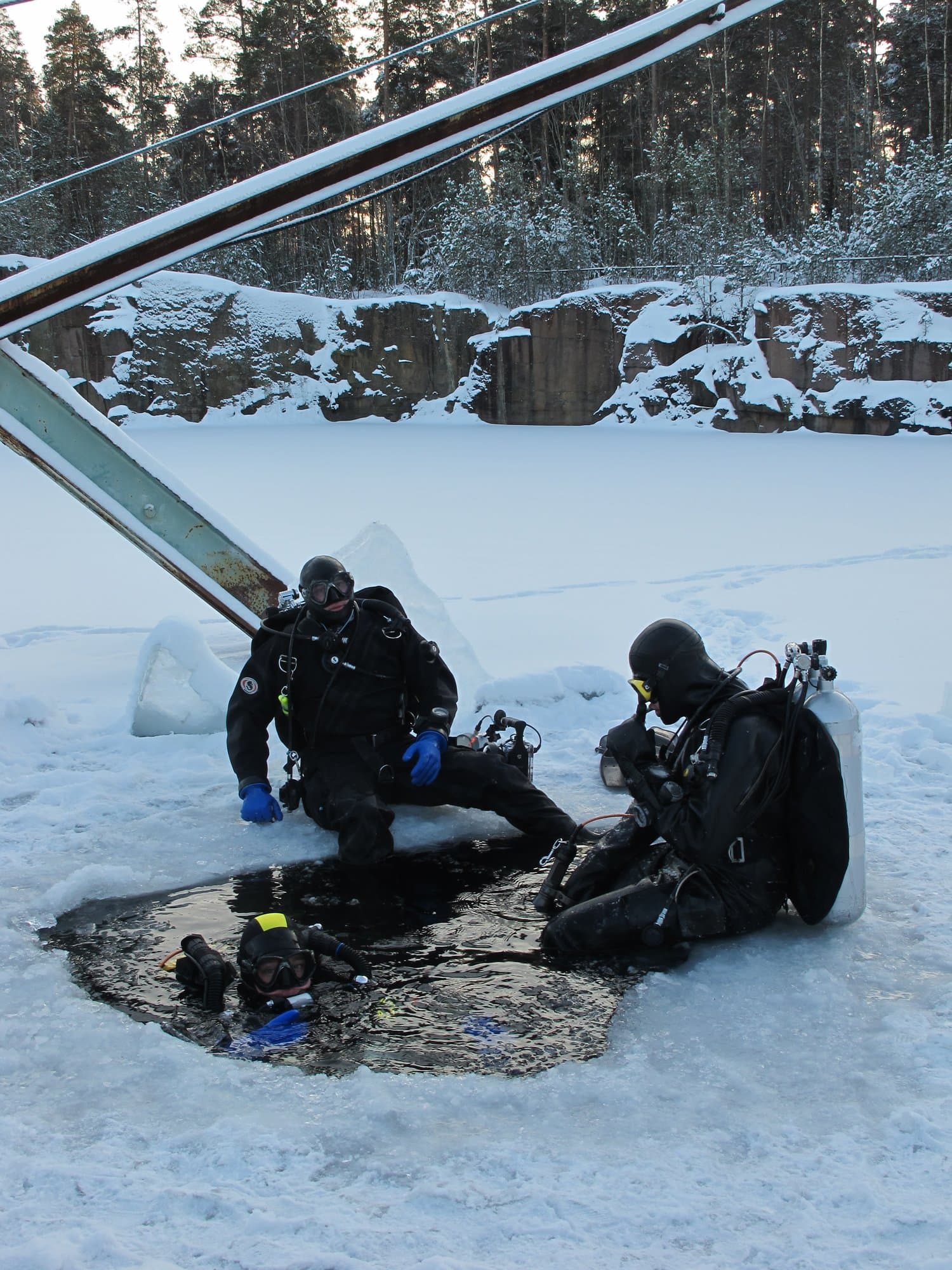
Yes, January through March, but it is treated seriously. All federation-listed sites freeze reliably with roughly 30-40 cm of pack ice; lessee clubs cut three holes at the start of each ice-dive event. Standard ice-diver certification is sufficient at the granite quarries and at Iso-Melkutin. Ojamon kaivos is the exception: ice diving there specifically requires cave or mine certification, because ice is treated as overhead-environment work in the Ojamo regulatory chain. Drysuit, hood and gloves are baseline kit; surface water sits 0-2 °C under the ice.
What freshwater fish will I see?▾
Defining species across the area is the European perch, which schools curiously around divers in pits with no real predators. Northern pike are documented near reed shores at Iso-Melkutin and around the pump house at Ojamo. Burbot turn up in autumn at Iso-Melkutin and on the Ojamo open side, and ruffe and smelt are common across the genre. European and signal crayfish are area-typical for flooded quarries. There are no marine species, no salmonids stocked at the dive-known sites, and the only algal life of note is the yellow-orange patches that appear on the Hilloisten bottom in summer.
Is Finnish quarry diving safe?▾
Finnish quarry diving requires a deliberate progression through training because the genre concentrates risk. The Sukeltajaliitto's national decompression-illness statistics for 2015-2017 show that 45 percent of treated DCS cases followed quarry or mine dives, against 25 percent for coastal or marine dives, driven by long deep dives in clear water tempting divers into multi-day repetitive profiles. Ojamon kaivos has had five fatalities recorded since 2000 against roughly 2000 dives a year, comparable to international cave-diving baselines. The lessee-club gatekeeping and member-only event registration are part of the safety architecture: every dive within the diver's training and experience, every plan reviewed by the event organiser. Compass, SMB and dive computer are baseline regardless of how navigable a site looks.
When is the best season to dive Finnish quarries?▾
Two seasons rather than one. Open-water training and weekend trips concentrate June through August, when surface water sits 14-22 °C and the sun-warmed thermocline at 3-5 m is sharp; below the thermocline temperatures stay 3-8 °C year-round. Ice-diving courses run January through March on 30-40 cm of pack ice, with under-ice surface water at 0-2 °C. Spring and late autumn are quieter and the federation-listed lake and quarry sites stay open. Ojamon kaivos runs year-round with heated changing cabins and a cut hole kept open by pumps.
Every dive has a story. Share yours.
Log your dives - notes, photos, conditions and the marine life you saw - and share them as one public diver profile. What you share helps the next diver, too.
Log every detail
Depth, duration, conditions, gear, buddy, notes — all in one place. Import from Suunto and other dive computers.
Track marine life
Record species sightings on each dive. Build a personal catalogue of everything you've seen underwater.
Your public dive profile
Share your dive history, stats, and experiences with a profile page you control. Show the world where you've been.