
Russarön pohjoispuolen hylky 1
Also known as: Hanko 2535, Russarö pohjoispuoli 1, Russarön lotja, Russarön pohjoisen puolen hylky, UHI02
Wooden barge wreck at 20 m off Russarö's north shore in Hanko's Defence Forces firing sector, partly buried in sand with two empty cargo holds.
Last updated April 2026
The dive
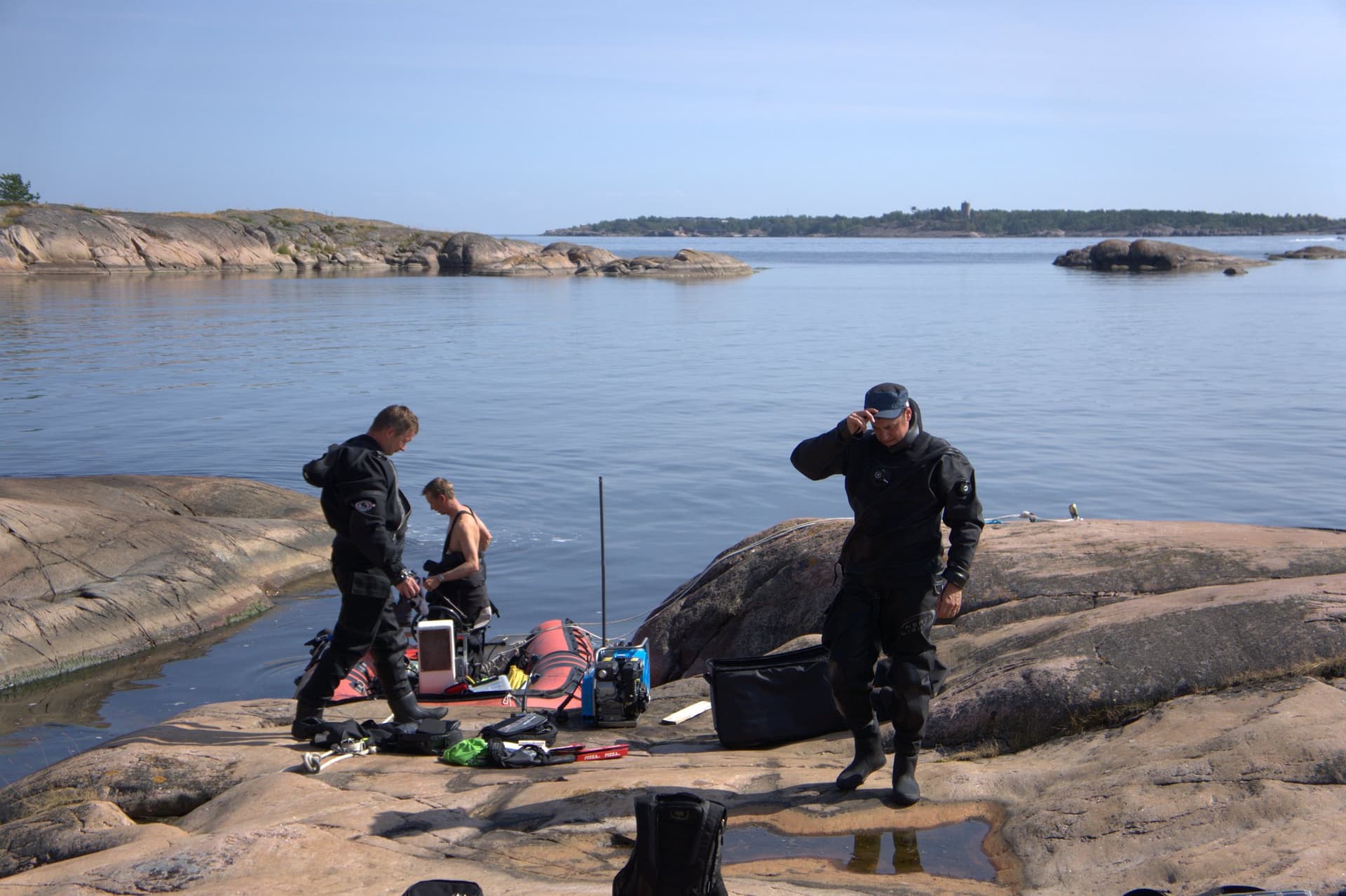
Boat out from Hanko Itäsatama, round Russarö's north shore, and drop to a 20 m sand bottom where a wooden hull lies partly buried. The barge form is clear up close: two empty cargo holds open to the water column, hull shape still recognisable, nothing left of the rigging or superstructure. Move along one side and look down into the holds rather than into them — the timber is fragile and the Antiquities Act is categorical. Visibility decides the dive. A calm day in late June or September shows the hull as a whole; mid-August plankton or a SW blow shows it in pieces.
What makes it special
The honest framing is that this is one option in a multi-wreck Russarö-direction boat day, not a destination on its own. The Heritage Agency dating is historiallinen, ei määritelty — historical, era undefined — with no vessel name, no build year and no sinking story on file. The site was first detected during a Finnish Maritime Administration multibeam-sonar survey in 2007 and reported the same year by the Border Guard. The Heritage Agency alternative name is lotja, Finnish for barge, which the hull form fits. The brackish Baltic's no-shipworm condition is why a wooden hull of unknown age still reads as a barge rather than as scattered timbers.
Know before you go
Confirm the firing notice first. The site sits inside the Russarö Defence Forces protection zone, and a single rolling notice on maavoimat.fi can close it on the morning of the dive. Drysuit certification with a tested undersuit is the working baseline at 20 m in this water; a 7 mm wetsuit is not appropriate. Carry compass, primary SMB and torch — outer-archipelago boat traffic makes an SMB on ascent essential. Antiquities Act compliance is categorical: no entry into the holds, no touching, no lifting of seabed objects near the wreck. The better-known Flying Dutchman is the NW-side site, and the Ryssö Fiskari motorboat sits on a different island ~2 km away, outside the firing sector.
Why Dive Russarön pohjoispuolen hylky 1
What makes this dive site stand out.
- Wooden barge form
Hull retains overall shape with two empty cargo holds; no rigging, no superstructure remains.
- Sonar-discovered 2007
First detected during multibeam-sonar survey; no pre-2007 record of the site exists.
- Inside the firing sector
Russarö Defence Forces zone; access depends on the rolling firing notice.
- Antiquities Act protection
Look-don't-touch: no entry, no recovery, no anchoring on the wreck.
- Multi-wreck day option
Pairs naturally with the NW-side Russarö wreck or Ryssö's south-side Fiskari boat.
Depth & Profile
Location
59.7773°N, 22.9441°E
Conditions & difficulty
August is warmest at the surface but plankton-bloom risk peaks then. Late June and September often give the clearest water.
No park entry fee or dive permit fee for the area. Operator boat-day pricing varies by season and group size; contact the operator directly to confirm.
Depth (20 m) is within OW limits. Drysuit experience is the binding skill, not depth — local operators expect tested cold-water competence.
Summary
Easy by depth alone. Moderate when cold-water exposure, outer-archipelago surface chop, and the firing-zone access uncertainty are factored in.
Safety considerations
What can go wrong here, and what divers do about it. Conditions change - take the briefing from the operator on the day.
- Cold and exposure: Bottom temperatures sit at 6-14 °C even in August. Drysuit failures are the dominant risk vector.Drysuit certification with a tested undersuit is mandatory. A 7 mm wetsuit is not appropriate at 20 m here.
- Surface and boat traffic: Outer-archipelago position; SW-W winds drive chop into the Russarö approach. Surface intervals and ascents can be uncomfortable.Confirm the marine forecast with the operator before departure. Carry a primary SMB.
- Site rules: Site sits inside the Russarö Defence Forces firing sector. Active firing notices close the dive on short notice.Check maavoimat.fi firing notices and confirm with the operator before each trip.
- Site rules: Antiquities Act protection: no entry into the holds, no touching, no recovery. The wreck is a fixed underwater monument.Stay off the structure; trim and buoyancy matter. Hover, don't settle.
Regulations
No general dive permit fee. The wreck is protected as a fixed underwater monument under the Finnish Antiquities Act (Muinaismuistolaki 295/1963): no entry, no touching, no recovery, no anchoring on the wreck. The surrounding waters sit inside the Russarö Defence Forces protection zone — diving is not generally restricted outside firing windows, but rolling firing notices can close the site on any given day.
Frequently Asked Questions
Is Russarön pohjoispuolen hylky 1 the same wreck as the Flying Dutchman?▾
No. The Flying Dutchman nickname attaches to the NW-side Russarö wreck (russaron-luoteispuolen-hylky), a separate two-masted merchant vessel of the late 1700s or early 1800s. The north-side site is a smaller wooden barge with two empty cargo holds, sonar-detected in 2007, and has no name on record. The two wrecks share an island but little else, and the -1 in the slug is a Heritage Agency catalogue index, not a ranking.
Can I dive this site if Russarö has a firing notice?▾
No. The site sits inside the Russarö Defence Forces protection zone, and during firing exercises a danger area extending up to 20 km is declared in the Russarö-Linnskär-Stora Tärnan and Russarö-Norrkobben-Morgonlandet sectors. The wreck is unreachable while a notice is active. Check maavoimat.fi firing notices and confirm with the operator before any trip; outside firing windows the surrounding waters are not generally restricted.
What does the Antiquities Act mean for divers here?▾
It means look-don't-touch in a strict sense. The wreck is a fixed underwater monument under the Finnish Antiquities Act (Muinaismuistolaki 295/1963). You may dive it and photograph it, but you cannot enter the holds, touch the structure, lift any seabed object near the wreck, or anchor on or close enough to drag the timber. The wood is partly sand-buried and the holds are open to the water column — disturbing them is incompatible with Heritage Agency recreational-diving guidance.
What will I actually see on the dive?▾
A wooden hull at 20 m, partly buried in sand, with two empty cargo holds as the obvious visual feature. No rigging, no loose finds, no superstructure remains. Visibility is the limiting variable — typically 5-10 m, more on a calm clear day, less during plankton blooms. Wreck-encrusting blue mussels are the consistent fauna; the brackish Baltic supports very little fish life, so the wreck form itself is the dive.
Do I need a drysuit?▾
Yes, in practice. Bottom temperatures at 20 m sit at 6-14 °C even in August, and a 7 mm wetsuit is not appropriate at this depth in this water. Drysuit certification with a tested undersuit is the realistic baseline; first-time drysuit divers should not pick this as their introduction to cold-water wrecks.
Is this site usually paired with another wreck?▾
Yes. The practical pattern is a Russarö-direction boat day combining two or three outer-archipelago 20 m wrecks. Common pairings are the NW-side Russarö wreck (russaron-luoteispuolen-hylky) and the Ryssö south-side wooden motorboat (rysson-fiskari, a different island ~2 km away). One non-firing day, one boat, multiple wrecks is the way the local cohort dives this part of the archipelago.
Photos
Every dive has a story. Share yours.
Log your dives - notes, photos, conditions and the marine life you saw - and share them as one public diver profile. What you share helps the next diver, too.
Log every detail
Depth, duration, conditions, gear, buddy, notes — all in one place. Import from Suunto and other dive computers.
Track marine life
Record species sightings on each dive. Build a personal catalogue of everything you've seen underwater.
Your public dive profile
Share your dive history, stats, and experiences with a profile page you control. Show the world where you've been.