
Diving in Dahab
Shore diving on the Gulf of Aqaba: walk-in reefs, the Canyon fissure and the Blue Hole sinkhole, with technical depths on the same walls.
Last updated October 2026
Overview
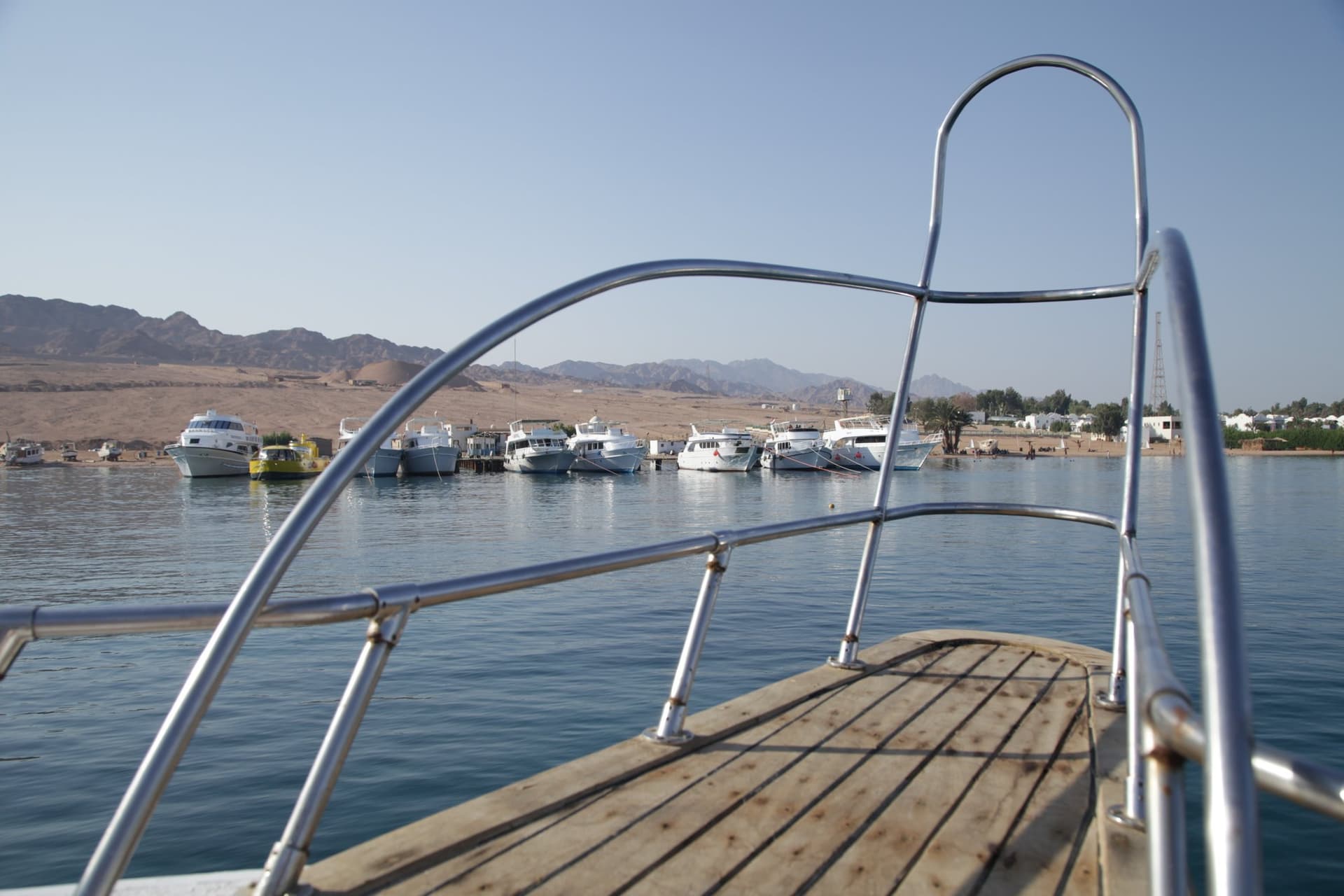
The reef at Dahab drops away steeply only metres from the beach, and that one fact organises the diving: nearly every signature dive is a walk-in from a pickup parked on a desert track, with no boat involved. The town grew from a Bedouin fishing village into a diving base through the 1980s and 1990s and still feels walkable and unhurried, with dive centres, cafes and restaurants strung along a low-rise waterfront. Freedivers, technical divers and windsurfers share the same few streets.
Three dives set the tone. The Canyon is a narrow fissure in the reef wall entered at around 20 m, where filtered light falls on a coral dome packed with glassfish. Gabr el Bint, about an hour south by boat, is the far-flung one, with giant fan corals on a grassy reef top that steps down in ledges. Closer in, Lighthouse and Eel Garden carry everyday diving: training, macro, night dives and a garden eel colony.
The third is the Blue Hole, a sinkhole roughly 100 to 110 m deep and rimmed by reef. Recreational divers work the outer wall to about 30 m, and the Arch that links it to the open sea is technical territory. The site is heavily crowded, shared with snorkelers at entry and exit, and verdicts on the rim run from bucket-list to unimpressed, though the outer wall draws steady praise.
Anthias cloud the walls, giant morays sit in the crevices, and a hawksbill turtle is resident at Lighthouse. Eagle rays and seahorses turn up occasionally. There is no notable wreck diving.
The Dahab marine section was added to the Nabq protected area by decree 33/1996 as the Dahab Environmentally Managed Area; the Abu Galum Protectorate to the north dates from 1992.
Planning your visit
Most visitors fly into Sharm el-Sheikh and cover the roughly 80 km by road: a little over an hour by taxi, up to about 75 minutes with the security checkpoints the driver handles. Dahab needs no full visa on a Sinai-only entry, but Thistlegorm trips and, divers report, Ras Mohammed do.
Dozens of dive centres work Dahab, most of them around Masbat, and they run the days: gear is set up at the centre and loaded onto a pickup for the nearer sites. A day is usually two dives; Gabr el Bint and El Shugarat are boat trips of about an hour, and night and sunrise dives are arranged through the centre. The Blue Hole entry fee is paid on top of the trip, in cash in US dollars, and is quoted anywhere from USD 20 to about USD 25 per person.
Shallow sandy slopes such as Eel Garden suit new divers, and the Canyon interior and the outer wall at the Blue Hole call for more experience. Egypt limits recreational air diving to 40 m, so deeper plans need the matching training and gas. A guided dive with full equipment costs about 35 to 60 EUR depending on the centre, and ten-dive packages at some centres come to around 29 EUR a dive (early 2026); most centres quote in EUR.
The northern Red Sea is salty, around 41 ppt against 35 elsewhere, so carry more lead than you are used to. A hyperbaric medical centre operates in town, next to the Dahabeya Hotel.
Geology & underwater terrain
A fringing reef along the Gulf of Aqaba where mountains meet the coast; the reef drops away steeply metres from the beach, forming walls, coral gardens, pinnacles, canyons and caves, plus the Blue Hole sinkhole.
Dive sites in Dahab
The diving here splits into 3 zones:
- Northern sector
- — The Blue Hole, the Bells, the Canyon and Abu Helal: deep groove entries, a fissure and wall profiles reached by pickup from town.
- Central sector (Masbat Bay)
- — House reefs on the town waterfront with sandy slopes and seagrass, used for training, macro and night dives.
- Southern sector
- — Coral gardens and sandy alleyways along the shore, with Gabr el Bint and El Shugarat at the far end, about an hour away by boat.
Northern sector
Blue HoleTop dive
Wall drift ending in a coral-fringed sinkhole, with a tech-only arch below
Abu Helal
Tide-gated coral garden with a technical canyon alongside
The Bells
A chimney entry onto a wall drift that ends in the Blue Hole
The Canyon
One reef crack for three levels: look-in, 30 m chamber, technical exit
Central sector (Masbat Bay)
Eel Garden
Garden eel field on a sand slope, entered through a reef channel
Lighthouse
All-levels divers wanting a versatile shore dive — training, night dives, macro, and technical warm-ups in one accessible site
Mashraba
Seagrass macro, a statues park and a quiet night dive from one beach entry
Southern sector
Gabr el Bint
A full day out to a wall on one side of a coral buttress and a gorgonian lagoon on the other
Golden Blocks
Anthias-draped coral towers and three sandy pathways, walk-in entry
Moray Garden
Left-or-right reef choice with sandy-shallows macro
Three Pools
Lagoon-to-reef shore dive: three sandy pools, then a coral circuit
Um El Sid
Longnose hawkfish on a sea fan, reached by a garden-eel slope
Marine life
When to dive
- Best season
- March to June and September to December
- Water temperature
- About 20 C at depth in February and March, rising to 26 C in September and October
Diving runs all year. Water at depth was 27 C throughout October 2025, so autumn keeps the summer warmth. Divers who feel the cold want at least a 5 mm wetsuit, with extra protection in winter.
Safety considerations
What can go wrong here, and what divers do about it. Conditions change - take the briefing from the operator on the day.
- Depth: The Blue Hole Arch, a tunnel reported at 52 m in some accounts and 55 m in others, lies beyond recreational limits. A 2012 figure reports more than 130 divers dead at the Blue Hole over 15 years, with other estimates up to 200; it is not an official count.Stay within your certification and Egypt's depth limits; the outer wall holds at 30 m.
- Surface and boat traffic: About 50 vehicles are parked at the Blue Hole, rising past 200 in summer, with a crowd of snorkelers at entry and exit.Ask your centre about timing and entry order before committing the day to it.
- Current: Wind-driven current can build at Eel Garden.Check conditions with the guide before entry and choose a sheltered site when wind builds.
- Current: Some southern shore entries are exposed to surge.Time the entry between wave sets and enter with the guide.
Rules and permits
Abu Galum Protected Area
Natural park
- Diving from sunrise to sunset.
- Conduct: no touching, no feeding, no taking anything, no disturbing wildlife, no damage to the seabed, no litter.
Park visitor leafletMarine activity conditionsPark decree (Arabic)Checked: Oct 2026
National rules also apply: Rules and permits in Egypt
Frequently Asked Questions
Is Dahab or Sharm el-Sheikh better for diving?▾
It depends on what you want underwater. Sharm is the region's big-boat hub, with daily boats to Ras Mohammed and the Strait of Tiran and the wreck diving Dahab lacks. Dahab trades that for shore access, lower prices and the freedom to dive on your own schedule. The two sit about 80 km apart, so wreck divers and shore divers can split a trip.
How deep is the Blue Hole, and is it dangerous?▾
The sinkhole is roughly 100 to 110 m deep. The risk sits in the Arch, a tunnel reported at 52 m in some accounts and 55 m in others, which is technical territory: Egypt caps recreational air diving at 40 m, extended range at 55 m and normoxic trimix at 60 m. A 2012 figure of more than 130 deaths in 15 years, with estimates up to 200, shows how often divers have pushed past those limits, though it is not an official count. Recreational divers dive the reef wall outside the hole, to about 30 m.
Is Dahab worth it for technical diving?▾
For divers with the training, yes. Most sites are area reefs that can be taken from recreational to technical depth on the same wall, so a diver can progress without changing venue. The Canyon and the Blue Hole are the deep objectives, and any dive beyond 40 m on air sits outside Egyptian limits, so the gas and training have to match.
What are the best dive sites in Dahab?▾
The Canyon, Gabr el Bint, El Shugarat and the Islands come up most often as the standouts, with the Blue Hole as the site everyone ticks off. The Islands, a set of coral formations with swim-through corridors in the south, is shallow and colourful. The house reefs at Lighthouse and Eel Garden suit second and third dives.
Can beginners dive in Dahab?▾
Yes. Eel Garden is a sandy slope reaching about 20 m, and the shallow sandy slopes at Lighthouse sit beside walls that drop to technical depth, so the easy part is the slope and the deeper wall is for later. Newly certified divers can stay on these while the Canyon interior and the outer wall at the Blue Hole wait for more experience.
Do I need a visa to dive in Dahab?▾
Not for Dahab itself: entry limited to Sinai needs no full visa. A full visa is officially required for trips to the Thistlegorm and, divers report, to Ras Mohammed, so arrange an e-visa beforehand if you plan to dive beyond Sinai.
How do I get from Sharm el-Sheikh to Dahab?▾
Fly into Sharm el-Sheikh International Airport (SSH) and go by road. A taxi takes a little over an hour, and a 2025 transfer took about 1 hour 15 minutes, with several security checkpoints that the driver handles. Most centres and hotels arrange the pickup.
Are Dahab's reefs affected by coral bleaching?▾
Concern about bleaching has centred on reefs further south in Egypt, and recent visitors to Dahab describe healthy reefs with varied marine life, including turtles, octopus and plenty of macro. Conditions change with the season and the year, so ask your centre how the reefs look right now before you book.
Is there a hyperbaric chamber in Dahab?▾
Yes. A hyperbaric medical centre sits in town next to the Dahabeya Hotel and has operated since 2006, so treatment does not mean the drive to Sharm el-Sheikh. Confirm the current emergency contacts with your centre before deep dives.
Also known as: ذهب
Every dive has a story. Share yours.
Log your dives - notes, photos, conditions and the marine life you saw - and share them as one public diver profile. What you share helps the next diver, too.
Log every detail
Depth, duration, conditions, gear, buddy, notes — all in one place. Import from Suunto and other dive computers.
Track marine life
Record species sightings on each dive. Build a personal catalogue of everything you've seen underwater.
Your public dive profile
Share your dive history, stats, and experiences with a profile page you control. Show the world where you've been.