
Diving in Koh Lanta
Andaman day-boat hub south of Krabi, built around offshore pinnacles for chance mantas, a limestone cavern cluster and a shallow park-island reef.
Last updated September 2026
Overview
Koh Lanta's identity is a single day-boat run out from Saladan to two deep offshore pinnacles, Hin Daeng and Hin Muang, sold locally as a shorter, cheaper way to a Similan-class pelagic encounter without a liveaboard booking. Hin Daeng's red-coral walls and Hin Muang's steeper, purple-draped face both work as chance encounters with an oceanic manta or, more rarely, a whale shark, and every operator here treats the trip as advanced, with a long open-sea crossing, moderate to strong current, and a deep-diving bar that differs by shop.
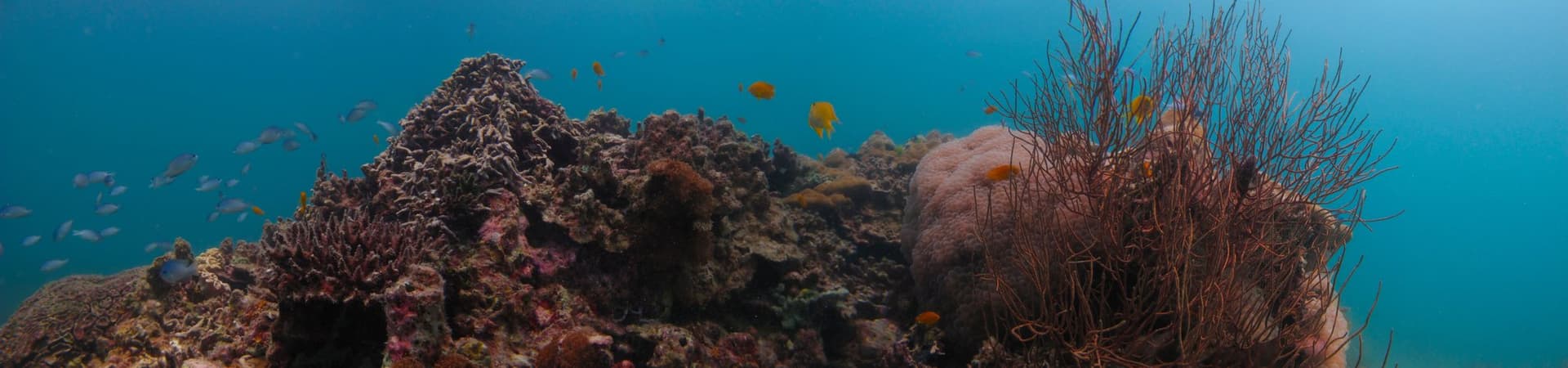
Closer to shore, Koh Haa is the area's other anchor, a six-island limestone cluster with a sheltered lagoon, a multi-chamber cave system locals call the Cathedral, and a vertical rock passage known as the Chimney, all reached on a shorter run and marketed for every level up to Discover Scuba. Divers who visited in different seasons disagree sharply on the reef's condition, some describing dead coral rubble and others rating it ahead of neighbouring Phi Phi, which reads less like a contradiction than a reef in flux. Koh Rok, further south inside Mu Ko Lanta National Park, is the shallow counterpart, a reef often just five metres down, hawksbill turtles as the standing sighting, and an island with a ranger station you can walk to between dives. The Kled Kaew Wreck, a former Royal Thai Navy transport scuttled in 2014, is sold almost entirely as a Koh Lanta day trip, though the wreck itself sits inside the marine park built around Phi Phi and not the one around Lanta. The same day boats also chain on Koh Bida and Hin Bida, karst pinnacles known for turtles and blacktip reef sharks, which likewise fall administratively inside Phi Phi's own park, not Lanta's. Koh Ngai, further out and administratively part of the district, is conventionally marketed with Trang's Koh Mook and Koh Kradan instead, and no Koh Lanta operator's own site names it as a destination.
Current is the area's defining condition at the pinnacles and mild almost everywhere else. Hin Muang's upper reef and Hin Daeng's western drop-off can run to what divers call ripping, while Koh Haa's lagoon and most of Koh Rok stay calm outside their tips and channels. In June 2026, the national park closed its headquarters beach and two outer-island sites after a large bloom of Portuguese man o' war washed ashore, and whether it has since reopened is unresolved; treat that as a live question to check before booking near the season's edges.
Planning your visit
Krabi International Airport is the usual gateway, about two hours from Saladan by minivan and ferry; Phuket and Trang airports also connect, and daily ferries link Ko Lanta to Krabi, Phuket and Ko Phi Phi. Saladan, at the island's north tip, is where every dive centre is based and where day boats leave from. No Koh Lanta operator runs its own liveaboard, though Hin Daeng and Hin Muang are also sold as one leg of Phuket-based "Southern Andaman" liveaboard itineraries, a second route to the same pinnacles.
High season runs November to April, when conditions and the pinnacles' manta and shark chances both peak; the shoulder months of May-June and October bring fewer crowds and more variable weather. Hin Daeng, Hin Muang and Koh Haa close entirely from 15 May to 15 October each year, and Koh Rok closes on its own separate dates, 1 June to 30 September, so the rainy season from July to September falls inside a closure at most of the area's published sites, not a windier-but-open shoulder. Mu Ko Lanta National Park closes its other, smaller outer islands from 16 May to 14 October; confirm current dates near either end of any window.
A park fee applies across the area, though the total varies between sources: the park's own detailed page gives a general entrance fee of 200 THB per foreign adult (100 THB child; 40/20 THB Thai), while at least one operator itemises a separate 600 THB marine park diving fee excluded from its trip price, and it is not clear whether the two amount to one charge or two that stack. Whether any fee or permit regime covers Hin Daeng and Hin Muang specifically is unresolved: the park's own visitor page does not name either pinnacle among its attractions. Budget for a fee on every trip regardless and confirm the current total with your operator.
Certification requirements split sharply by site. Koh Haa's Lagoon and main cave routes, and most of Koh Rok's reef, sit within Open Water range and are marketed for every level; Hin Daeng and Hin Muang are advanced day trips at every operator, with the exact bar, a minimum dive count, a recent dive, or an Advanced certification, differing between the three Saladan-based shops. Operators verified for this dossier include Lanta Diver, Blue Planet Divers and Phoenix Divers Koh Lanta, all based in Saladan.
Geology & underwater terrain
Karst limestone islands and submerged granite and limestone pinnacles rising from the Andaman seabed, with fringing coral reef around the near islands and mangrove along Ko Lanta Yai's own east coast.
Dive sites in Koh Lanta
The diving here splits into 4 zones:
- Offshore pinnacles (Port: Saladan)
- — The area's offshore pinnacle pair, a red- and purple-coral duo at the end of a long open-sea crossing. The area's advanced, current-swept dive and its best chance at an oceanic manta ray.
- Near reef and cavern cluster (Port: Saladan)
- — Koh Haa's limestone lagoon and cave system and the Kled Kaew Wreck sit on a shorter run than the pinnacles, in calmer water and with a lower certification bar for most of it.
- Southern park islands (Port: Saladan)
- — Koh Rok's twin islands inside Mu Ko Lanta National Park, a shallow reef with a ranger station and beach you can walk to between dives.
- Trang-adjacent (Port: Klongdao Pier)
- — Koh Ngai, administratively part of the district and ferry-connected from Klongdao Pier, conventionally marketed with Trang's Koh Mook and Koh Kradan and not documented by any Koh Lanta-based dive operator.
Offshore pinnacles
Near reef and cavern cluster
Marine life
When to dive
- Best season
- November to April
- Water temperature
- 27 to 30°C year-round; most divers use a 3mm shorty
Dry-season visibility runs 15 to 30m generally; at the offshore Hin Daeng/Hin Muang pinnacles it typically reads closer to 10 to 30m, with one operator's page advertising up to 45m there. Hin Daeng, Hin Muang and Koh Haa close entirely from 15 May to 15 October each year, and Koh Rok closes on its own separate dates, 1 June to 30 September; Mu Ko Lanta National Park closes its other, smaller outer islands from 16 May to 14 October.
Safety considerations
What can go wrong here, and what divers do about it. Conditions change - take the briefing from the operator on the day.
- Current: Current runs moderate to strong at Hin Daeng and Hin Muang, strongest over Hin Muang's upper reef and at Hin Daeng's western drop-off, occasionally reaching a level divers describe as ripping.Book the pinnacles only once deep-diving experience is already logged, not as a first open-water dive, and descend and ascend together on the line.
- Marine life: A large bloom of Portuguese man o' war washed ashore in June 2026, prompting Mu Ko Lanta National Park to close its headquarters beach at Laem Tanod plus two outer-island sites; whether the closure has since been lifted is unresolved.Check current status with your operator before booking near the closed sites, and give any washed-up animal a wide berth on the beach: a sting still releases venom after the animal has died.
Rules and permits
Mu Ko Lanta National Park
National park
- Closed to diving from June 1 to September 30, every year. (in some zones)
- Closed to diving from August 1 to September 30, every year. (in some zones)
Park closure dates 2026Sunscreen banDive service zonesChecked: Oct 2026
National rules also apply: Rules and permits in Thailand
Frequently Asked Questions
Which is better for diving: Koh Lanta, Koh Phi Phi or a Similan liveaboard?▾
It depends on time and appetite for a boat commitment. Koh Lanta's day-boat run to Hin Daeng and Hin Muang is sold locally as a shorter, cheaper way to a Similan-class pelagic encounter without booking a liveaboard, while Phi Phi's reef circuit sits closer to shore and busier. A full Similan or Surin trip stays the higher-rated pelagic experience by reputation, but it asks for a multi-day commitment Koh Lanta does not.
How does Koh Haa compare to Phi Phi's dive sites?▾
Differently, not better or worse. Koh Haa's draw is its limestone cavern system, the Cathedral and the Chimney, plus a sheltered lagoon that suits every level; Phi Phi's day-trip sites add blacktip reef sharks that Koh Haa does not reliably offer. Both are reached from separate hub towns, so which one you dive usually comes down to where you are staying, not a fixed quality gap between them.
Is there a fee to dive in Koh Lanta, and how much?▾
Yes, though the exact total varies between sources. The park's own detailed page states a general entrance fee of 200 THB per foreign adult (100 THB child; 40/20 THB Thai), while at least one operator itemises a separate 600 THB marine park diving fee excluded from its trip price, and it is not clear whether the two are the same charge under different names or two that stack. Budget for a fee on every trip and confirm the current total with your operator.
Are Hin Daeng and Hin Muang inside a national park?▾
Unresolved. The park's own detailed visitor page names Ta Nod, the caves, Ko Talabeng, Mu Ko Rok and Ko Ngai as its attractions and does not mention either pinnacle; one commercial liveaboard site states flatly that they lie inside Mu Ko Lanta National Marine Park without citing an official source; the two accounts disagree and neither is conclusive. Operators charge a marine park fee on the trip regardless of how that question resolves.
When is the best time to dive Koh Lanta, and are any sites closed seasonally?▾
High season runs November to April, when conditions and the offshore pinnacles' manta and shark chances both peak. Hin Daeng, Hin Muang and Koh Haa close entirely from 15 May to 15 October every year, and Koh Rok closes on its own dates, 1 June to 30 September, so the rainy season from July to September falls inside a closure at most of the area's published sites. Mu Ko Lanta National Park closes its other, smaller outer islands from 16 May to 14 October; check current dates near either end of any window.
Is there a current closure or hazard I should know about before booking?▾
In June 2026, Mu Ko Lanta National Park closed its headquarters beach at Laem Tanod plus two outer-island sites after a large bloom of Portuguese man o' war washed ashore; the park chief warned the tentacles can still release venom after the animal has died. No source since has reported the closure lifted, so confirm current status with your operator before a trip to that end of the park.
Do I need to be an experienced diver to dive Koh Lanta, or can beginners come too?▾
Both are possible on the same island. Koh Haa's Lagoon and main cave routes and most of Koh Rok's reef sit within Open Water range and are marketed for every level, including Discover Scuba trips. Hin Daeng and Hin Muang are advanced day trips at all three Saladan-based operators, though the exact bar, a minimum dive count, a recent dive, or an Advanced certification, differs between them.
How do I get to Koh Lanta and out to its dive sites?▾
Krabi International Airport is the usual gateway, about two hours from Saladan by minivan and ferry; Phuket and Trang airports also connect, and daily ferries link Ko Lanta to Krabi, Phuket and Ko Phi Phi. Saladan, at the island's north tip, is where every dive centre is based and where day boats leave from. Hin Daeng and Hin Muang are also sold as one leg of Phuket-based liveaboard itineraries, a second route to them and not a second home base.
Is Koh Lanta a good place to learn to dive, or is it better suited to an advanced trip?▾
It works for both, on different sites. New divers train and do check dives at Koh Haa's Lagoon or on Koh Rok's shallow reef, both marketed for every level; the area's better-known pull is the advanced day trip out to Hin Daeng and Hin Muang, which asks for logged dives and deep-diving experience at every shop. No Koh Lanta operator runs its own liveaboard, so a multi-day boat trip means booking a Phuket-based itinerary in addition.
Also known as: Ko Lanta, Koh Lanta Yai, Mu Ko Lanta, Mu Ko Lanta National Park
Every dive has a story. Share yours.
Log your dives - notes, photos, conditions and the marine life you saw - and share them as one public diver profile. What you share helps the next diver, too.
Log every detail
Depth, duration, conditions, gear, buddy, notes — all in one place. Import from Suunto and other dive computers.
Track marine life
Record species sightings on each dive. Build a personal catalogue of everything you've seen underwater.
Your public dive profile
Share your dive history, stats, and experiences with a profile page you control. Show the world where you've been.