
Diving in Puerto Galera
Drift, wreck and macro diving off Sabang Beach, where the tide at Escarceo Point turns the same site from a gentle slope into a fast drift.
Last updated October 2026
Overview
A dive briefing here starts with the tide, because the same site can be a gentle slope one morning and a fast drift the next. Escarceo Point, the headland just east of Sabang, is where that happens. West Escarceo is a shallow photography slope on an ordinary day and a flying drift on a strong flood, and the flood carries divers on toward Hole in the Wall and The Canyons. Hole in the Wall is a short swim-through at about 13 metres, dived by Open Water divers with good buoyancy, with hydroids and scorpionfish on its walls. The Canyons is an Advanced drift: one operator's chart gives 22 to 32 metres, another 25 to 35 and a third 30, and the slope drops to 40 metres or more on every side. It runs hardest on a full-moon tide, so watch your no-decompression time and stay with the group on the blue-water ascent.
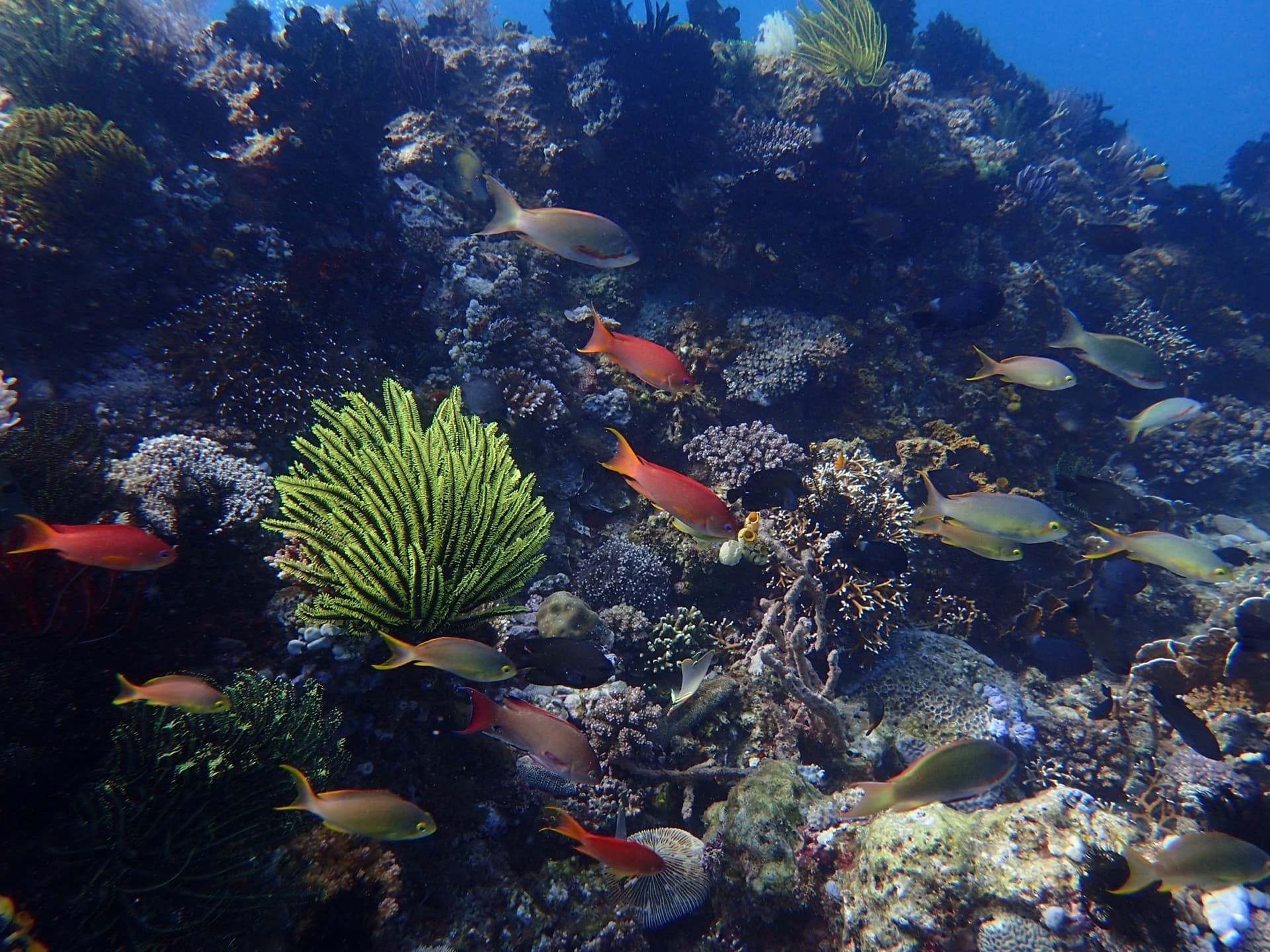
The everyday reputation is small life. Sinandigan Wall, a rocky slope broken by two walls, is the nudibranch dive, and one operator puts a single dive at up to 15 species. Coral Cove holds ribbon eels, pygmy seahorses on the fan corals and banded sea kraits, Monkey Beach has warty frogfish and mantis shrimp on the sand, and Pink Wall works as a night dive. A diver weighing it for a beginner notes that the bottom is firmer than the fine volcanic silt of other macro coasts, so poor buoyancy silts the group up less. Big animals are the gap, and divers who compare it with Red Sea and Caribbean trips say so in the same sentence as their praise. A thresher shark turns up at Kilima Steps now and then, as a chance and not a schedule.
Wrecks stay inside the bay. The Alma Jane, a cargo vessel sunk in 2003, lies at 20 to 30 metres on one chart and 25 to 30 on another, rated Advanced. The Sabang Wrecks are a popular night dive, and the Dry Dock, a steel and plywood boat-lifting structure sunk in 1998 as an artificial reef, is not for beginners. The Japanese Wreck is the deep one, and the charts disagree: Tec at 42 metres on one, 5 to 40 on another.
Verde Island is the day trip divers talk about most. It lies across the passage and is administered from Batangas City, so it is not a Puerto Galera site, but shops here run it as a full-day outing with several dives, about 40 minutes away by speedboat in normal conditions, at extra cost. It is a drift dive that can run with very strong current, and divers are told to stay close to the guide.
Puerto Galera has been a UNESCO Man and the Biosphere reserve since 1977, but the designation is a land one, with 14,659 of its 14,661 hectares terrestrial1. Coral reef conservation is among the reserve's stated tasks, yet it is not what protects the dive sites. A zoned municipal marine protected area with a no-take core also exists.
Planning your visit
The settled season is the amihan, roughly November to May. June to October is the habagat, with typhoon risk: when a storm is near, boats may not go out for a few days and ferries can be cancelled, then business resumes. Diving continues through those months and August trips are reported as good, so build a spare day into a short stay. The water runs about 29 C at the surface in the warm months and somewhere between 24 and 28 C in winter, cooler again below the thermocline. A 3 mm suit is the default, and divers repeatedly wish they had 5 mm in the cool season. Operators quote 15 to 25 metres of visibility. Divers report 8 to 20, 25 on a good day, and green single-digit water often enough that a ten-day trip can meet it throughout.
Fly into Manila and allow four to six hours door to door: a bus of about two hours to Batangas Pier, the ferry across the passage to Balatero, Muelle, Sabang or Minolo, then a tricycle to Sabang. The earliest ferries run from about 6 am and the last crossings leave in the early afternoon, so a late start in Manila costs a diving day. The town charges a 120 peso environmental user's fee on every tourist, divers included, collected once per stay at six entry points under Municipal Ordinance No. 2025-0302. Registering online through PG-Pass opens a registered lane. Expect it on top of every dive price.
Shops sit two doors apart along Sabang and the La Laguna beaches, and resorts run up to five slots a day, sunset included, with sites chosen by tide and by certification on the day. Name the sites you want when you book, give your real experience, and take the grading from the shop: one waypoint can be easy or advanced. Group size is the usual complaint, with one guide to six or eight divers reported, so ask about ratios before paying. On the Escarceo and Verde drifts carry an SMB and ask how pickup is run. Nitrox is widely available, and many boat rides are 15 minutes or less.
Geology & underwater terrain
The northern tip of Mindoro, facing the Verde Island Passage. Escarceo Point produces the drifts; east of it the bottom is rocky slope broken by short walls, one of Sinandigan's two walls running to about 30 metres.
Dive sites in Puerto Galera
The diving here splits into 4 zones:
- Sabang and the La Laguna beaches (Port: Sabang)
- — The dive strip: shops two doors apart on three adjoining beaches, with the wrecks and the shallow bay reefs a short boat ride out.
- Escarceo Point (Port: Sabang)
- — The headland just east of Sabang that produces the area's drifts, where the flood decides whether a site is gentle or fast.
- The eastern coast (Port: Sabang)
- — Rocky slopes and short walls beyond the point, led by the nudibranch dive at Sinandigan and the thresher chance at Kilima.
- The western channels (Port: Muelle)
- — Channels, coral gardens and the deeper walls running west toward the town proper, reached from Muelle.
Marine life
When to dive
- Best season
- November to May
- Water temperature
- About 29 C at the surface in the warm months, 24 to 28 C in winter, cooler below the thermocline
The amihan, the northeast monsoon, settles the weather from roughly November to May. The habagat from June to October brings typhoon risk and the odd run of days when boats stay in, and diving continues through it.
Safety considerations
What can go wrong here, and what divers do about it. Conditions change - take the briefing from the operator on the day.
- Current: Tide-driven current on the Escarceo drifts, hardest at The Canyons on a full-moon tide, and at times very strong on the Verde Island drift.Stay with the guide, carry an SMB, watch your no-decompression time and take the guide's call on the blue-water ascent.
- Depth: Several well-known dives pass 30 metres, and a site listed elsewhere as easy can turn out to be a 35 metre wall.Take the grading from the shop on the day and state your real experience.
- Marine life: Hydroids and scorpionfish line the walls of the Hole in the Wall swim-through.Hold good buoyancy through the tunnel and mind the tank valve.
- Surface and boat traffic: Groups from several companies can meet on the same busy site.Stay with your own guide and fire an SMB on the drifts.
Rules and permits
National rules also apply: Rules and permits in Philippines
Frequently Asked Questions
How deep is The Canyons, and is it an advanced dive?▾
Treat it as Advanced. The depth depends on the chart: one gives 22 to 32 metres, another rates it Advanced at 25 to 35, and a third says 30, so on at least two of them the bottom of the dive sits past the 30 metre Advanced Open Water limit. What the charts agree on is the shape. You drop in near Hole in the Wall, ride the current down the slope into three canyons, shelter behind their walls, and leave by a blue-water ascent when the guide calls it, because the slope drops to 40 metres or more on all sides. It runs hardest on a full-moon tide, and a diver who has done it warns to watch your no-decompression time. In a strong-current week some visitors have not been able to dive it at all.
How deep are the wrecks, and which ones need technical training?▾
The Alma Jane, a cargo vessel sunk in 2003, lies at 25 to 30 metres on one chart, rated Advanced, and 20 to 30 on another. The Japanese Wreck is the one to question: one chart rates it Tec at 42 metres and another gives 5 to 40 metres, with the engine block and propeller on the sand. Until your shop tells you the depth it actually dives, treat it as a deep or technical profile. The Dry Dock, a steel and plywood boat-lifting structure sunk in 1998 as an artificial reef, is not a beginner dive. The Sabang Wrecks are the group most often done at night, and their listed depths run from about 5 to 22 metres across the charts, so ask which hull a given dive covers.
Can you dive Verde Island from Puerto Galera, and what does it involve?▾
Yes, as a separate outing. Verde Island is administered from Batangas City, in Batangas province on the far side of the passage, so it is not a Puerto Galera site. Shops here run it as a full-day trip with multiple dives, about 40 minutes away by speedboat in normal conditions. It costs extra because of the distance, and the price per diver falls as the group grows. It is a drift dive that can run with very strong current, and divers are told to stay close to the guide. The site's own description mentions upwelling, and visitors report down currents. It is for Advanced divers, so carry an SMB and ask how surface pickup is run before you book. Those who make the trip report clearer water and denser fish life than on the home reefs.
What does typhoon season mean for a trip to Puerto Galera?▾
The habagat runs from about June to October, and August and September are the stretch with typhoon risk. When a storm is near, boats might not be allowed out for a few days and ferries can be cancelled, and once it passes business continues as usual. Expect rougher surface conditions and poorer visibility while it lasts. A diver who went in August describes the trip as perfect, so the season is a risk to the schedule, not a closed one. Build a spare day into a short stay and check the Batangas crossing before you travel.
Is the visibility as good as the 15 to 25 metres operators quote?▾
Usually lower. That figure is the top of what shops quote, and divers who have been report that 15 to 25 is not what they got. Reports run 8 to 20 metres, with 25 on a good day. Green single-digit water turns up often enough that one ten-day trip in March met it every day. It does not follow the season cleanly either: two divers describe consecutive Mays, a year apart, in opposite terms. Verde Island is reported clearer than the home reefs, and the muck sites in the bays run lower. For macro the frame is small, so it costs you less than it sounds.
Is Puerto Galera a good place for a newer diver?▾
Yes, if the site list is handled properly. A long-term regular calls it excellent for newbies, with sites for every level. The shallow coral and macro slopes suit Open Water divers, Hole in the Wall is dived by Open Water divers with good buoyancy, boat rides are 15 minutes or less, and the bottom is firmer than the fine volcanic silt of other macro coasts, so imperfect buoyancy silts the group up less. The caution is on the other side. The Canyons and the Verde Island trip are Advanced current dives, and a site that looks easy on paper can be a 35 metre wall. Tell the shop what you have actually dived and treat the drifts as something to work up to.
Will you see thresher sharks at Kilima Steps?▾
Perhaps, and it should not be the reason you book. One 2025 visitor saw a thresher on both dives at Kilima Steps, and a 2024 post describes finally seeing one after years of trying. Nobody describes the encounter as scheduled, and the site is busy with divers. Divers who want a dependable thresher dive point to places where the animal is a daily event. Here it is a chance on a coast whose draw is small life, tide drifts and wrecks.
How crowded is the diving, and how should you choose a shop?▾
Recent visitors name group size as the complaint. Reports include one guide for six to eight divers, a group of 15 with a guide at the front and another at the back, and several companies' groups meeting on one site. Kilima is described as very busy. Small operators are the counterweight: one 2026 visitor had a boat with one to three other divers and found it never crowded underwater. So the choice that matters is group size, not brand. Ask the guide ratio, the boat size and how many groups share the site before you pay.
How do you get from Manila to Sabang, and what does it cost?▾
Allow four to six hours door to door. A bus takes about two hours from Manila to Batangas Pier, then the public ferry crosses in roughly 70 to 120 minutes depending on the operator and the sea, at about 600 to 800 pesos per person according to one operator. A combined bus and ferry ticket from a Manila hotel was 1,500 pesos, about 25 USD, in April 2026. Ferries land at Balatero, Muelle, Sabang or Minolo, and a tricycle covers the last 20 to 30 minutes to Sabang, around 270 pesos for a solo traveller in April 2026. The earliest ferries run from about 6 am and the last crossings leave in the early afternoon. A resort water taxi from Batangas skips the port and the tricycle, and is expensive unless you are a group. Fares move, so confirm with your resort.
Also known as: PG, Sabang
References
- 1.UNESCO Man and the Biosphere Programme — Puerto Galera Biosphere Reserve
- 2.DitoSaPilipinas, June 5, 2026 — Puerto Galera Implements New E-Pass System For Tourists
Every dive has a story. Share yours.
Log your dives - notes, photos, conditions and the marine life you saw - and share them as one public diver profile. What you share helps the next diver, too.
Log every detail
Depth, duration, conditions, gear, buddy, notes — all in one place. Import from Suunto and other dive computers.
Track marine life
Record species sightings on each dive. Build a personal catalogue of everything you've seen underwater.
Your public dive profile
Share your dive history, stats, and experiences with a profile page you control. Show the world where you've been.