

Aldora Divers
Downtown Cozumel operator running six-diver boats on high-pressure steel tanks, with gear set up before divers board and cleaned after.
PADI7 services4 languages
Flooded limestone caves under the jungle behind the Riviera Maya, dived for stalactite rooms, columns of daylight and a halocline you can see.
Last updated October 2026
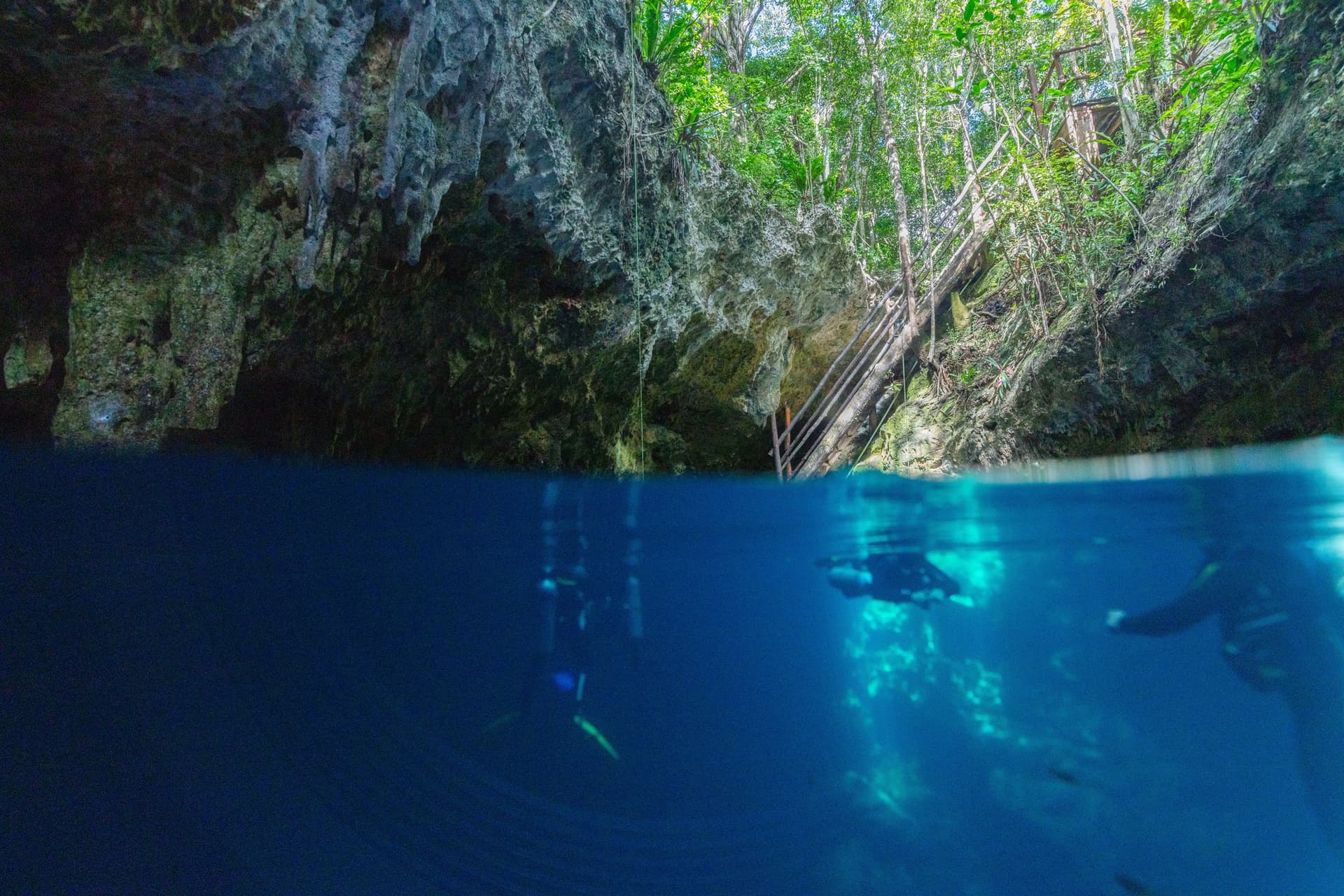
A staircase down a hole in the jungle floor, and then a room hung with stalactites in water clear enough to see the far wall. In the cave cenotes there is no swell, no wind and no current, and the water sits at 24 to 25 C every week of the year. Casa Cenote, open to the sea, is the exception, with a tidal channel. What changes is light. Where a ceiling has fallen in, sunlight drops through the opening as a column, and the sun is high enough to do that from May to September.
The two longest surveyed flooded cave systems on Earth run under this coast. Ox Bel Ha has 496,804 m of surveyed passage as of January 2025 and Sistema Sac Actun 379,569 m, and a diver with an Open Water card and a guide can be inside the second of them on the morning of a beach holiday.1 Sac Actun absorbed Sistema Dos Ojos in January 2018, when divers of the Gran Acuífero Maya project reported the link between the two and the smaller system stopped existing under survey convention.2
Dos Ojos runs two lined routes from one car park, the Barbie line in daylight the whole way and the Bat Cave line finishing under an air dome with bats over your head. Chac Mool has a curtain of light and it is a morning thing or nothing. Car Wash changes with the season, green with algae in summer and lidded with orange tannin after rain. Then the two vertical ones, both Level 3. The Pit is a shaft that drops far deeper than any guided dive goes,3 and no swimming or snorkelling is allowed at the cenote. Angelita is classed Level 3 as well, though it is not a cave at all but an open well with a cloud lying flat across it and drowned treetops standing through.
The animals are small. The water is filtered through rock and is poor in food and light, so a cenote holds freshwater fish such as mollies and silversides, cave shrimp, an eyeless cave fish that navigates by feel, and turtles at a couple of sites. Brackish Casa Cenote, a few steps from the sea, adds tarpon and a wild crocodile that has bitten a swimmer. Come for the architecture and the light, and expect no reef fish, no rays and nothing schooling.
The gate is where the rules are enforced. Every cenote sits on private or ejido land, and the landowners require a registered guide from anyone who is not full cave certified, cavern card included. The standard behind it is written by CREER, the regional body that also registers the guides.4 The federal norm for dive operators, NOM-012-TUR-2016, addresses no caves or cenotes; what it does require is that an operator employ guides accredited by the tourism secretariat.
CREER grades the sites from 1 to 4, and the grade shapes your trip more than your card does. Level 1 wants Open Water and recent time in the water. Level 2 adds a Level 1 cenote dive already done. Level 3 wants Advanced Open Water plus one Level 1 and one Level 2 dive logged, so it comes late in a trip.5 Four divers go with a guide, 30 m is the ceiling, the dive stays in daylight with no decompression, and CREER's last permitted start falls between 15:00 and 16:00. Book the deep sites for the back half of a trip and the shallow decorated ones for the front.
Operators in Playa del Carmen, Puerto Aventuras, Akumal and Tulum sell largely the same cenotes, usually as a day of two cenotes with transport in the package, so name the ones you want when you enquire. In August 2026 an Akumal operator's guided day ran USD 145 to 195 per person before entrance fees, while operators in Tulum and Playa del Carmen quoted USD 160 to 249 with entrance fees included.
Gates open roughly 08:00 to 17:00. Chikin Ha shuts on Saturdays in low season and Eden on Saturdays, so check the day before you drive out.
Sunscreen and insect repellent stay out of the water, including the products sold as biodegradable: a study that used the pandemic tourism collapse as a natural experiment found sunscreen concentrations in this groundwater rising with visitor numbers.6 Suit up at the car, which also keeps the mosquitoes off. One operator recommends a full 5 mm wetsuit.
The Tren Maya railway opened in late 2024, and its Section 5 South runs about 120 km between Playa del Carmen and Tulum, directly over Sac Actun.78 Federal enforcement confirmed cement spilled into four caves, Garra del Jaguar, Oppenheimer, Manitas and Dos Balas.9 None of those four is a dive site, and none of the cenotes on this page is among them. How far the damage extends is contested: the minister counted eight affected caverns and cenotes on Section 5 in October 2025, and divers count about 120.10 A February 2026 suspension obliges tighter supervision of the works and stops short of cancelling them.11
The Yucatán Peninsula is a slab of porous limestone with almost no surface rivers. Rainwater takes carbon dioxide from the air and soil, turns into a weak acid and dissolves the rock, and through the low sea levels of the ice ages that dissolution opened kilometre after kilometre of cave under what is now jungle. Stalactites, columns and flowstone grew in those passages while they stood in air. The sea came back and drowned them. Where a ceiling thinned past the point of carrying its own weight it fell in, and the hole it left is a cenote, from the Yucatec Maya ts'onot. Fresh rainwater floats on sea water that pushes inland under the rock, so most sites have a visible boundary between the two.
The diving here splits into 3 zones:
A lily-pad garden and the light looking back out of the cavern
A cenote day in two moods: the bright route by morning, the dark one after lunch
Depth, scale and a beam of sunlight in one vertical shaft
Book online or contact a centre that dives this area.
Downtown Cozumel operator running six-diver boats on high-pressure steel tanks, with gear set up before divers board and cleaned after.
Owner-run SSI Instructor Training Center in Cozumel with seven marine-ecology specialties alongside standard boat diving and courses.

Owner run PADI 5 Star IDC Resort in downtown Cozumel, guiding every dive with an instructor at one per six divers, on two boats the shop owns.
Get in touch to add or claim your dive center listing on DiveCodex.
The water has no season and the light does: the high sun from May to September drops beams through ceiling openings, with June to August the window for The Pit, and beam sites are morning dives. November to April is peak tourism and the cenotes are busier. Heavy rain mutes the top few metres at some sites, and Car Wash turns green with algae in summer and lidded with orange tannin after rain.
What can go wrong here, and what divers do about it. Conditions change - take the briefing from the operator on the day.
Managed by CREER (regional cenote diving committee) and the landowners · No permit required
Each cenote is a private or ejido gate with its own cash fee, roughly 200 to 600 MXN a head for diving (2026), and some gates add a camera fee; there is no government park fee.
If you do not hold a full cave certification, yes, and a cavern card does not change that. The requirement is enforced at the gate by the families and ejidos who own the land, with CREER's regional standard behind it, and CREER also registers the guides. Divers often describe it as Mexican government regulation. The federal norm for dive operators, NOM-012-TUR-2016, never mentions caves, caverns or cenotes, though it does oblige an operator to use guides accredited by the tourism secretariat. A diver with a full cave card can go in without a guide, and that is the only exception.
The guided product is cavern diving, and here that is a defined thing and not a soft version of cave diving. The local cave community drew the line so that a recreational diver could see these caves without a cave diver's training and kit. A cavern route stays in the daylight zone, within 60 m of the nearest surface point, above 30 m, on a permanent line, with no restriction narrower than two divers side by side and no decompression. Past any of those limits it is a cave dive and needs the full certification. Warning signs mark the boundary underwater, and CREER's rule is never to pass one.
CREER's gate is a ladder of cenote dives, not a count of logs. Level 1 takes Open Water plus recent diving, Level 2 wants one Level 1 cenote dive already done, and Level 3, home of The Pit and Angelita, wants Advanced Open Water plus one Level 1 and one Level 2 dive, so it comes late in a trip. Level 4 asks for a Level 3 dive first and drops the ratio to three divers per guide. Minimum age is 15. Opinions differ on the number: one diver advises about 50 dives with buoyancy you do not have to think about, while another says some operators suggest 20 to 25. Buoyancy matters more than the card, because one kick into the silt ends visibility for the whole group.
Casa Cenote or Car Wash. Both are Level 1 and shallow, and both give you the halocline and the light without an unfamiliar overhead on day one. Casa Cenote sits a few steps from the sea, which makes it brackish and the liveliest water in the corridor, with tarpon among the mangrove roots. It is also the one cenote here with a tide you can feel, and after days of heavy rain the flow at its seaward end can run inward, so it suits a first dive in settled weather with the recreational dive ending at the warning sign. Its crocodile bit a swimmer on 12 May 2026 after people threw stones at it, and restrictions that may cover diving near the animal have been proposed and not enacted. Car Wash is the stiller choice. Dos Ojos is the other common first dive, with its Level 1 daylight route and its darker Level 2 route. The order matters because a Level 1 dive in the logbook unlocks Level 2, and a Level 1 plus a Level 2 unlocks the deep shafts.
Treat it as unsettled and ask the operator before you plan around it. CREER has carried a note from February 2024 that does not recommend cavern tours there, because the line is unsafe from sediment stirred up after the excavation of neighbouring Cenote Esmeralda. One operator still lists Tajma Ha as a Level 2 cenote with two dives and a gate fee of 300 MXN, with no warning on the page. Either may be right about the day you go. If your trip needs a second Level 2 cenote, Chac Mool or Calavera are the alternatives to ask about, and Calavera's access also moves from season to season.
Ask whoever is taking you before you count on it. Gran Cenote is not among the cenotes CREER rates for guided cavern diving, and current tourism guides describe it as a place to swim and snorkel. Some operator pages still sell it as a cavern dive of around 10 m, and none gives a date for any change. If it matters to your plan, keep Dos Ojos or Car Wash as the fallback for that slot in the day.
Nobody can say, because the two counts on the record are an order of magnitude apart and neither comes with a list of names. The environment minister told legislators in October 2025 that eight caverns and cenotes on Section 5 had been affected and that cleaning was under way, while divers who work the same water say about 120. The route-wide figure of 125 punctured caves and cenotes has never been published as names either, so no individual cenote on this page can be checked against it. Federal enforcement did name four caves with cement contamination, and none is a dive site. The February 2026 suspension is a supervision order, not a cancellation, though several headlines called it one. What is not in dispute is that Section 5 South crosses directly over Sac Actun, and that one aquifer carries whatever enters it seaward. Ask your operator which cenotes they have dived this season.
Take the cenote. The reef off this coast is good, but it is the same reef you can dive from a dozen Caribbean towns, whereas nothing in the sea looks like a room of drowned stalactites with a column of sunlight through the middle of it. Conditions decide it too: wind, swell and the sargassum that lands on this coast between March and October can shut the boats and cannot touch the caves, so a cenote day is the standard rescue for a ruined reef week. With two days, do one of each, and for the single day pick a shallow decorated cenote over a deep shaft.
Also known as: Cenotes of the Riviera Maya, Los cenotes de la Riviera Maya, Quintana Roo cenotes
Log your dives - notes, photos, conditions and the marine life you saw - and share them as one public diver profile. What you share helps the next diver, too.
Log every detail
Depth, duration, conditions, gear, buddy, notes — all in one place. Import from Suunto and other dive computers.
Track marine life
Record species sightings on each dive. Build a personal catalogue of everything you've seen underwater.
Your public dive profile
Share your dive history, stats, and experiences with a profile page you control. Show the world where you've been.