

Fulidhoo Dive & Water Sports
PADI 5-Star IDC dive centre on the local island of Fulidhoo, northern Vaavu Atoll, running boat-based channel, drift and night dives with stay-and-dive packages.
PADI5 services1 language
Channel-diving atoll south of Malé: hook-in shark drifts, an Alimatha nurse-shark night dive and quiet local-island bases.
Last updated October 2026
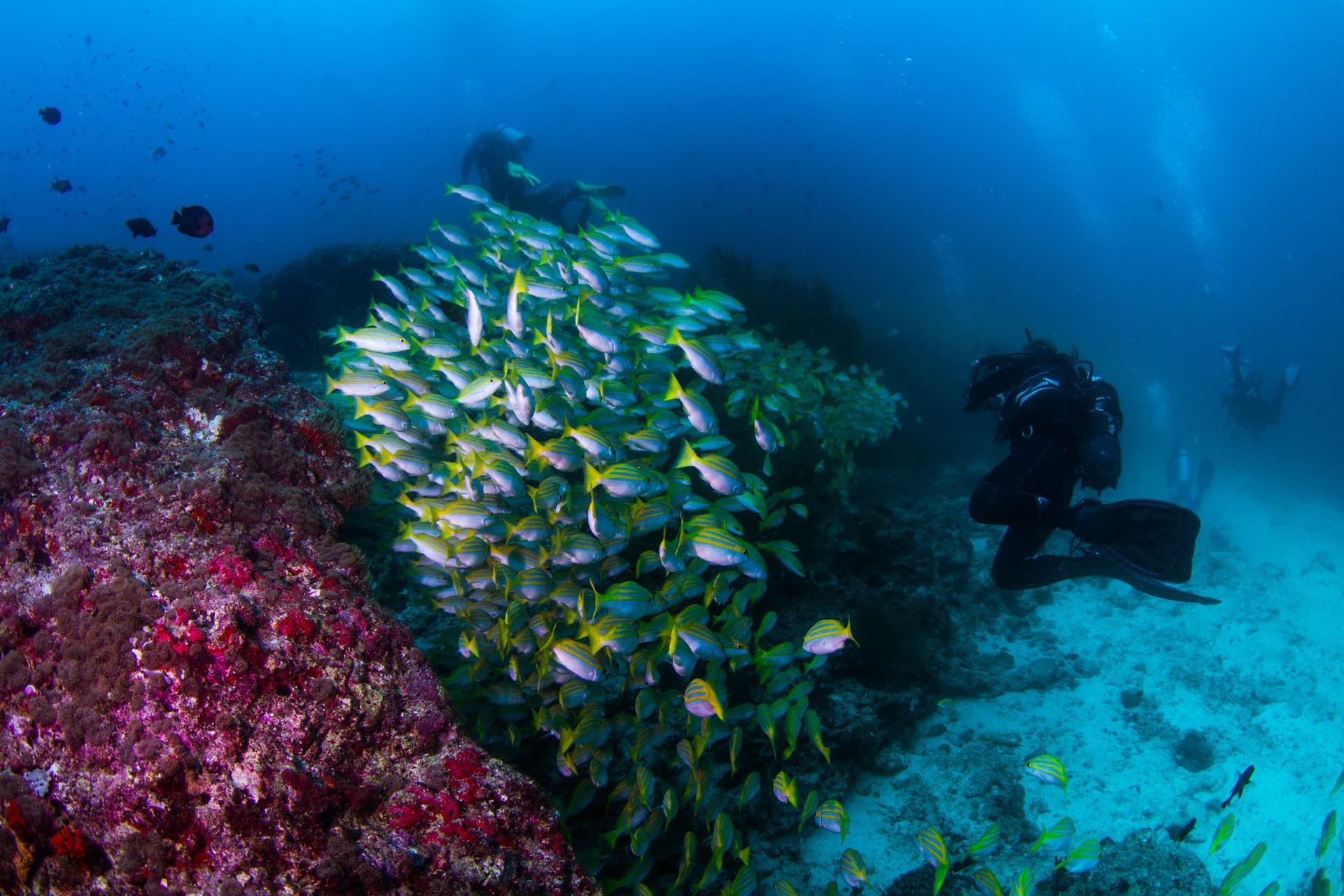
Tide organises Vaavu. The atoll is a thin reef chain less than 70 km south of Malé, on the eastern side of the central atolls, and the diving happens in the channels (kandus) that cut through it. When the current runs, grey reef, whitetip, blacktip and silvertip sharks stream through, and divers hook onto the reef and watch. Miyaru Kandu is the shark spectacle, a hook-in drift with numbers that can climb into the dozens, inside a protected area. Fotteyo Kandu, far to the east, is the dive local guides rate highest: soft-coral overhangs and swim-throughs, with scalloped hammerheads reported at sunrise now and then. An operator describes the reef there, Fotteyo Falhu, as 55 km of unbroken coral and the longest in the Maldives. After dark the Alimatha jetty reef fills with nurse sharks, a shallow night dive where guides ask for calm buoyancy and distance, because it is easy to kick or corner the sharks and rays. Turtles, eagle rays and humphead wrasse are regular company. Reef mantas pass through seasonally and whale sharks only rarely.
Protection here is site-level, not atoll-wide. Miyaru Kandu has been a protected area since 1995, according to the atoll council, and in October 2023 the government announced eight more Vaavu areas under the Environmental Protection and Preservation Act (Law No. 04/93), among them Rakeedhoo Corner.
Where you sleep decides which dives you get. Fulidhoo, in the north, is near Miyaru Kandu and Alimatha. Thinadhoo and Keyodhoo, in the centre, suit Fotteyo, which means a start around 4 am, a significant extra charge, and a centre willing to go; at least one Thinadhoo operator runs it when enough divers are keen. Centres collect divers from neighbouring islands daily, so your guesthouse and your dive shop need not share an island. Liveaboards on the central route usually pass Alimatha and Miyaru and often skip the far east.
Resort guests transfer by speedboat or seaplane arranged by the resort; the local islands are reached by public speedboat or a slower government ferry.
The headline dives are drifts to about 30 m in strong current, so Advanced Open Water, a reef hook and an SMB are the sensible baseline. December to April is the best window, with January to April the safer plan. Mantas favour the wet southwest monsoon, and reported windows differ, so none is firm.
Recreational diving in the Maldives stops at 30 m. The deep cave off Dhekunu Kandu lies below it and is not a recreational dive.
A thin chain of barrier reef cut by tidal channels (kandus), with large outer-reef overhangs and soft-coral caves; the lagoon thilas stay shallow and calm.
The diving here splits into 3 zones:
Book online or contact a centre that dives this area.
PADI 5-Star IDC dive centre on the local island of Fulidhoo, northern Vaavu Atoll, running boat-based channel, drift and night dives with stay-and-dive packages.
PADI 5 Star IDC Resort dive centre at NAKAI Alimathà Resort, Vaavu Atoll, built around a tawny nurse shark house reef and Felidhoo Atoll channel dives.
The Nakai Diving Center at NAKAI Dhiggiri Resort in Vaavu Atoll, offering near-resort reef-shark snorkelling at Shark Point alongside Felidhoo Atoll channel dives including Fotteyo Kandu.
Get in touch to add or claim your dive center listing on DiveCodex.
Safari boats based elsewhere that run itineraries to these dive sites.
35-metre, 20-guest liveaboard - the original hull of Carpe Diem Cruises Maldives, refitted in 2022, running the fleet's shared catalogue from central manta and reef weeks to the Baa Hanifaru snorkel season and seasonal southern shark charters, out of Male.
43-metre flagship of the Carpe Diem Cruises Maldives fleet - 12 cabins and 22 guests across three decks, with a dedicated camera room - running the shared Maldives catalogue from Male, from central Best-of and Ari weeks to the Baa Hanifaru snorkel season and seasonal southern shark charters.
38-metre, 20-guest sister in the Carpe Diem Cruises Maldives fleet, with a jacuzzi and a broad 10-metre beam, running the same shared catalogue - central Best-of and Ari weeks, the Baa Hanifaru snorkel season, and seasonal southern shark charters - from Male.

36m, 11-cabin, 22-guest wooden liveaboard (2010) running Luxury Yacht Maldives' full atoll catalogue - North to Lhaviyani, Baa & Hanifaru, central Best-5 to Laamu, and northeast-season Extreme South weeks - with free nitrox and rebreather support.

A comfortable 35-metre wooden liveaboard for up to 24 divers in 12 cabins, with a main-deck jacuzzi and bar, running Emperor's shared Maldives catalog from Male.

Emperor's 40-metre Maldives flagship, a 13-cabin, 26-guest fiberglass liveaboard running the year-round Best of Maldives week from Male plus the fleet's seasonal shark, northern-manta and Deep South charters.

The fleet's most intimate hull: a 35-metre wooden liveaboard for up to 18 divers in 9 cabins, with ocean-view upper-deck cabins, running Emperor's shared Maldives catalog from Male.

Emperor's value-focused 30-metre wooden liveaboard, 10 cabins for up to 20 divers, built around the diving and running the fleet's shared Maldives catalog from Male.
The dry northeast monsoon brings the best visibility, roughly 10 to 35 m, and the strongest channel currents. Reef mantas favour the wet southwest monsoon, when plankton can cloud the water.
What can go wrong here, and what divers do about it. Conditions change - take the briefing from the operator on the day.
National rules also apply: Rules and permits in Maldives
It comes down to what you want from the dives. Divers who have done both describe Vaavu as fewer but more thrilling channel dives, with less underwater traffic and a genuine local-island feel. South Ari offers more site variety and the whale-shark and manta draw, but every liveaboard passes through it, so it is busier. Pick Vaavu for shark-charged drifts from a quiet base.
Sometimes. Liveaboards on the central route pass through and run it, while some local operators reportedly do not take guests there after dark. Operators on nearby islands may collect divers for it, so ask your dive shop when you book instead of assuming it is on the schedule.
A central island such as Thinadhoo or Keyodhoo. Fotteyo sits at the far-eastern edge of the atoll, and reaching it before sunrise means a departure around 4 am from Thinadhoo, with a significant extra charge. Bases in the north are close to Miyaru Kandu and Alimatha and a long way from Fotteyo, and not every centre goes there.
For the headline dives, plan on it. The best channels are worked at around 30 m with strong current and a hook-in entry, and recent drift experience helps as much as the card. Interior reefs and the shallow Alimatha night dive suit less experienced divers.
December to April is the dry northeast monsoon and the best window. Local guides say seasons and currents have moved since the 2004 tsunami: in 2019 the incoming currents did not start until the end of January. That makes January to April the safer plan than a December start. One diver with more than a thousand dives called July and August the worst months, with rain and poor visibility.
By public speedboat in about an hour to an hour and a half, with departures around 11 am daily except Friday. The government ferry from the Villingili terminal runs three times a week and takes over three hours. Resort guests transfer by speedboat or seaplane arranged by the resort.
Neither is a safe bet. Mantas are seasonal and lean to the wet southwest monsoon, but reported windows range from May-June to June-September, so no month is firm. Whale sharks are rare here, with a single juvenile reported in 2019. If either animal is the point of the trip, build it around the atoll known for it.
Five Italian divers died on 14 May 2026 in the deep cave system off Dhekunu Kandu, also called Devana and Thinwana Kandu, near Alimatha. The cave mouth lies about 50 to 58 m deep, and the authorities say the group did not hold the separate deep-exploration permit. A Maldivian Coast Guard sergeant died during a recovery dive. A joint statement from the Maldivian authorities and the divers' alert network presumes the divers could not find the exit, most likely through disorientation, and warns against entering without authorisation, cave training and technical equipment. Recovery divers say they would never enter without a reel and guideline, and the group reportedly deployed no line. The channel dives are a different activity, and recreational diving here stays within 30 m.
Also known as: Felidhe Atoll, Felidhu Atoll, Vaaf Atoll
Log your dives - notes, photos, conditions and the marine life you saw - and share them as one public diver profile. What you share helps the next diver, too.
Log every detail
Depth, duration, conditions, gear, buddy, notes — all in one place. Import from Suunto and other dive computers.
Track marine life
Record species sightings on each dive. Build a personal catalogue of everything you've seen underwater.
Your public dive profile
Share your dive history, stats, and experiences with a profile page you control. Show the world where you've been.