
Badalona
Also known as: Inmersión urbana Badalona, Pantalan de Badalona, Pont del Petroli, Pont del Petroli Badalona
Urban shore dive at a converted oil pier 10km from Barcelona, with seahorses on the pillars, full-moon night dives, and a 3-15m sandy profile.
Last updated May 2026
The dive
A short, shallow dive that is almost entirely about looking carefully at small things. From the beach south of the pier, descend through bottle-green water onto fine sand at about 5 metres, then follow the row of pillars seaward. There is no wall, no relief, no pelagic swim-through; the structure is the only landmark on otherwise featureless ground. Visibility commonly sits at 3-4 metres on the bottom and up to 6 metres on the surface, with rare calm days reaching ten. The pier runs 275 metres east into the sea, finishing in a circular platform with a viewing hole in its centre that lets daylight pierce through to the sand below.
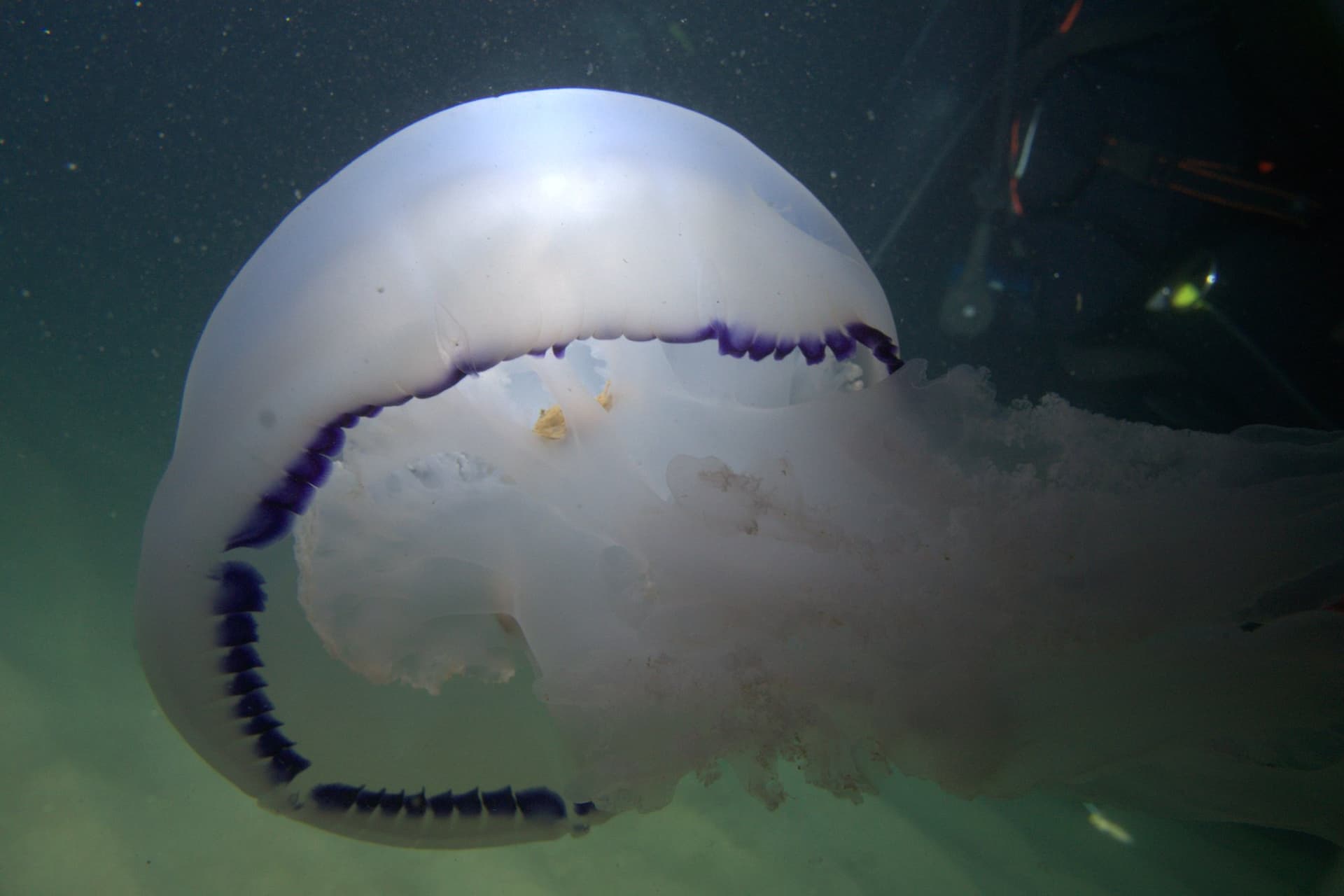
The interest is on the pillars and what hides on the sand between them. Encrusting fauna and nudibranchs cover the concrete; long-snouted seahorses cling to pillar bases and net edges where divers know to look; the occasional sand conger lies half-buried, and on a good day an electric ray flushes from a kick-stir. By night the site changes character: torches pick out emerging shrimp and crabs, and Rhizostoma jellyfish drift through under the structure in numbers, harmless to divers and a wide-angle photographer's reward in shallow water.
What makes it special
Three things keep local divers coming back. First, the geographic positioning: this is the closest dive to Barcelona by public transport, with metro and commuter-rail access from the city centre that almost no other Spanish dive site offers. Second, the seahorse colony on the pillars, anchored by a local marine-conservation NGO's Save the Sea Horses programme that uses the site as a monitoring point. Third, a night-dive culture that local club SASBA has built across five decades of full-moon scheduling, with an annual underwater-photography night competition on the pier.
What this is not is a destination dive. The right mental model is macro on pillars with jellyfish overhead, in a working harbour-suburb setting where the post-dive scene is the city promenade itself, not a separate dive-town.
History and origin
The pier was built in the 1960s by CAMPSA, the Spanish state petroleum company, for unloading oil tankers, and ran in that role until petroleum-handling moved elsewhere in the 1990s. Local divers continued to use it informally as a shore entry through the abandonment period. Badalona City Council purchased the structure from CAMPSA's successors in 2003, and the pier reopened in 2009 as a 275-metre public promenade with a circular viewing platform. SASBA, founded 1973, has used the Badalona coast as its home water across all of these phases. The history is industrial-modern; there is no Roman-road or classical-harbour legend here, and any such framing belongs to the Mataró stretch further north.
Photographer's notes
Macro setups outperform wide-angle for most of the year, working the encrusting fauna, nudibranchs, and the seahorses on the columns. Older community accounts describe the seahorses as elusive rather than easy, so a patient pass and a guide who knows the current spots are both useful. In Rhizostoma season, typically spring through summer, the trade-off flips: a dome-port wide-angle setup pays off in shallow water, and one community account from the early 2010s described forty jellyfish drifting along the pier in a single session. Night dives sit between the two, with torch beams isolating subjects against dark sand. The annual fotosub night competition draws a stable cohort of repeat photographers, and ambient promenade lighting at full moon gives the site a chiaroscuro look that is hard to find elsewhere on the Catalan coast.
Know before you go
Check the Badalona municipal beach-status page before driving out; heavy rainfall the day before tends to spike turbidity, and swim-ban days correlate with the worst diving days. The row of columns is the navigational reference, so carry a backup torch on night dives. Trim and buoyancy matter on this fine-sand bottom; hover, don't settle, because one careless fin-kick reduces team visibility to under a metre. Shore-anglers fish from the pier and small craft cross the bay, so pick entry points away from active fishing lines and carry an SMB on ascent. SASBA runs on a club-membership model, Freedome lists try-dives at 120 EUR for the May-to-October season, and Anèl·lides operates educational dives by appointment rather than as a recreational centre.
Why Dive Badalona
What makes this dive site stand out.
- Closest dive to Barcelona
10km from the city, reachable by L2 metro or R1 commuter rail without a car
- Pillars as the macro habitat
Encrusting fauna, nudibranchs, and seahorses cling to the structure on otherwise featureless sand
- Full-moon night-dive culture
Local club schedules nocturnals at full moon for soft ambient promenade light
- Industrial-modern history
Former CAMPSA petroleum pier from the 1960s, opened to the public as a promenade in 2009
Depth & Profile
Location
41.4500°N, 2.2474°E
Conditions & difficulty
Warmer water, less rainfall-driven turbidity, longer dive days. Year-round operation; the local club's 2026 season opened on 11 April.
Freedome try-dive listed at 120 EUR for 2026. SASBA runs on club membership; non-members contact the club directly. Anèl·lides educational pricing by quote.
Try-dives capped at 10m with 1:1 instructor. Open Water and above can dive in a buddy pair without a guide.
Summary
Shore entry, shallow, no current. The challenge is buoyancy on fine sand and patience for low visibility, not depth or navigation.
Safety considerations
What can go wrong here, and what divers do about it. Conditions change - take the briefing from the operator on the day.
- Visibility: Fine sand stirs easily; one careless fin-kick reduces team visibility to under a metre.Trim and buoyancy matter; hover, don't settle.
- Visibility: Beach swim closures correlate with the worst diving conditions, typically after heavy rain.Check the Badalona municipal beach status page before driving out.
- Surface and boat traffic: Shore-anglers fish from the pier; small craft in the bay.Choose entry points away from active fishing lines and carry an SMB on ascent.
Marine Life
Regulations
No fees for shore access. Spanish recreational-dive law (RD 550/2020) applies: insurance required, 40m max recreational depth, two-person buddy unit minimum.
Frequently Asked Questions
Can I reach Pont del Petroli from Barcelona without a car?▾
Yes. The R1 commuter rail from Plaça de Catalunya runs to Badalona station in about 18 minutes, or take the L2 metro to Badalona Pompeu Fabra and walk fifteen minutes to the seafront. That metro/rail accessibility is rare for Spanish dive sites and is the main reason Barcelona-based divers without a car keep coming back.
Is Pont del Petroli a good dive for beginners?▾
One of the easiest entries on this coast. Shore walk from the beach, no current, and try-dives are capped at 10 metres with 1:1 instructor supervision through SASBA or Freedome. The honest caveat is visibility: locally described as bottle-green, with bottom visibility often 3-4 metres, so first dives benefit from a guide who can find features in low contrast.
What makes night diving at Pont del Petroli the local specialty?▾
Local club SASBA has scheduled night dives at the site for decades, full-moon timing is the convention, and an annual underwater-photography night competition is held on the pier. The shallow profile and ambient promenade lighting give nocturnal sessions a soft chiaroscuro that doesn't exist at deeper or more remote Mediterranean sites.
Can I see seahorses at Pont del Petroli?▾
Seahorses cling to the pier pillars and the local marine NGO uses the site as a Save the Sea Horses monitoring point. Community divers describe them as reliably present but elusive, so a slow careful pass along the pillar bases gives the best chance. Species is most likely Hippocampus guttulatus but is not formally confirmed for this site.
Is Pont del Petroli safe to dive year-round?▾
The site is diveable in all seasons. Winter bottom temperature drops to 13-14 degrees and most regulars switch to a 7mm semi-dry or drysuit. The bigger variable is water quality: heavy rainfall the day before tends to spike turbidity from coastal collectors, and the municipality occasionally closes the beach to swimming. Check the beach status page before heading out.
How does diving at Badalona compare to the rocky reefs further up the Maresme coast?▾
Different experience entirely. The Maresme reefs off Mataró and Port Balís are boat dives on rocky ridges at 15-35m with reef-fish density. Badalona is a sandy-bottom pier dive at 3-15 metres with macro on pillars and jellyfish overhead. The appeal here is accessibility and night-dive culture, not depth or topography.
Photos
Every dive has a story. Share yours.
Log your dives - notes, photos, conditions and the marine life you saw - and share them as one public diver profile. What you share helps the next diver, too.
Log every detail
Depth, duration, conditions, gear, buddy, notes — all in one place. Import from Suunto and other dive computers.
Track marine life
Record species sightings on each dive. Build a personal catalogue of everything you've seen underwater.
Your public dive profile
Share your dive history, stats, and experiences with a profile page you control. Show the world where you've been.