
Diving in Dauin
A 10 km strip of black volcanic sand dived slowly for cryptic animals, among tyres, cars and steel sunk on purpose, inside municipal sanctuaries.
Last updated October 2026
Overview
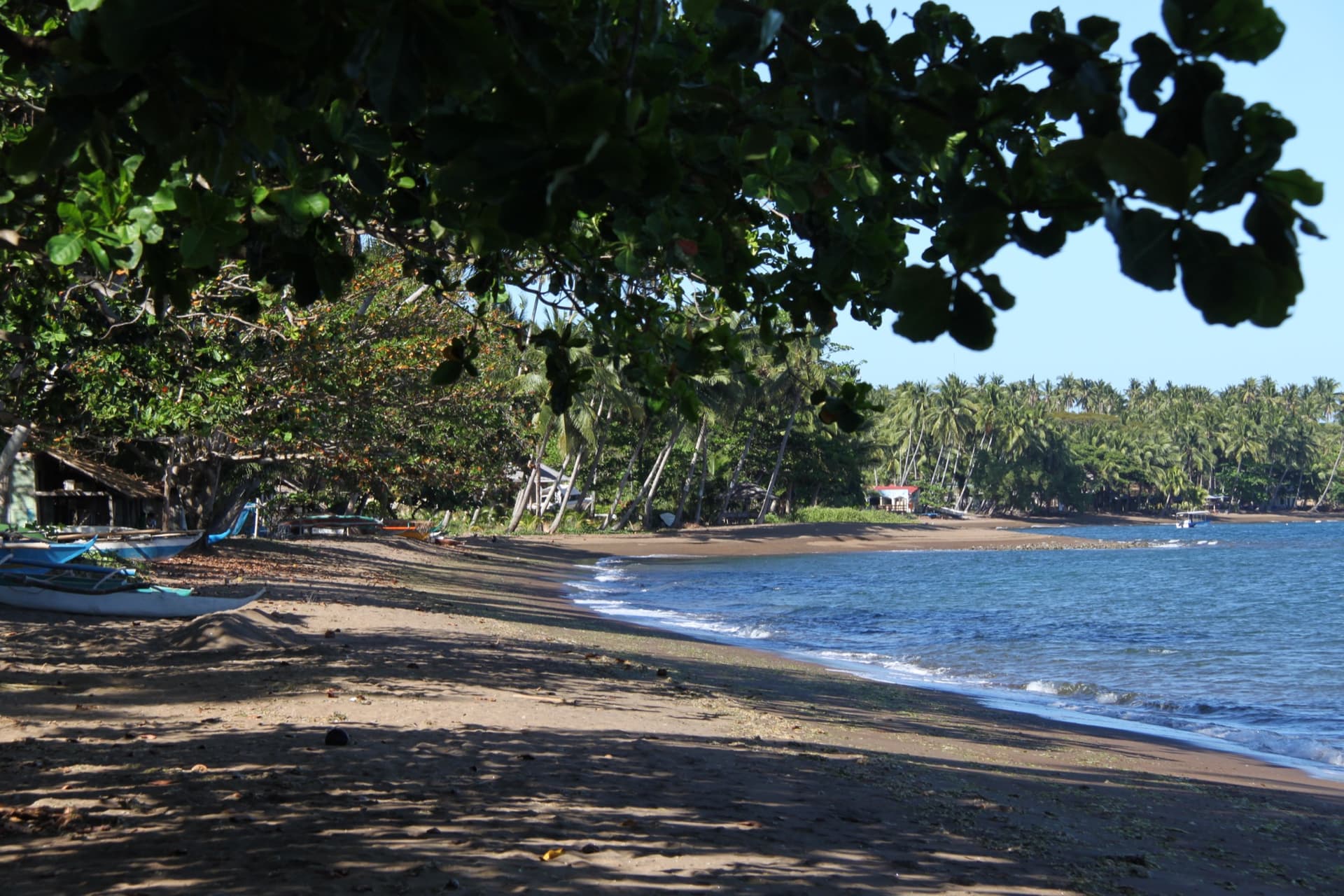
Dauin is ten kilometres of black volcanic sand, and diving it is a search. The slope drops from about five metres with almost no relief, and it fits the definition the research literature gives muck diving: finding rare, cryptic species that are seldom seen on coral reefs1. You swim a metre off the bottom at walking pace while a guide points out frogfish of several kinds, blue-ringed, mimic and wunderpus octopus, flamboyant cuttlefish, ornate ghost pipefish, thorny seahorses and harlequin shrimp. Frogfish carry the reputation, and the frogfish of Dauin are the subject of the second episode of Planet Earth III2.
The dive sites are municipal sanctuaries. Nine of them lie off seven of the eight coastal barangays, two to nine hectares each and about 52 hectares in all3, and Apo Island has its own. Much of what you look at inside them was put there. Ginama Point is truck tyres tied into tidy clumps, and the name is Cebuano for man made. Car Wreck holds cars, concrete pipes and a mixer at the deep end of the coast, and Pyramids is welded steel standing on open sand. Mainit is the odd one, with warm patches in the seabed and the coast's one real drift. The Masaplod Norte sanctuary has been protected since 1995.
The sanctuaries came before the industry, the opposite of the usual order. Apo Island's, set up in the mid 1980s with Silliman University and the municipal government, is generally described as the country's first successful community-based coastal resource management project. On the mainland the first sanctuaries went in at Masaplod Norte in 1995 and Poblacion District 1 in 1996, with six more between 2002 and 20053. Dive tourism began on Apo's coral and shifted to the muck off the Dauin beaches1.
What you are buying is a spotter. In a late 2015 survey, 35 percent of the Dauin guides sampled held an instructor rating, and guides in this kind of diving averaged close to 4,000 dives1. Divers coming home talk about the person who found things, not the sites.
Know what is missing. There is no wall, no big animal and no sweeping scenery. Divers who want reef go to Apo Island, a barangay of this same municipality and a day trip by bangka from the beach.
Planning your visit
Fly to Dumaguete (DGT) and drive 20 to 30 minutes south; Dauin lies 15 to 20 km from the city. Most operators sit in Dauin though many market under Dumaguete's name, and no sites lie in Dumaguete itself, so book by where the shop sits. Diving is mostly shore entry, over rocky, unstable ground that makes hard-soled booties worth packing, with short boat rides for the rest. Dives are commonly single-tank outings with a return to the resort between them, in groups of up to four divers per guide at one operator. Open Water is enough for the sanctuaries and the reefs in front of the resorts. Buoyancy matters more than the card, because the silt lifts easily and a loose fin takes the dive away from everyone behind you. Mainit is dived as a drift, and the deeper artificial-reef sites at the south end are where a shop will ask for Advanced and recommend nitrox, which one operator offers to 32 percent with a surcharge.
Protection here is municipal, declared by ordinance of the municipal council and enforced by barangay fishers' associations. Fishing is banned inside the sanctuaries; diving is allowed on payment of a fee that attaches to each dive at each site, not to the day. Your shop buys entrance tickets in advance from the Treasurer's Office at the municipal hall, and the sea wardens on duty collect them3. Operators describe the money as splitting 40 percent to the municipality, 40 percent to the fishers' association that maintains the sanctuary and 20 percent to the host barangay. Rates come from an ordinance and move, so ask what a dive package includes. Night and dusk access is set sanctuary by sanctuary and has been withdrawn before, so ask close to your dates.
Water runs 26 to 30 C, 3mm is comfortable and many divers wear less. Diving goes on all year, with December to April the drier stretch. Stonefish, scorpionfish, stargazers, lionfish, cone shells and the blue-ringed octopus sit in the sand you are photographing, so hover and touch nothing. A hyperbaric chamber facility is reported operating in the municipality. Apo Island charges its own entrance fee at its own registration office; the crossing is 30 to 45 minutes each way, usually for up to three dives, and its sanctuary has been closed for rehabilitation before, so confirm access near your dates. Tell the shop which animal you most want to see; finding it is the guide's job.
Geology & underwater terrain
Black and brown volcanic sand on the south-east coast of Negros, sloping from about 5 metres to past 30 with very little relief, with scattered coral patches and seagrass in the shallows. Warm patches in the seabed at Mainit and gas bubbling from the bottom at Bahura show the volcano still working. Much of the structure divers visit was sunk here on purpose.
Dive sites in Dauin
Marine life
When to dive
- Best season
- December to April
- Water temperature
- 26 to 30 C, diveable year-round
December to April is the drier, settled stretch; the wet months bring typhoon risk to the region and diving carries on. March is the coolest month at around 26 C.
Safety considerations
What can go wrong here, and what divers do about it. Conditions change - take the briefing from the operator on the day.
- Overhead: Soft sediment slopes where poor trim or fin technique lifts the bottom and ends the dive for everyone downstreamSort your buoyancy before booking; frog kick; stay off the sand
- Marine life: Stonefish, scorpionfish, stargazers, lionfish, cone shells and the blue-ringed octopus are the animals people come for, and they sit in the substrate, not on a reefHover, do not settle, and touch nothing
- Current: Mainit is dived as a drift; elsewhere on the strip current is rarely an issueDive Mainit on the operator's timing and carry an SMB
- Conditions: Dusk dives run on into darkness over an unlit sand slopePrimary and backup light, and a guide who knows the patch
- Surface and boat traffic: Rocky, unstable shore entries, with local boats working the same stripHard-soled booties; use the entry and exit points the guide gives you; SMB on ascent
Rules and permits
National rules also apply: Rules and permits in Philippines
Frequently Asked Questions
Is Dauin the same place as Dumaguete?▾
No. Dauin is its own municipality in Negros Oriental, 15 to 20 km south of Dumaguete City, and the sites on this page lie in Dauin waters. Divers and operators often use Dumaguete as the market name, and shops sitting in Dauin trade under it, so a search for either lands in the same place. A two-year resident puts it plainly: there are no dive sites in Dumaguete itself. Book by where the shop actually sits. Zamboanguita, the next municipality south, is a separate case, and resorts there list their own sites apart from Dauin's.
Can you night dive in Dauin?▾
Night and dusk dives are on sale, but access is a municipal decision taken sanctuary by sanctuary, and it has been withdrawn before. Declaring one reef in front of the resorts a sanctuary stopped night diving there for a period, and limits on night diving have stayed a complaint of the local dive trade. A 2010 trip report describes a dusk dive at Bahura that starts around half past five, waits for mandarinfish to emerge and turns into a night dive; read it as a possibility, not a fixture. Ask the shop what is currently permitted at the sanctuary you want, and ask close to your dates.
Is Dauin worth it for divers who want reef or big animals?▾
Probably not. There is no wall here and no shark, manta or pelagic school, and the dive is a close look at the bottom. A 2026 trip report from two experienced macro photographers, a month and more than thirty dives, found the density and variety of life disappointing and wished they had skipped the Apo Island day. That is one report, from photographers who had already shot better-known muck sites. Others describe a week without running short of subjects, with a few night dives mixed in. The coast suits a diver who enjoys slow work on sand.
How deep is the diving in Dauin, and does it change the certification you need?▾
The reports disagree, and both are single voices. A July 2026 trip report describes sandy slopes dropping to 30 to 40 m, while a 2010 report puts the week's maximum depths at 18 to 26 m. Operator-published site maxima run from about 18 to 32 m. The gap crosses a certification line, since 18 m is the Open Water limit. Most of the coast is shallow slope and sanctuary, which is Open Water diving; the deeper artificial-reef sites at the south end, Car Wreck's deep end among them, are where a shop will ask for Advanced and a look at your logbook. Ask the shop for the planned maximum of the site, not the area's.
What are the shore entries and the current like in Dauin?▾
Mostly from the beach, and a 2026 reporter found the entries rocky and unstable enough to recommend hard-soled booties. Current is rarely an issue on the sand strip; the same diver had one dive in a month cut short by it. Mainit is the exception, advertised by its operator for currents and dived as a drift. Follow the guide's entry and exit points and carry an SMB.
How good is the visibility in Dauin?▾
One March 2026 trip report found it generally excellent, frequently better than 20 to 30 m, with water at 27 to 28 C and a couple of mild thermoclines. That is a single recent voice, so treat it as encouraging and not as a norm. What every account agrees on is the mechanism: these are silty slopes, and a diver with loose fins can take a clear dive down to brown water within seconds, for everyone behind. The group makes the visibility.
Is there a hyperbaric chamber in Dauin?▾
Divers report a new, modern hyperbaric chamber facility in Dauin as of mid 2026, which would be unusual for a Philippine dive coast and a point in its favour for repetitive multi-day diving. Confirm its operating status before relying on it. Carry insurance that covers recompression treatment, and ask whoever you dive with what their plan is for moving an injured diver.
Does it matter which dive shop you choose in Dauin?▾
Less than the name suggests, since every shop dives the same sanctuaries. Divers describe the difference as guiding ratio, boat load, price and the bed. One operator caps groups at four divers per guide, and a 2025 report contrasts two or three divers per guide at one shop with a boat of a dozen or more at its neighbour. Ask the group size when you book, and ask for a guide known for finding small animals.
Also known as: Dauin muck diving, Dumaguete diving
References
- 1.Marine Policy 83 (Elsevier) — The economic contribution of the muck dive industry to tourism in Southeast Asia
- 2.The Philippine Star, October 20, 2023 — Dauin frogfish feature in BBC's 'Planet Earth III'
- 3.Aghamtao, Journal of the Ugnayang Pang-Aghamtao (Philippine Social Science Council) — Revisiting tensions and successes of marine protected areas in a Visayan municipality
Every dive has a story. Share yours.
Log your dives - notes, photos, conditions and the marine life you saw - and share them as one public diver profile. What you share helps the next diver, too.
Log every detail
Depth, duration, conditions, gear, buddy, notes — all in one place. Import from Suunto and other dive computers.
Track marine life
Record species sightings on each dive. Build a personal catalogue of everything you've seen underwater.
Your public dive profile
Share your dive history, stats, and experiences with a profile page you control. Show the world where you've been.