
Diving in Phi Phi Islands
Andaman day-boat hub built on its own national park, diveable year-round, known for leopard and blacktip reef sharks off the Bida Islands and Ko Phi Phi Leh.
Last updated September 2026
Overview
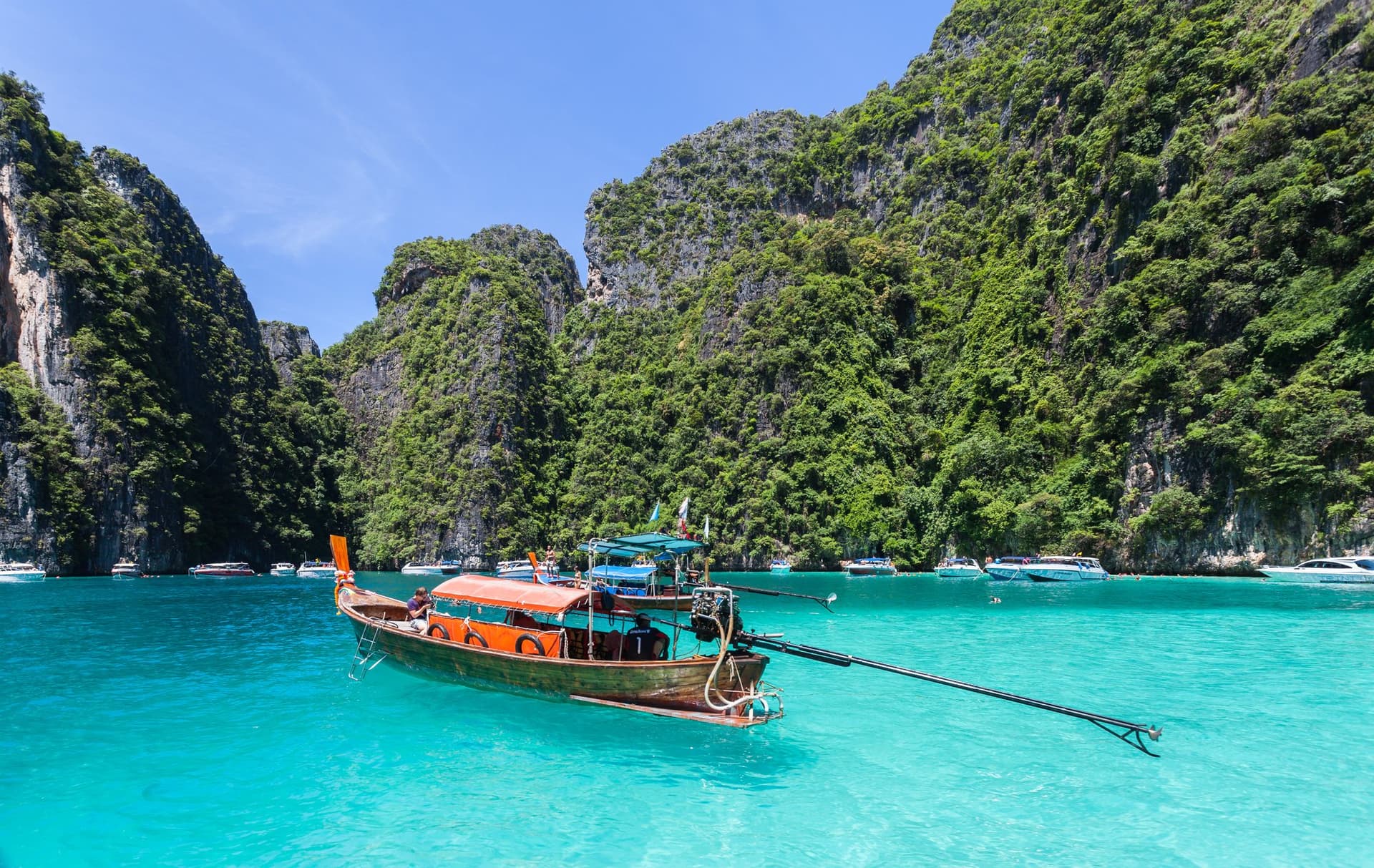
Phi Phi is Thailand's day-boat answer to a liveaboard destination: a national park built entirely around one limestone archipelago, reached directly from Phuket or Krabi, and diveable and marketed year-round, unusual for an Andaman hub, where Similan and Surin close entirely for the mid-year monsoon. The same karst topography that made Ko Phi Phi Leh's Maya Bay famous on land, sheer cliffs dropping straight into deep water, continues underwater as walls, swim-throughs and submerged pinnacles. That is where Phi Phi makes its case: divers who have also done Similan and Richelieu Rock still call Phi Phi's own reef walls comparable or better for everyday reef life, even while rating the north for bigger open-water encounters.
The signature dive is the paired Bida Islands south of Ko Phi Phi Leh. Koh Bida Nok, the larger twin, opens from a sheltered beginner bay into a colourful southwest wall and a current-swept ridge locals call the Finger Reef; its smaller twin, Koh Bida Nai, runs one continuous circuit from the calm Anemone Bay through a named outcrop, Fantasy Reef, to a proper wall on its north and west sides. Both carry a close-to-guaranteed leopard shark or blacktip reef shark sighting on an early dive. On Ko Phi Phi Leh's south side, next to Maya Bay, Loh Samah Bay circles a single small islet in one relaxed tank and turns into one of the area's stronger night dives after dark. Maya Bay's own beach closed to tourists from 2018 to 2022 for coral rehabilitation, while the surrounding dive walls, Loh Samah included, stayed open throughout. Two more walls further along the same coast, Palong and its near-namesake Malong, add the same blacktip and leopard shark pattern on calmer days. Hawksbill turtles, giant moray eels, bluespotted rays and a dense reef-fish and macro assemblage turn up at nearly every site.
Coral condition here is a live, time-layered question, not a settled one. A 2010 bleaching event and heavy diving pressure damaged several sites, including parts of the Bida/Camel Rock stretch; one long-running local operator reports a strong recovery at Camel Rock since, while more recent visitor accounts describe patchy, less vibrant coral at some of the same sites. Manta rays and whale sharks are sometimes marketed by local operators, but the Andaman's dependable manta cleaning stations lie elsewhere, at Koh Bon and Hin Daeng/Hin Muang; treat it as a bonus, not the reason to book.
Planning your visit
Ferries reach Tonsai Pier on Ko Phi Phi Don from Phuket or Krabi in roughly 90 minutes to two hours; speedboats cover the same routes in 45 minutes to an hour. There is no motorised transport on the islands themselves, and Ko Phi Phi Don is the base for local operators generally. Open Water covers most of the local diving: Loh Samah Bay and the sheltered halves of both Bida islands sit inside Open Water's limits, while Koh Bida Nok's outer wall and Koh Bida Nai's Fantasy Reef run into the mid-to-high 20s and suit Advanced Open Water better. High season, October to April, brings the clearest water, to about 30m, and the calmest seas; the May-to-October southwest monsoon drops visibility to 10-15m and adds afternoon rain, though operators simply move to more sheltered sites rather than stopping.
A national park fee applies throughout: a nationwide schedule sets 200 THB for a foreign adult, but the special-zone rate that covers Ko Phi Phi Don, Leh and Bamboo Island, where nearly all the diving happens, runs to 400 THB, and a further 200 THB diving supplement applies on top of that, putting a first day's diving at around 600 THB total.12 The rate steps down on consecutive diving days within the same three-day cycle. Since April 2025, Thailand's national coral-protection rules apply here as everywhere: every diver needs a licensed guide or instructor, an underwater camera requires Advanced Open Water certification or 40 logged dives, and snorkellers need a lifejacket unless freediving-certified. Divers set on Hin Daeng, Hin Muang or Koh Haa can book them as a day trip from Phi Phi, but these sit inside Koh Lanta's own marine park, carry a higher fee, run roughly November to April only, and need a full boatload of at least eight divers before an operator will run the trip; Koh Lanta itself is the steadier base when one of those three is the actual target.
Geology & underwater terrain
Non-volcanic limestone, the same karst that forms Krabi's mainland cliffs, continuing underwater as sheer walls, swim-throughs and submerged pinnacles around every island in the group.
Dive sites in Phi Phi Islands
The diving here splits into 2 zones:
- South of Ko Phi Phi Leh: the Bida Islands
- — Twin limestone islets and the area's signature pairing, sheltered bays opening onto walls patrolled by leopard and blacktip reef sharks.
- Ko Phi Phi Leh's south side, next to Maya Bay
- — Sheltered walls and a single-islet circuit next to Maya Bay, calm enough for beginners and strong enough after dark to be one of the area's better night dives.
South of Ko Phi Phi Leh: the Bida Islands
Ko Phi Phi Leh's south side, next to Maya Bay
Marine life
When to dive
- Best season
- October to April, calmest and clearest around December-April
- Water temperature
- 27-30°C year-round, warmest February-May, coolest December-January; a shorty or rashguard covers every month
Phi Phi dives year-round, with no mandatory closure like Similan and Surin's further north. The May-October southwest monsoon drops visibility to 10-15m and brings afternoon rain; operators simply move to whichever walls are sheltered that day.
Safety considerations
What can go wrong here, and what divers do about it. Conditions change - take the briefing from the operator on the day.
- Current: Current strengthens at exposed outlying pinnacles and on the Hin Daeng/Hin Muang/Koh Haa day trips beyond the park.Follow your guide's plan and expect a stronger drift on these sites than on the sheltered walls close to Ko Phi Phi Don.
- Surface and boat traffic: Day-boat and speedboat traffic is heaviest around Maya Bay and the main pier at Tonsai.Deploy a surface marker buoy well before ascending and hold safety stops away from mooring lines.
Rules and permits
Hat Noppharat Thara-Mu Ko Phi Phi National Park
National park
- Closed to diving from August 1 to September 30, every year. (in some zones)
Park closure dates 2026Sunscreen banDive service zonesChecked: Oct 2026
National rules also apply: Rules and permits in Thailand
Frequently Asked Questions
What is the signature dive at Phi Phi?▾
The paired Bida Islands, south of Ko Phi Phi Leh. Koh Bida Nok, the larger of the two, opens from a sheltered bay into a colourful wall and a current-swept ridge; its twin, Koh Bida Nai, runs one circuit from a calm bay through a named outcrop, Fantasy Reef, to a proper wall. Both carry a close-to-guaranteed leopard or blacktip reef shark sighting on an early dive.
Is Phi Phi diveable year-round?▾
Yes, and that is unusual for the Andaman coast. Similan and Surin further north close completely for the monsoon; Phi Phi's operators instead shift to whichever sites are sheltered that day when the southwest monsoon brings rain and lower visibility between roughly May and October.
How much is the national park fee at Phi Phi?▾
A general nationwide schedule sets 200 THB for a foreign adult, but the higher special-zone rate applies to the islands nearly everyone visits, Ko Phi Phi Don, Ko Phi Phi Leh and Bamboo Island, at 400 THB, and operators add a 200 THB diving supplement on top of that. A first day of diving runs to around 600 THB; repeat days within the same three-day cycle drop back to about 200 THB before the cycle resets.
What certification level do I need to dive Phi Phi?▾
Open Water covers most of it. Loh Samah Bay and the sheltered bays on both Bida islands sit inside Open Water's depth limits, while Koh Bida Nok's outer wall and Koh Bida Nai's Fantasy Reef run into the mid-to-high 20s and suit Advanced Open Water better.
Can I dive Hin Daeng, Hin Muang or Koh Haa from Phi Phi?▾
It's bookable, but treat it as a special trip rather than a standard day out. These sites sit inside Koh Lanta's own marine park, carry a higher park fee, run roughly November to April only, and need a full boatload, at least eight divers, to go out at all. Koh Lanta itself is the more reliable base if these three are your actual target.
Which 'Shark Point' is Phi Phi's own?▾
Hin Bida, a pinnacle east-southeast of Ko Phi Phi Leh with a near-guaranteed leopard shark sighting, reached on Phi Phi's own day boats. A separate site also called Shark Point sits roughly halfway to Phuket and is a different place entirely, usually paired with the King Cruiser wreck on Phuket-based trips.
Do Phi Phi day trips reach the King Cruiser wreck?▾
It's sometimes sold as a shared stop with Phuket, since the wreck sits roughly the same distance from both islands, but check which port your specific trip departs from when you book it. If you do go, expect an Advanced-level profile: the wreck's deeper sections and the current at the neighbouring reef push past a standard Open Water plan.
Is the reef in good condition at Phi Phi?▾
It depends where and when you ask. A 2010 bleaching event and heavy diving pressure damaged several sites, including parts of the Bida/Camel Rock area; one long-running local operator reports a strong recovery at Camel Rock since, while more recent visitor accounts describe patchy, less vibrant coral at some of the same sites. Expect variation dive to dive, not one settled verdict.
Will I see manta rays or whale sharks at Phi Phi?▾
Is Phi Phi better than Koh Lanta or Similan for diving?▾
It depends what you're after. Divers who have done both consistently rate Similan and Richelieu Rock ahead of Phi Phi for big open-water encounters, but call Phi Phi's own walls comparable or better for everyday reef life. Against Koh Lanta specifically, Phi Phi wins on convenience and its own site list; Koh Lanta is the better base when Hin Daeng, Hin Muang or Koh Haa are the actual goal.
Also known as: Hat Noppharat Thara - Mu Ko Phi Phi National Park, Ko Phi Phi, Koh Phi Phi, Mu Ko Phi Phi, Mu Ko Phiphi, หมู่เกาะพีพี
References
- 1.Department of National Parks, Wildlife and Plant Conservation (DNP), June 2, 2022 — อุทยานแห่งชาติ กลุ่มที่ 2 (nationwide national park fee-group schedule)
- 2.Department of National Parks, Wildlife and Plant Conservation (DNP), via TAT repost, September 19, 2022 — แหล่งท่องเที่ยวที่ต้องชำระค่าบริการเป็นพิเศษ (special-fee tourism sites announcement)
Every dive has a story. Share yours.
Log your dives - notes, photos, conditions and the marine life you saw - and share them as one public diver profile. What you share helps the next diver, too.
Log every detail
Depth, duration, conditions, gear, buddy, notes — all in one place. Import from Suunto and other dive computers.
Track marine life
Record species sightings on each dive. Build a personal catalogue of everything you've seen underwater.
Your public dive profile
Share your dive history, stats, and experiences with a profile page you control. Show the world where you've been.