
Diving in Southern Leyte
Sogod Bay: walls dropping into water a kilometre deep off Napantao and Limasawa, black-sand macro, and a snorkel-only whale shark season.
Last updated October 2026
Overview
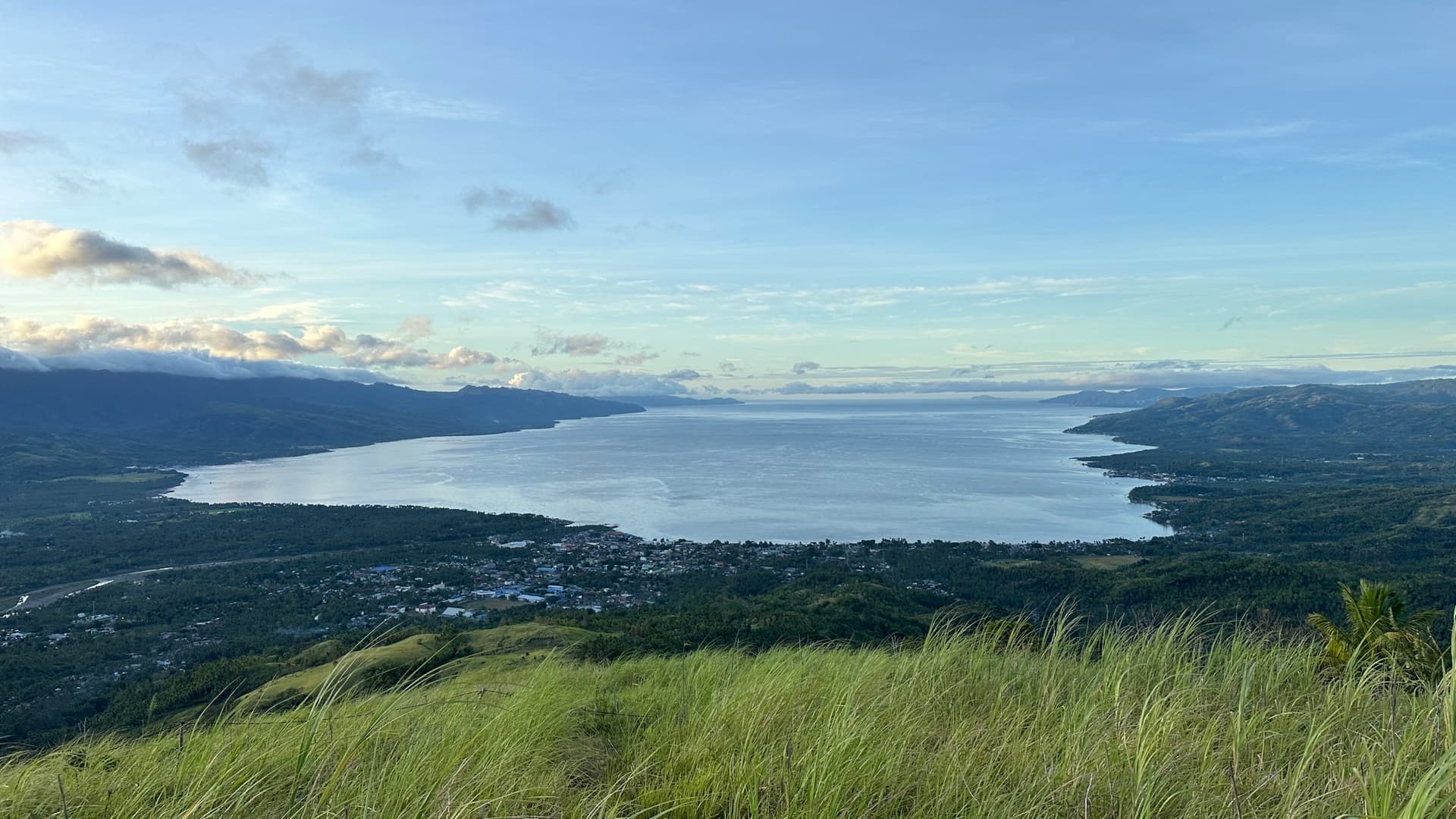
Sogod Bay is about twelve kilometres across and over a kilometre deep, with a central channel reaching roughly 1,460 metres. The reefs hang on its edges as narrow fringing shelves that fall away almost at once, and the diving follows that shape: walls. Southern Leyte is the province; divers search for the bay and for its places, Padre Burgos, Panaon Island and Limasawa.
Napantao, on the Panaon side, is a horseshoe of wall projecting into the current, and upwelling pushes cool water and fish up its face, so it is dived as a drift. Limasawa, half an hour out towards the bay mouth, has walls that start at a five-metre lip and look bottomless below, with black coral and gorgonian fans; Gunter's Wall is the name to ask for. Dives on both are run to recreational depth, around 40 metres, whatever the wall does beneath. Nearer town, the two Medicare dives are turtle sanctuaries, South steeper to about 30 metres and North shallower, and Max Climax drops from the Padre Burgos house reef into a gentle sand slope. Pygmy seahorses sit on the house-reef sea fans. About 15 km north of Padre Burgos the coast turns to black sand. Two rivers enter that end of the bay, so heavy rain puts silt in the water, and the same sediment holds blue-ringed octopus, wunderpus, dragonfish and long-horned cowfish.
Whale sharks are the seasonal draw. The bay is an IUCN Important Shark and Ray Area: 321 individuals were photo-identified between 2006 and 2020, two thirds of them resighted, and it ranks second in Asia among natural aggregation sites1. Nothing is put in the water to bring them in. You meet them on snorkel from a spotter-led boat, and there is never a guarantee.
Protection covers only part of the bay. Republic Act No. 12238, approved on 29 August 2025, made the waters around Panaon Island a protected seascape covering Liloan, San Francisco, Pintuyan and San Ricardo2. It does not name Padre Burgos, Limasawa, Macrohon or Malitbog, so the house reefs and Limasawa sit outside it, under small community sanctuaries. The law calls for guidelines on vessel speed to protect the large animals that pass through, and a 2020 expedition found Panaon coral cover about three times the national average, alongside overfishing, destructive fishing and plastic3. Ask locally which corners of Panaon are open in the season you visit.
Planning your visit
Diving in Sogod Bay is bought with a bed. The resorts are small and owner-run, at Padre Burgos and Lungsodaan, Macrohon on the north-west shore and Pintuyan on Panaon for the sharks. Boat, guide and tanks come as a package with the room, a marine-park fee is added per site at the sanctuaries, in low three-figure pesos, and whale shark trips are priced separately with the environmental fee folded in. Nitrox is available at some resorts, which helps on repeated 30 to 40 metre wall profiles.
The walls ask more than the shallows. Padre Burgos Pier, Tangkaan MPA North, Santa Sofia and Medicare North are easy and shallow; Turtle Rock, Sonok Point, Max Climax and Medicare South sit in the middle. Napantao, Adrian's Cove, Zack's Cove, Olly's and Puloy's Wall, Gunter's Wall and Jun's Pinnacle are run in current on vertical ground, as drifts, so arrive with current experience and an SMB. Boats run 30 minutes to Limasawa and about 45 to Napantao.
November to May is the settled season: calmer seas, visibility that often reaches 20 to 30 metres on the outer walls and 10 to 20 inshore, and the whale sharks. Water sits near 27 to 29 C, but expect 25 to 26 C on the walls from November to April, where a 5 mm suit helps if you feel the cold. June to October is the wet monsoon half, with rougher crossings and silt in the north.
The whale shark trip is a separate day: about 1.5 hours by boat from Padre Burgos, six to eight hours door to door, with departures around 08:30 and again in the afternoon. Spotters in small outriggers go ahead and the guest boat moves only when one finds an animal, so expect a three-hour cap at sea, no scuba or surface-supplied air (Sogod Bay is a listed site in the national circular4), and no feeding, baiting or touching. Pintuyan declares each season through its tourism office: it opens from November, trips generally run to the end of May, and the 2026 interactions ended on 1 June with the next opening in October5. Confirm dates before booking flights.
Getting here costs a day at each end. Fly to Tacloban and take the three-and-a-half to four-hour van, or the 07:00 ferry from Cebu to Maasin, arriving at 10:00, then about 45 minutes by road. Plan four to five diving days plus two travel days.
Geology & underwater terrain
A deep, narrow inlet of the north-eastern Bohol Sea with a steep seabed and almost no coastal shelf, so the reefs are narrow fringing shelves that fall away at once; two rivers in the north load the bay with the sediment behind its black sand.
Dive sites in Southern Leyte
The diving here splits into 5 zones:
- Padre Burgos house reefs (Port: Padre Burgos)
- — Drop-offs into gentle sand slopes off the resorts, Max Climax among them, and the pier at Padre Burgos as the night macro dive in under 20 metres.
- Tangkaan Point and south (Port: Padre Burgos)
- — Hard-coral shelves and small municipal sanctuaries: Turtle Rock, Heaven's Gate, Santa Sofia and the two Medicare dives, with green and hawksbill turtles.
- North bay, Bunga to Malitbog (Port: Padre Burgos)
- — About 15 km north of town the coast turns to black sand and the diving turns to macro. Two rivers enter this end of the bay, so heavy rain brings silt.
- Panaon Island east (Port: Pintuyan)
- — Napantao's walls, Olly's and Puloy's Wall, Sonok Point and Jun's Pinnacle, plus the whale shark waters off Pintuyan and San Ricardo. Current is strong and the walls are dived as drifts.
- Limasawa Island (Port: Padre Burgos)
- — A day trip about 30 minutes out towards the bay mouth: Gunter's Wall, Adrian's Cove and Zack's Cove, steep walls with black coral. The south point is shallower, where currents converge.
Marine life
When to dive
- Best season
- November to May
- Water temperature
- 27 to 29 C at the surface, around 25 to 26 C on the walls from November to April
November to May brings calmer seas and the clearest water, and the whale shark window sits inside it; June to October is the wet monsoon half, with rougher crossings and silt in the northern bay after heavy rain. The whale shark season is approximate: it starts in November and the Municipality of Pintuyan declares each year's end.
Safety considerations
What can go wrong here, and what divers do about it. Conditions change - take the briefing from the operator on the day.
- Current: Strong current at Napantao and on the Limasawa walls, where upwelling also brings cool water up the face; converging currents at Limasawa's south point.Dive these as drifts with the guide, carry an SMB, and build up with current experience before the walls.
- Visibility: The northern sites silt up in heavy rain, and the monsoon months cut visibility.Choose the Padre Burgos or Panaon sectors after downpours, or plan the macro coast for the settled months.
Rules and permits
National rules also apply: Rules and permits in Philippines
Frequently Asked Questions
Can you ever see a whale shark on a scuba dive in Sogod Bay?▾
Sometimes, by chance. Operators report whale sharks turning up on ordinary dives over the years at Napantao, Sonok, Limasawa, Malitbog, Liloan and off the Padre Burgos shore, so a regular dive can end with one. None of that is a product you can book: the organised meetings off Pintuyan and San Ricardo are snorkel only, and the national circular lists Sogod Bay among the sites where scuba is barred.
When does whale shark season start and finish, and who decides?▾
Everything agrees on a November start. The end moves: one operator runs trips through the end of May, the municipality closed the 2026 interactions on 1 June, and the next opening was announced for October. Pintuyan sets each year's dates through its tourism office, and the sharks follow the plankton, so a window printed anywhere is approximate. Because an October opening and a November opening are different trips, confirm the current dates with the resort before booking flights.
Are the Sogod Bay whale sharks fed, like the ones at Oslob?▾
No. Local authorities prohibit feeding, baiting and touching, and the boats work with spotters who search first. Research on whale sharks at Oslob, where they are provisioned every day, found animals less likely to avoid people over repeat visits. The same research recorded the opposite in Southern Leyte, with sharks moving away from tourist vessels that came close. A snorkeller here is still not guaranteed a shark on any given morning.
Is Southern Leyte worth the journey compared with Malapascua or Moalboal?▾
It depends on how many days you have. Divers who compare the places agree that all of them take a long drive to reach, and a diver with five days has chosen Moalboal instead. With a week or more, Sogod Bay gives you wall diving in the Bohol Sea with few other boats, black-sand macro on the same coast and a whale shark season run on the animals' terms. Plan four to five diving days plus two travel days.
How do you get to Padre Burgos from Cebu or Manila?▾
There are two routes and neither is quick. From Tacloban, which has several flights a day from Manila and Cebu, it is three and a half to four hours by private van or four to four and a half by public transport. Take an early flight, because public connections thin out late in the day. From Cebu the 07:00 fast ferry from Pier 1 reaches Maasin at 10:00, and Padre Burgos is about 45 minutes by road beyond it. Slower ferries to Hilongos and Ormoc leave long road legs at the far end.
Is Napantao an advanced dive, and how deep is it actually dived?▾
The wall runs past 50 metres and one operator describes it dropping from seventy metres up to seven, but the dive is run to recreational limits, around 40 metres at the deep end and often shallower. What makes it demanding is the water: a horseshoe wall in the current with upwelling up the face, always dived as a drift. Divers new to current should build up to it on the gentler sectors first.
Can an Open Water diver enjoy a week in Sogod Bay?▾
Yes, for about half of it. Padre Burgos Pier, Tangkaan MPA North, Santa Sofia and Medicare North are easy and shallow, and Turtle Rock, Sonok Point, Max Climax and Medicare South sit in the middle. The walls at Napantao, Adrian's Cove, Zack's Cove, Olly's and Puloy's, Gunter's Wall and Jun's Pinnacle go deeper, steeper and in current, so an Open Water diver would miss much of what the bay is known for unless drift experience builds during the week.
Is Sogod Bay a macro destination or a wall destination?▾
Both, and in different places. The walls are on Panaon and Limasawa, at the end of boat rides of 30 to 45 minutes. The macro is nearer the resorts: pygmy seahorses on the sea fans of the house reefs, mandarinfish, frogfish and the pier night dive, then black sand towards Malitbog with blue-ringed octopus, wunderpus, dragonfish and long-horned cowfish. Many days pair one wall dive with one macro dive.
Also known as: Limasawa, Padre Burgos, Panaon Island, Sogod Bay
References
- 1.IUCN SSC Shark Specialist Group — Sogod Bay Important Shark and Ray Area factsheet
- 2.LawPhil Project, Arellano Law Foundation, August 29, 2025 — Republic Act No. 12238, the Panaon Island Protected Seascape Act
- 3.Oceana, August 29, 2025 — The Philippines Protects One of the Planet's Most Biodiverse Marine Regions
- 4.Department of Tourism, Department of Agriculture, Department of the Interior and Local Government, Department of Environment and Natural Resources — Joint Memorandum Circular No. 01, series of 2020: Rules and Regulations Governing the Conduct of Marine Wildlife Tourism Interactions in the Philippines
- 5.Daily Tribune, June 3, 2026 — Pintuyan ends whale shark interaction season in Sogod Bay, tourism to resume in October
Every dive has a story. Share yours.
Log your dives - notes, photos, conditions and the marine life you saw - and share them as one public diver profile. What you share helps the next diver, too.
Log every detail
Depth, duration, conditions, gear, buddy, notes — all in one place. Import from Suunto and other dive computers.
Track marine life
Record species sightings on each dive. Build a personal catalogue of everything you've seen underwater.
Your public dive profile
Share your dive history, stats, and experiences with a profile page you control. Show the world where you've been.