
Arcs del Dui
Also known as: Arches of Duï, Arcs del Dui, Arcs Dui
Easy Costa del Montgrí boat dive: three sea-eroded rock arches break a coralligenous wall between 12 and 20 m, with red coral and small reef life.
Last updated May 2026
The dive
Drop down the buoy line into clear water and settle on the rocky shoulder around six metres. The first ten minutes are a calibration phase: buoyancy on a sloping reef, eyes on the small holes that pock the rock face, the kind of bottom where new divers learn that a Costa Brava wall is not a flat painted backdrop but a layered apartment block of moray, octopus, and small wrasse. Around twelve metres the first arch opens. The largest of the three is wide enough for a relaxed approach without snagging gauges or fins; light bends through the passage rather than disappearing, because these are short open-ended formations rather than roofed caves.
Past the arches, the slope continues to about twenty-five metres at the toe, with rock corridors flanking the path before they give way to coralligenous patches: small colonies of red coral on shaded faces, sponges, the occasional Paramuricea fan typical of Montgrí walls. Most centres turn here and work back along the wall a level shallower to extend bottom time. A 40-50 minute profile sits comfortably inside Open Water no-deco margins for the typical visiting diver. A torch helps inside the arches and pulls colour out of the deeper rock niches.
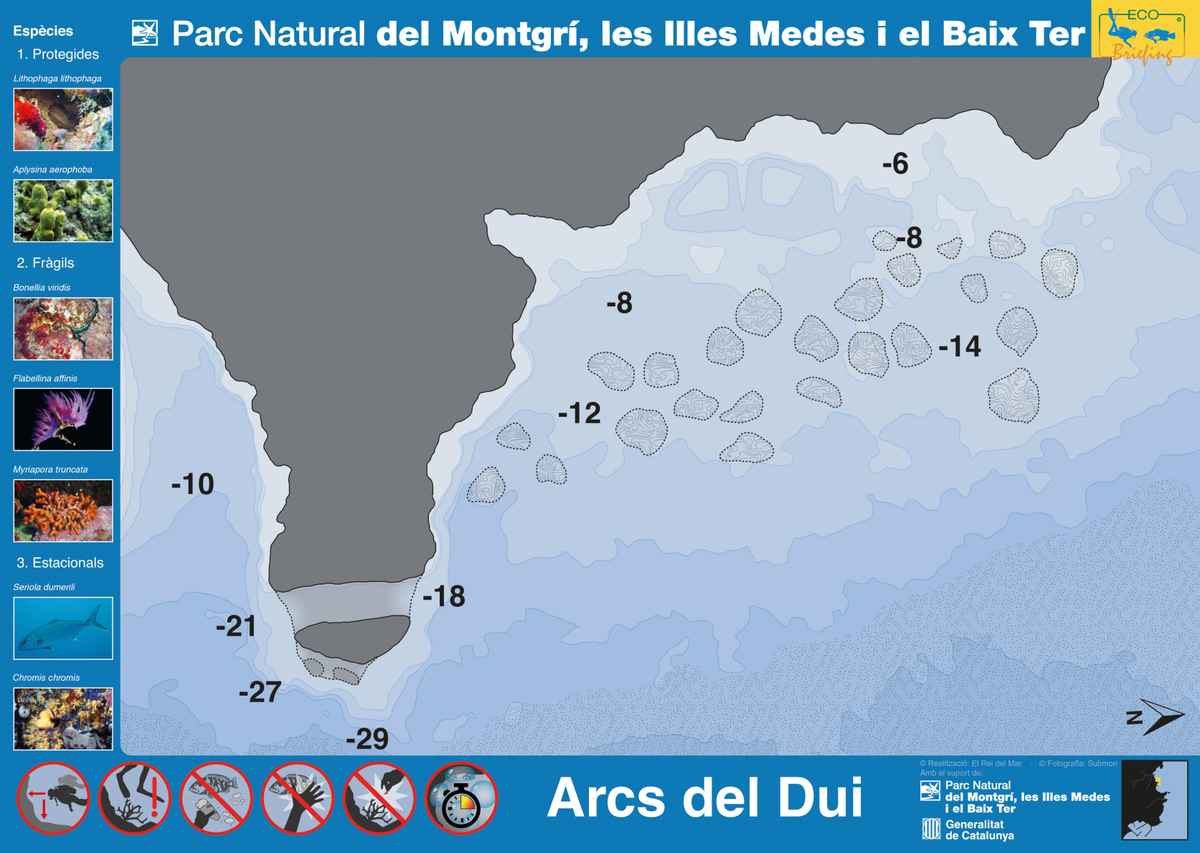
Illustration: Parc Natural del Montgrí, les Illes Medes i el Baix Ter — Generalitat de Catalunya
What makes it special
Most Costa del Montgrí sites a beginner can comfortably dive give you a slope and the marine life that finds it. Arcs del Duï adds one piece of geometry: three rock arches at recreational depth that you can swim through without overhead-environment training. That tighter pitch is why centres slot it into try-dive mornings, OW check-outs, and afternoon second dives. It is the relaxed end of a coast better known for the technical Cala Pedrosa tunnel, the deeper Reggio and Marmoler wrecks, and the tramuntana-proof Negre del Falaguer.
The marine-life texture is the second feature, in a quieter register. The wall sits in precoralligenous habitat — small holes and niches sheltering octopus, morays, forkbeards in shaded faces, sargos cruising the open water, and small red coral colonies on the shaded rock. The coralligenous community is fragile and slow-growing, which is the only real ask the site makes of a diver: hover off the wall, do not settle, and trim through the arches.
Know before you go
Bring a torch. The arches and the deeper rock niches both reveal more under a directed beam, and centres explicitly recommend one. Spanish recreational-diving law requires a dive computer and insurance — centres sell day cover. The site is inside the Parc Natural del Montgrí, les Illes Medes i el Baix Ter but outside the strict Medes Reserva Natural Parcial, so there is no diver quota, no permit, and no per-dive park tax for the coast. Anchoring on Posidonia is prohibited park-wide; centres use mooring buoys only.
The arches are open-ended swim-throughs, not cave penetrations — cave certification is not required, and the dive does not need overhead-environment training. Park cave rules still apply at the limit cases: small groups, no entry beyond natural light, no recreational diving past 30 m inside caves. None of those are practical concerns at Arcs del Duï's 12-20 m arch depth, but they explain why guides keep groups compact through the passages. If you are pairing the site with a Medes-islands dive, the reserve tax applies to the Medes leg only.
Why Dive Arcs del Dui
What makes this dive site stand out.
- Three sea-eroded arches
Rock arches of varying sizes between 12 and 20 m, large enough for divers to swim through
- Coralligenous wall texture
Wall riddled with small holes and niches, opening into precoralligenous habitat with red coral colonies
- Easy check-dive profile
Centres slot the site into try-dive mornings, OW course skills, and afternoon second dives
- Outside the Medes reserve
Inside the Natural Park but no diver quota, no permit, and no per-dive park tax for coast dives
Depth & Profile
Location
42.0638°N, 3.2107°E
Conditions & difficulty
Main dive season is April to November. May to October gives the warmest water and best visibility; spring and autumn are quieter.
Costa del Montgrí coast dive rates apply, lower than Medes archipelago dives. As an example of 2026 pricing, El Rei del Mar lists a single coast dive at 42.50 € (low season, weekends, July and August). Verify current pricing with your dive centre.
Open Water sufficient for the full site profile. The arches are short open-ended swim-throughs at recreational depth, not overhead environments.
Summary
Shallow profile, no documented current, and arches that pass-through rather than penetrate. Centres specifically use the site for check dives and afternoon second dives.
Safety considerations
What can go wrong here, and what divers do about it. Conditions change - take the briefing from the operator on the day.
- Overhead: Three short open-ended rock arches in the 12-20 m band. They are swim-throughs, not penetration features.Stay within the natural-light envelope, hold buoyancy and trim through the arches, and follow park cave-penetration rules: small groups, no entry beyond natural light, no recreational diving past 30 m inside caves.
Rules and permits
Dive centres in Catalonia must require insurance from every diver on their dives, and must be able to offer a policy to anyone who has none.
Frequently Asked Questions
Do I need a permit or pay a park tax to dive Arcs del Duï?▾
No. The site sits on the Costa del Montgrí coast, inside the Parc Natural del Montgrí, les Illes Medes i el Baix Ter but outside the strict Medes Reserva Natural Parcial. Coast dives have no diver quota and no per-dive park tax. The 5.30 € Medes-specific tax applies only to dives entering the Medes archipelago. Spanish law still requires diving insurance and a dive computer.
Are the arches a cave penetration?▾
No. The three arches at Arcs del Duï are short open-ended swim-throughs. Light enters from both ends and divers pass through rather than enter an enclosed space. Cave certification is not required. Park rules still apply: no penetration beyond natural light, small groups, and no recreational diving past 30 m inside caves.
Is Arcs del Duï a good site for an Open Water diver?▾
Yes. Centres specifically use the site for check dives, OW course skills, and afternoon second dives. The wall sits in the 6-22 m band, the arches are at recreational depth (12-20 m), and there is no documented strong current. The maximum depth at the toe of the slope is around 25 m, which is within OW range with appropriate planning.
What marine life will I see?▾
Small red coral colonies on shaded faces, octopus tucked into wall recesses, sargos and other seabreams in open water along the wall, forkbeards in shaded niches, and spiny lobsters reported in the coralligenous zones. The site is a precoralligenous community — the texture of small life on the wall is the headline rather than a single signature species.
Should I bring a torch?▾
Yes. A torch helps inside the arches and in the deeper rock niches where colour benefits from a directed beam. Local centres explicitly recommend carrying one. A dive computer is compulsory under Spanish recreational-diving law.
Which dive centres run Arcs del Duï?▾
Most L'Estartit centres include the site on their Costa del Montgrí coast rotation: Aquàtica Illes Medes, El Rei del Mar, Unisub, Calypso Diving, Costa Brava Divers, La Sirena, and Xaloc Diving Center. The boat ride from L'Estartit harbour is short.
How does Arcs del Duï compare with the other Costa del Montgrí sites?▾
Arcs del Duï sits at the easy end of the coast spectrum. Cala Pedrosa builds the dive around a 70 m skylit tunnel for AOW-comfortable divers. Reggio Messina (about 32 m) and Marmoler (about 42 m) are the area's two wreck dives at advanced depths. Negre del Falaguer is the tramuntana-proof shelter when north wind closes the islands. Arcs del Duï is the relaxed arch-led check dive.
Photos
Every dive has a story. Share yours.
Log your dives - notes, photos, conditions and the marine life you saw - and share them as one public diver profile. What you share helps the next diver, too.
Log every detail
Depth, duration, conditions, gear, buddy, notes — all in one place. Import from Suunto and other dive computers.
Track marine life
Record species sightings on each dive. Build a personal catalogue of everything you've seen underwater.
Your public dive profile
Share your dive history, stats, and experiences with a profile page you control. Show the world where you've been.