
Cala Calella
Also known as: Cala Calella (Costa del Montgrí), La Calella
Coast cove dive south of Punta Salines, in the Parc Natural del Montgrí: 6-30 m along rocky walls and coralligenous, no permit needed.
Last updated May 2026
The dive
The dive starts on the south shoulder of Punta Salines and works the coast back into the cove. Above 15 m the coralligenous wall is busy: castanyoles hang in clouds over the rock, three-tails flicker in shaded overhangs, and scorpionfish settle into crevices where a torch is the difference between seeing them and missing them. Past 18-20 m the wall steps down through coralligenous patches toward sandy bottom, with small caves and recesses where moray eels - and, gencat's "fins i tot algun mero" notwithstanding, the occasional grouper - take refuge. Most divers turn around at the sand and run the shallows again on the way back, picking up detail the first pass missed.
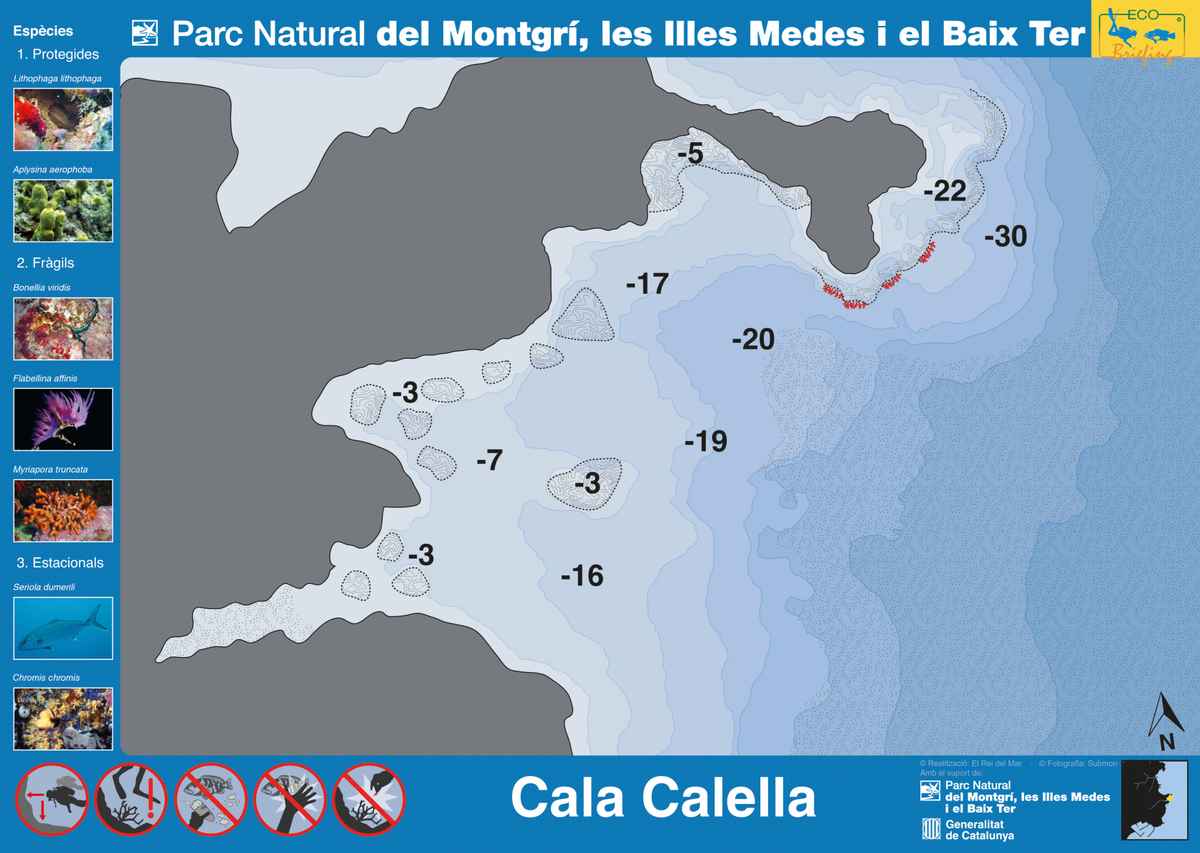
Illustration: Parc Natural del Montgrí, les Illes Medes i el Baix Ter — Generalitat de Catalunya
What makes it special
Two things place this site on a coast-day list. It is on the Generalitat's official 16-itinerary catalogue, with a per-site ecobriefing reissued in April 2024, and its 6-30 m range plus all-levels rating make it one of the few coast cove dives that legitimately serves a try-dive group, an Open Water profile, and a deeper Advanced run on the same boat. The pull is benthic: schooling fish on the wall, anthias in shadow, and the macro detail in the rock - not the dense reserve concentrations a kilometre offshore.
Know before you go
Carry a torch. Most of the visible life sits in shaded crevices and small caves on the wall, and the site reads as bare rock without a light. Punta Salines is exposed; tramuntana N/NNE is the coast's main cancel driver, and force 4 or above is a hard pause without solid coast experience. The coralligenous wall is slow-growing - the park calls it fragile - so trim and buoyancy matter here: stay off the structure, hover, don't settle. Cave-recess discipline applies: small groups, no penetration past natural light, no recreational dives beyond 30 m inside any cave.
Why Dive Cala Calella
What makes this dive site stand out.
- Coralligenous wall sections
Vertical rock with slow-growing coralligenous; gencat names schooling damselfish, three-tails, and scorpionfish
- 6 to 30 m profile
Shallows from 6 m, sandy seabed at 30 m. Most life sits in the 6-15 m band
- Park itinerary, no permit
One of 16 official ecobriefed coast itineraries; Natural Park rules apply, Medes permit and tax do not
- Coast-day fallback
L'Estartit operators run it on coast rotation when wind or programme rules out the islands
Depth & Profile
Location
42.0603°N, 3.2136°E
Conditions & difficulty
May-October for water temperature and visibility. Spring and autumn preferred by local divers for lower crowds.
Coast-day rates apply. No Medes park tax or permit fee. Verify current prices with your L'Estartit centre.
Open Water divers run the shallow profile comfortably. Advanced Open Water suits the full 6-30 m descent on a wall-toe run.
Summary
Easy in the shallows, moderate on the full wall when current builds. A torch matters; benthic life sits in shaded crevices.
Safety considerations
What can go wrong here, and what divers do about it. Conditions change - take the briefing from the operator on the day.
- Current: Moderate current is typical, with tramuntana days carrying more onto the headland.Check forecast and surface conditions before entry; pause dives at force 4 or above without solid coast experience.
- Site rules: Coralligenous wall is slow-growing and the park calls it fragile.Stay off the structure. Trim and buoyancy matter here; hover, don't settle.
Rules and permits
Dive centres in Catalonia must require insurance from every diver on their dives, and must be able to offer a policy to anyone who has none.
Frequently Asked Questions
Do I need a permit to dive Cala Calella?▾
No. Cala Calella sits inside the Natural Park but outside the Illes Medes marine reserve. Coast dives need no diver permit, no quota, and no €5.30 reserve tax. Spanish dive insurance is compulsory; centres handle the rest.
Is Cala Calella good for beginners?▾
The 6-15 m shallows are well suited to Open Water divers, and gencat officially rates the site as adapting to all levels. The full 6-30 m profile leans on Advanced Open Water when current builds along the wall.
What will I see at Cala Calella?▾
The gencat description names damselfish schools, three-tails (Anthias), scorpionfish, and the occasional grouper. Moray eels in the crevices and benthic life on coralligenous walls round out the dive. Carry a torch; much of it sits in shadow.
How does Cala Calella compare to the Illes Medes?▾
Same bioregion, much lower density. The Medes reserve has decades of strict protection and habituated grouper concentrations; coast walls don't carry that effect in equal measure. The trade-off is no permit, no quota, and coast-day rates.
When is the best time to dive Cala Calella?▾
May to October for water temperature and visibility. Spring and autumn run quieter; local divers often prefer them. Winter is diveable for experienced divers in a 7 mm wetsuit or drysuit; tramuntana wind is the main cancel driver.
Do I need a torch at Cala Calella?▾
Yes. The shallows hold the bulk of the marine life, but most of it - scorpionfish, morays, the small caves - sits in shaded crevices. Without a light, much of the site reads as bare rock.
Photos
Every dive has a story. Share yours.
Log your dives - notes, photos, conditions and the marine life you saw - and share them as one public diver profile. What you share helps the next diver, too.
Log every detail
Depth, duration, conditions, gear, buddy, notes — all in one place. Import from Suunto and other dive computers.
Track marine life
Record species sightings on each dive. Build a personal catalogue of everything you've seen underwater.
Your public dive profile
Share your dive history, stats, and experiences with a profile page you control. Show the world where you've been.