
Cala Pedrosa
Also known as: La Pedrosa, Pedrosa Cove
Secluded pebble cove between Tamariu and Llafranc, foot-access only via GR92. Shallow granite reef to 10m, best for snorkeling. Exceptional water clarity.
Last updated April 2026
The dive
The name means "Rocky Cove" and the cove earns it. No sand at all: rounded pebbles, exposed granite boulders, and then water that visitors describe as among the clearest on this stretch of coast. Water shoes go on before you step onto the rocks, not after. Sea urchins cover the granite surfaces near shore in numbers that make entry without protection a bad idea. Past that zone, the reef opens onto crevices and small overhangs running to about 10m at the outer edge. The natural light at these depths is strong enough for photography without a torch. Octopus and morays work the rock. Sea bream pass in loose schools. At 3-8m with negligible current, a single tank stretches past an hour without effort.
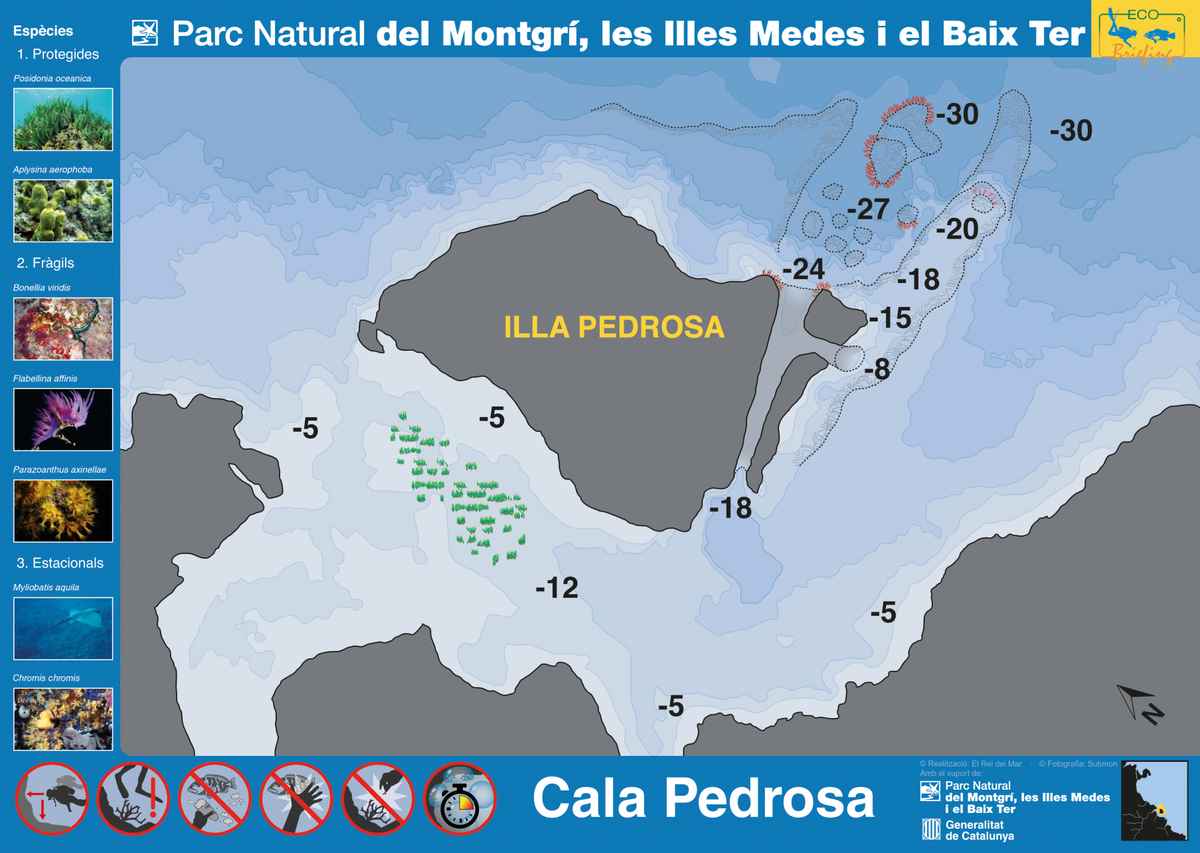
Illustration: Parc Natural del Montgrí, les Illes Medes i el Baix Ter — Generalitat de Catalunya
What makes it special
Cala Pedrosa is not a dive destination in the way Cap de Begur or Furió Fitó are. No center runs trips here. There is no mooring line. What the cove offers instead is isolation and clarity. You reach it after 15 minutes on the Cami de Ronda from Tamariu, and outside peak season you often have it to yourself. For snorkelers, that combination is hard to beat on the Costa Brava. For divers, the honest comparison is less flattering: Aiguafreda has chimneys and a denser invertebrate community, and Canons de Tamariu has gorgonian-lined canyons at depth. The call to make is whether the isolation and the water quality justify a site where the marine life is good but unremarkable. In summer, leisure boats anchor here and temporarily cloud the water near the cove entrance. May-June and September are when it is at its best.
Know before you go
The seasonal beach bar at the cove accepts cash only; cards are not always available. Parking near Tamariu fills quickly on summer mornings, with paid lots available in the village. The path from Tamariu has an uneven boulder section at the final descent, and one visitor flagged rockfall on the stairs after rain. In easterly or southerly conditions, waves reach inside the cove and make shore entry awkward. Check the forecast before making the walk. The name "Cala Pedrosa" is frequently confused in search results and forums with La Pedrosa near L'Estartit, which is an advanced cave dive roughly 30km north.
Why Dive Cala Pedrosa
What makes this dive site stand out.
- Exceptional water clarity
Visitors describe it as among the clearest water on this stretch of coast.
- Snorkel-first character
No dive center operates here. Honest assessment: snorkelers rate it higher than divers.
- Sea urchin entry hazard
Urchins cover the rocky entry zone. Water shoes are mandatory, not optional.
- Foot-access only
10-15 minute walk from Tamariu on the GR92 coastal path. No road access.
- Shallow granite reef
Boulders and crevices to 10m shelter octopus, morays, and reef fish.
Depth & Profile
Location
41.9056°N, 3.2098°E
Conditions & difficulty
May-June and September offer the best combination of warmth and calm before peak-season boat traffic builds
No dive center operates here. Self-organised access only.
No certification required for snorkeling. OW sufficient for scuba at this site.
Summary
Shallow and generally calm inside the cove. Rocky shore entry with dense urchins requires water shoes.
Safety considerations
What can go wrong here, and what divers do about it. Conditions change - take the briefing from the operator on the day.
- Marine life: Sea urchins dense on rocky entry surfacesWater shoes mandatory for entry and exit
- Surface and boat traffic: Cove open to E-S winds. Can become choppy, complicating entry and exit.Check forecast before visiting. Avoid in easterly conditions.
- Orientation: Shoal Sa Galera at east entrance covered by 0.9m of waterApproach by boat from SW only
- Access and entry: Rocky path descent with reported rockfall risk on stairsWear sturdy footwear. Extra caution after rain.
Regulations
Outside the Reserva Marina de Ses Negres. No permit required for diving or snorkeling.
Frequently Asked Questions
Is Cala Pedrosa better for snorkeling or diving?▾
Snorkeling. The maximum depth is about 10m and no dive center organises trips here. Visitors who snorkel consistently rate it higher than divers do. One reviewer put it plainly: the fauna is not the best, but the water is even clearer than other coves. Divers with their own kit can do a long, relaxed 60-minute dive over granite boulders, but nearby Aiguafreda and Canons de Tamariu offer richer underwater life for committed scuba divers.
How do you reach Cala Pedrosa?▾
Walk the GR92 Cami de Ronda coastal path from Tamariu. The walk takes 10-15 minutes, but the final descent is rocky and steep. Bring sturdy footwear and pack light. Full scuba equipment is awkward on this approach. Some visitors arrive by kayak from Tamariu as an easier alternative to the footpath.
Are there sea urchins at Cala Pedrosa?▾
Yes, in significant numbers. Sea urchins are the most consistently reported hazard at this site. They cover the rocky entry surfaces and visitors without water shoes risk punctures before reaching swimming depth. Multiple accounts specifically flag this. Bring water shoes and treat it as mandatory, not optional.
Can you anchor a boat at Cala Pedrosa?▾
Yes, in calm weather. Anchor in 5-10m depth inside the cove. Approach from the SW. The shoal Sa Galera at the east entrance has only 0.9m of water cover. The cove is open to E and S winds and becomes rough in easterly conditions.
What marine life can you see at Cala Pedrosa?▾
The rocky reef shelters octopus, moray eels, and sea bream in schools. Scorpionfish, wrasse, combers, and blennies are typical of the Costa Brava granite coast. Visitor accounts are honest that the marine life is less diverse than at protected areas like Ses Negres or the Illes Medes, though the water clarity is a genuine asset for observation.
Is Cala Pedrosa the same as La Pedrosa near the Illes Medes?▾
No. La Pedrosa (Illa Pedrosa) near L'Estartit is a completely separate site with a 70m tunnel and advanced wall diving. Cala Pedrosa near Tamariu is a shallow snorkeling cove. The two are roughly 30km apart. Search results and forum posts frequently confuse them.
Is Cala Pedrosa inside a marine reserve?▾
No. The Reserva Marina de Ses Negres lies further north, between Cap Negre and Pa de Pessic. Cala Pedrosa falls outside its boundary. No permit is required for diving or snorkeling here.
Photos
Every dive has a story. Share yours.
Log your dives - notes, photos, conditions and the marine life you saw - and share them as one public diver profile. What you share helps the next diver, too.
Log every detail
Depth, duration, conditions, gear, buddy, notes — all in one place. Import from Suunto and other dive computers.
Track marine life
Record species sightings on each dive. Build a personal catalogue of everything you've seen underwater.
Your public dive profile
Share your dive history, stats, and experiences with a profile page you control. Show the world where you've been.