

Costa Brava Divers
PADI 5 Star centre on L'Estartit seafront with stay-and-dive packages, four daily boat dives between Illes Medes and Montgrí, plus tec diving.
PADI6 services5 languages
Also known as: Coves de Cala Viuda
Shallow cave complex on the Montgrí coast with 200 m of interconnected passages, three air chambers, and multiple route options.
Last updated April 2026
The boat anchors in a sheltered cove between limestone cliffs. Below, a series of openings in the rock lead into what the Generalitat de Catalunya describes as one of the finest submarine cave complexes on the Catalan coast. The system runs to 200 m of interconnected passages, with three chambers where you can surface and breathe.
Most guided dives pick a route through two or three chambers. The first entrance leads into a wide cavern with natural light filtering through the opening behind you. From there, narrower passages branch off, some leading to air chambers with low rock ceilings, others descending briefly before opening into the next section. Sponges coat the walls in patches of orange and yellow. Conger eels watch from crevices in the rock.
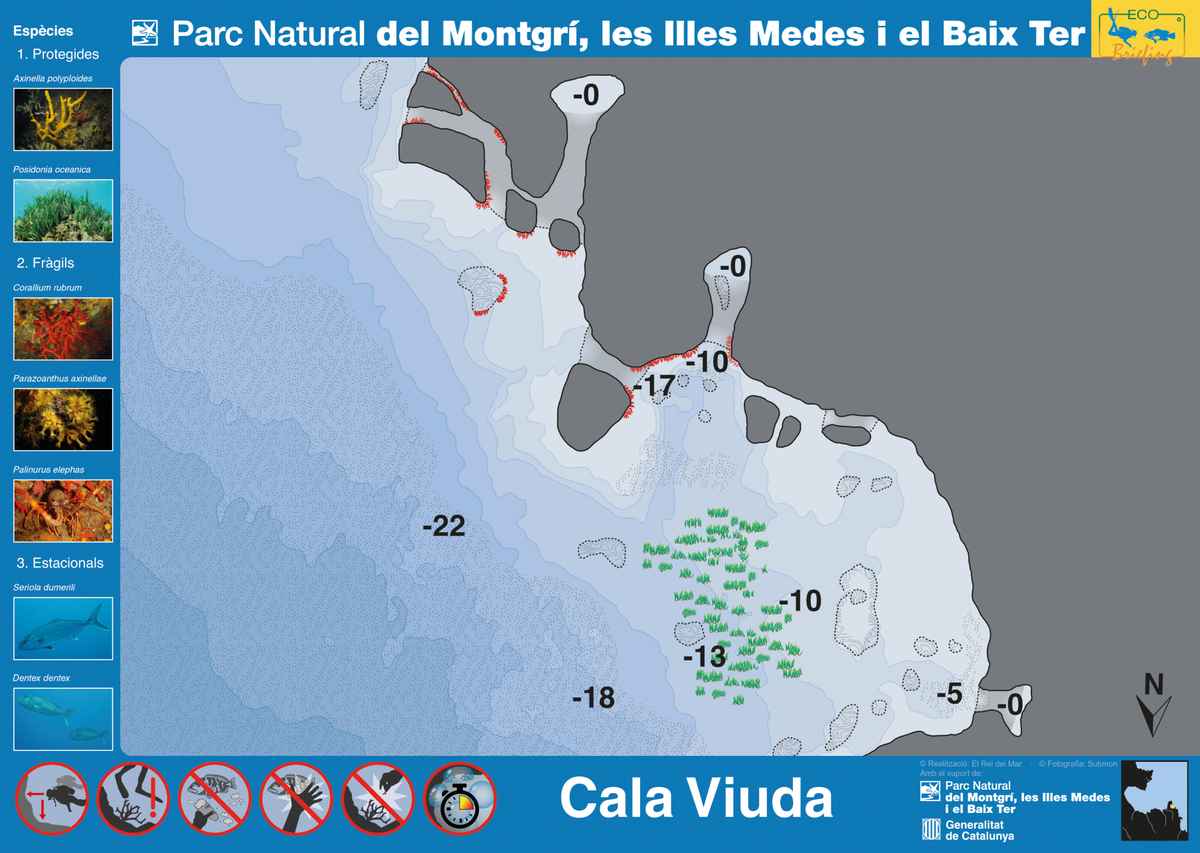
Illustration: Parc Natural del Montgrí, les Illes Medes i el Baix Ter — Generalitat de Catalunya
The sheer extent of the system sets Cala Viuda apart. The Medes caves are spectacular tunnels, but each is essentially a single swim-through. Here the routes branch and reconnect. Three separate air chambers give natural rest points where you surface inside the rock. The depth stays shallow, mostly between 3 and 8 m, which keeps bottom time generous and decompression out of the equation.
A guide is essential. The park authorities recommend one for anyone wanting to explore the full complex, and the multiple route options make it easy to lose orientation without local knowledge. The park's responsible diving guidelines apply here: enter caves in small groups, minimise time inside to protect ceiling organisms from air bubbles, and avoid stirring sediment with careless fin kicks. The cave entry points are on the outer coast, so a boat is the only practical access.
What makes this dive site stand out.
Multiple interconnected passages with three air chambers
Shallow depths and natural light make it ideal for divers starting cave diving
Numerous route options through the complex require local knowledge
42.1039°N, 3.1822°E
Calm sea conditions for comfortable cave entries. Diveable year-round in settled weather.
Coast dive rates apply (no Medes park permit needed).
Open Water divers can explore the outer cavern areas with natural light. Full cave passages require cavern or cave diving certification.
Summary
Shallow and sheltered, but navigation through the cave complex demands awareness. Not a beginner dive without guide supervision.
Safety considerations
What can go wrong here, and what divers do about it. Conditions change - take the briefing from the operator on the day.
Book a guided dive at this site.
PADI 5 Star centre on L'Estartit seafront with stay-and-dive packages, four daily boat dives between Illes Medes and Montgrí, plus tec diving.
Get in touch to add or claim your dive center listing on DiveCodex.
Dive centres in Catalonia must require insurance from every diver on their dives, and must be able to offer a policy to anyone who has none.
For the outer cavern areas with natural light, Open Water certification is enough with a guide. The deeper passages where light fades require cavern or cave specialty training. The park prohibits recreational diving in caves beyond natural light or past 30 m.
A single dive cannot cover all 200 m of passages. Most guided dives focus on one section, spending 40-50 minutes exploring two or three connected chambers. Return visits reveal different routes through the complex.
The air chambers create dramatic light effects where the surface meets rock ceilings. Wide-angle lenses work best for the cave interiors. Buoyancy control is critical to avoid stirring silt that ruins visibility and images.
Scale. La Vaca and the Dofi tunnels on the Medes are single passages you swim through. Cala Viuda is a branching network with multiple routes and three separate air chambers. The Medes caves are deeper and have more red coral; Cala Viuda is shallower and more extensive.
The cove is sheltered from the tramuntana (north wind), so it often stays diveable when exposed sites are blown out. Easterly swells can make the boat approach and entry uncomfortable. Your centre will assess conditions on the day.
Log your dives - notes, photos, conditions and the marine life you saw - and share them as one public diver profile. What you share helps the next diver, too.
Log every detail
Depth, duration, conditions, gear, buddy, notes — all in one place. Import from Suunto and other dive computers.
Track marine life
Record species sightings on each dive. Build a personal catalogue of everything you've seen underwater.
Your public dive profile
Share your dive history, stats, and experiences with a profile page you control. Show the world where you've been.