

Rubicon Diving
SSI Diamond ITC in Playa Blanca with 4 boats across two sectors, daily Museo Atlantico excursions, tech diving to 100m+, and Lanzarote's only Mermaid School.
SSI4 languages
Also known as: Riesengarnelen-Höhle, Shrimp Cave
Deep cavern on the Playa Chica wall in Puerto del Carmen sheltering narwhal-shrimp swarms that dusky groupers hunt under torchlight at 40m.
Last updated May 2026
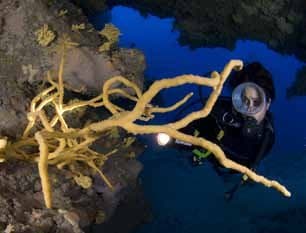
You walk in from Playa Chica beach and drop down a volcanic wall toward sand. Garden eels work the slope as you descend; on the wall itself the usual reef cast lines up — Atlantic damselfish, anthias, a yellow gorgonian here and there fixed to the basalt. The depth keeps building. At forty metres a recess opens in the wall on your left, the chamber the dive is named for. The protocol the centres still teach goes back a long way and is always the same: torches off into the cavern, eyes settle on the dim space, and on the guide's cue the lights come on against the back of the recess. The narwhal shrimp resolve out of the dark, dense in the better years, scattered in the leaner ones. The dusky groupers staged outside the entrance read the beams and move in to hunt; the sequence is the dive's reason for being. One or two well-managed minutes inside is the visit by design — bottom time at this depth costs deco time on the wall return. Divers equipped for it can edge below forty on the deep extension to see black-coral colonies; everyone else turns and works the wall back, picking up the shallow reef cast on the ascent before the swim home.
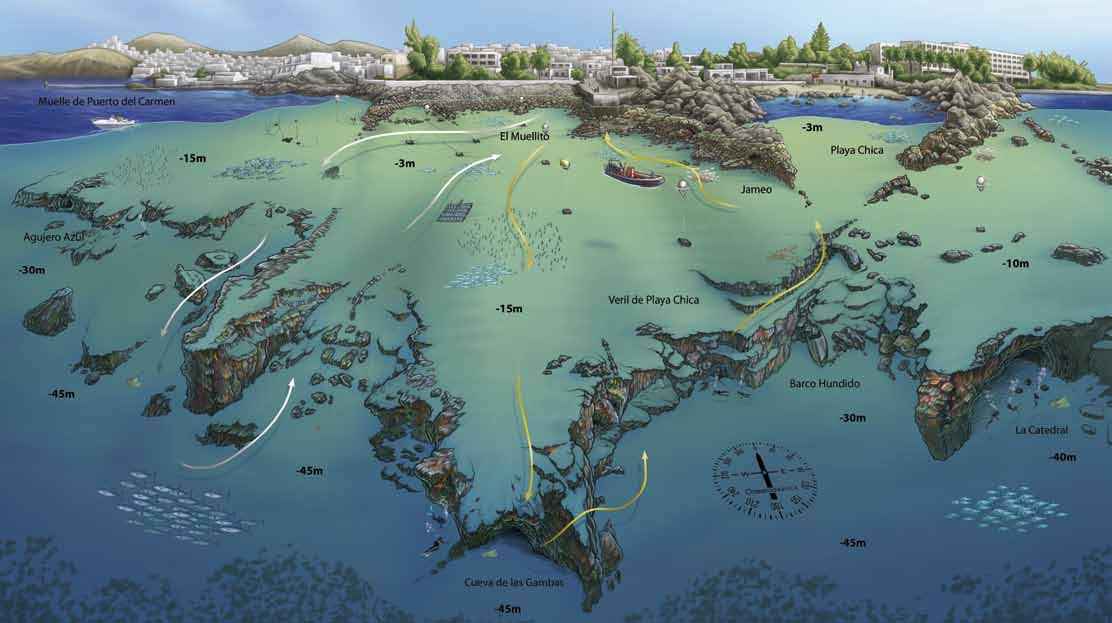
Illustration: Oceanografica / Reserva de la Biosfera de Lanzarote (2011)
Among the routes that launch from the Playa Chica entry, Cueva de las Gambas is the only one that combines a defined cavern overhead with a documented predator-prey interaction at the recreational deep ceiling. Cathedral, further along the same wall, is the larger and shallower sponge-vaulted cavern; the veril sites are vertical reef. The shrimp recess is a different proposition — a deliberate, narrow visit to a small chamber where lighting the shrimp brings the groupers in, and where the choice to be there at forty metres in an overhead is part of the planning. The site is one of the named cavern dives along the Puerto del Carmen wall, with the dark-ambush grouper behaviour at the recess part of its long-standing local lore. Spanish-language community discussion across more than a decade has watched the shrimp population thin and rebound, and the dive's reputation has softened with it; that range, more than any single account, is the signal a visiting diver should plan around.
Depth and gas are the binding constraints. Bottom time inside the cavern is a deliberate one or two minutes; total dive time falls in the 35-45 minute range counting wall ascent and stops. EAN32 does not reach the cavern depth, so the standard plan is air or a leaner mix decided at the briefing. A primary torch is essential, with a backup; the protocol asks for torches off into the recess and a steady, focused beam against the shrimp at the back. Buoyancy and finning matter — the chamber silts up in seconds with poor finning, and the groupers spook with bouncing lights from multiple divers. Standard safety kit applies: dive computer with deco capability, SMB for the wall ascent, compass for orientation against the wall, plenty of redundancy on light. In winter the water is around eighteen degrees and a 7mm with hood and gloves is the practical minimum; summer dives run on a 5mm. Open Water divers can be guided to shallower routes from the same entry, but the cavern itself sits beyond their depth limit.
What makes this dive site stand out.
Plesionika narval cluster in the back of a dim chamber at the foot of the Playa Chica wall.
Dusky groupers stage outside and rush in to feed when torches expose the shrimp.
Descent along the volcanic wall from Playa Chica beach; bottom time at the cavern is short.
Defined overhead chamber with light from the entrance, not a true penetration cave.
Antipathella wollastoni colonies below 40m for those certified to follow the wall further.
28.9173°N, 13.6705°W
Diveable any month. Summer favours surface comfort; winter favours visibility but raises the suit-thickness cost.
AOW with deep training is the working floor; centres run the cavern itself as a managed deep dive with brief bottom time. Open Water divers stay above on the wall and do not reach the chamber.
Summary
Working depth at the recreational ceiling combined with an overhead recess. Local Lanzarote voices have argued for a deep-and-cavern-experience floor stricter than centre marketing implies.
Safety considerations
What can go wrong here, and what divers do about it. Conditions change - take the briefing from the operator on the day.
Book a guided dive at this site.
SSI Diamond ITC in Playa Blanca with 4 boats across two sectors, daily Museo Atlantico excursions, tech diving to 100m+, and Lanzarote's only Mermaid School.

PADI 5-Star IDC in Puerto del Carmen, the only Halcyon dealer in the Canary Islands, with 5.0/5 across 386 reviews and Playa Chica shore-diving access.
Get in touch to add or claim your dive center listing on DiveCodex.
Free shore access. The Playa Chica caves cluster sits within a Natura 2000 Special Conservation Site (habitat-level designation) but no diving permit, fee, or quota applies. The only formal Lanzarote marine reserve is the Chinijo Archipelago in the north.
It is a cavern. The chamber is set into the foot of the Playa Chica wall and keeps a daylight reference from the entrance. There is no line, no full overhead penetration, and recreational divers stay in the daylit zone with a torch on hand. It is the depth and the gas plan, not the overhead, that drive the difficulty rating.
Advanced Open Water with deep training is the working floor that centres apply, and many will ask about recent depth experience and overhead-environment comfort before taking a diver to the cavern. Local voices in Lanzarote have argued for a stricter combination of deep and cavern experience than the marketing language alone suggests.
Probably, but not guaranteed. Dense swarms of narwhal shrimp inside the cavern are the canonical reason to dive here, but community reports through 2025 note wide year-to-year variation, sometimes down to a handful of individuals in a single hard-to-see hole. Treat the spectacle as the goal, not the contract.
The group enters the cavern with torches off, lets eyes adjust to the dim recess, and on cue lights up the shrimp at the back of the chamber. The dusky groupers waiting outside the entrance read the light as a feeding cue and move in. A steady, focused beam works better than a sweeping one; multiple bouncing lights spook the groupers and silt the floor.
No. The site is not inside a formal marine reserve. The Playa Chica caves cluster does fall under a Natura 2000 Special Conservation Site, but that is a habitat-protection designation and does not impose dive permits, fees, or diver quotas. Lanzarote's only marine reserve is the Chinijo Archipelago in the north of the island.
Spanish-speaking divers have flagged a long-running concern that traffic and torch attraction have thinned the shrimp population since the early 2010s, with the issue still discussed in 2025. The site remains accessible, but ethical practice matters: keep torches steady, do not harass the groupers, stay off the chamber walls and floor, and accept that the spectacle may be quiet on a given day.
Log your dives - notes, photos, conditions and the marine life you saw - and share them as one public diver profile. What you share helps the next diver, too.
Log every detail
Depth, duration, conditions, gear, buddy, notes — all in one place. Import from Suunto and other dive computers.
Track marine life
Record species sightings on each dive. Build a personal catalogue of everything you've seen underwater.
Your public dive profile
Share your dive history, stats, and experiences with a profile page you control. Show the world where you've been.