



Dive College Lanzarote
Family-run PADI 5-Star IDC in Playa Blanca with beachside pool, house reef, 12 rotating dive sites, and a formal partnership with Safari Diving.
PADI6 languages
Volcanic Atlantic island: lava caves and walls, a shore-dive bay with routes for days, angel sharks on the sand and an underwater sculpture park.
Last updated October 2026
Playa Chica, a sheltered bay at Puerto del Carmen, gives at least six good dives from a single shore entry, and most clubs run the same ones. Divers here work through a familiar set of routes in mild, clear water, and the variety comes from the terrain. The 1730 to 1736 Timanfaya eruptions and older volcanic phases left lava reefs, caves, arches, swim-throughs and walls, and submarine cliffs close to the coast fall below 200 m.
On the Playa Chica routes the Cathedral cave holds a dusky grouper local divers call Felix, and Cueva de las Gambas fills with narwal shrimp. Divers report angel sharks on the sand there and at Mala, where black lava meets white sand and the shore entry sits inside a naturist resort. At Playa Blanca the Museo Atlántico, a sculpture installation opened in 2016 and billed as Europe's first underwater museum, lies at 12 to 15 m on sand.
The Chinijo archipelago off the north coast, around La Graciosa, is the island's marine reserve. It was declared in 1995 for its fisheries interest and covers 707 km2, one of the largest in Europe. At La Burrera the algal forest survives where urchin grazing has stripped it across much of the archipelago.
Lanzarote's marine Natura 2000 space totals 86 km2, and the Playa Chica cliff caves fall within a Special Conservation Zone in that network.
Most centres work from Puerto del Carmen, with smaller bases at Playa Blanca and Costa Teguise and Orzola as the jump-off for the Chinijo. The airport is a short drive from every base.
Most shore and shallow boat sites suit Open Water divers. The deeper cave routes, Pechiguera and the exposed northern sites call for Advanced Open Water or more. Technical diving, trimix included, is reportedly available at a small number of centres.
Visibility averages around 20 m and reaches 40 m. If you want the weather-dependent north-east and Chinijo, keep spare days and treat them as a bonus. Hyperbaric chambers were listed at the Hospital Insular and the Instituto Náutico Pesquero, both in Arrecife, in 2011; ask your centre whether they are current.
Lava reefs, caves, arches and walls built by the 1730 to 1736 Timanfaya eruptions and older volcanic phases, with sandy plateaus between and cliffs that fall below 200 m close to shore.
The diving here splits into 4 zones:
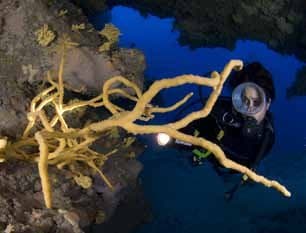
AOW-plus divers wanting a short, deliberate deep-cavern visit on the Playa Chica shore-entry circuit
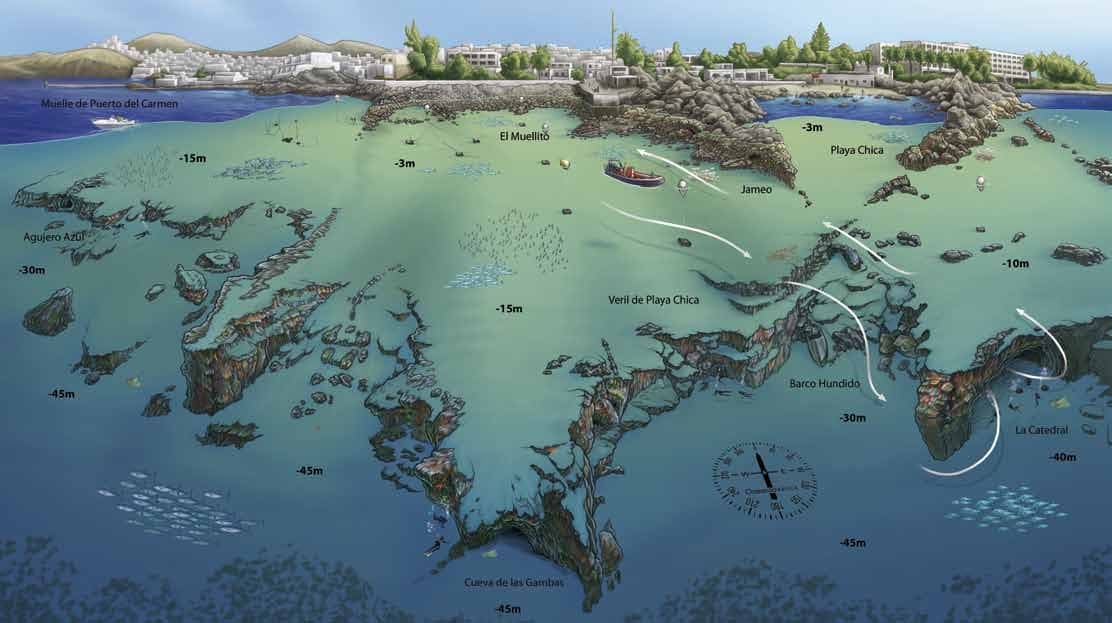
First dives and night dives in a calm Puerto del Carmen shore bay
Lanzarote's steepest near-shore wall, with tec depth from the beach
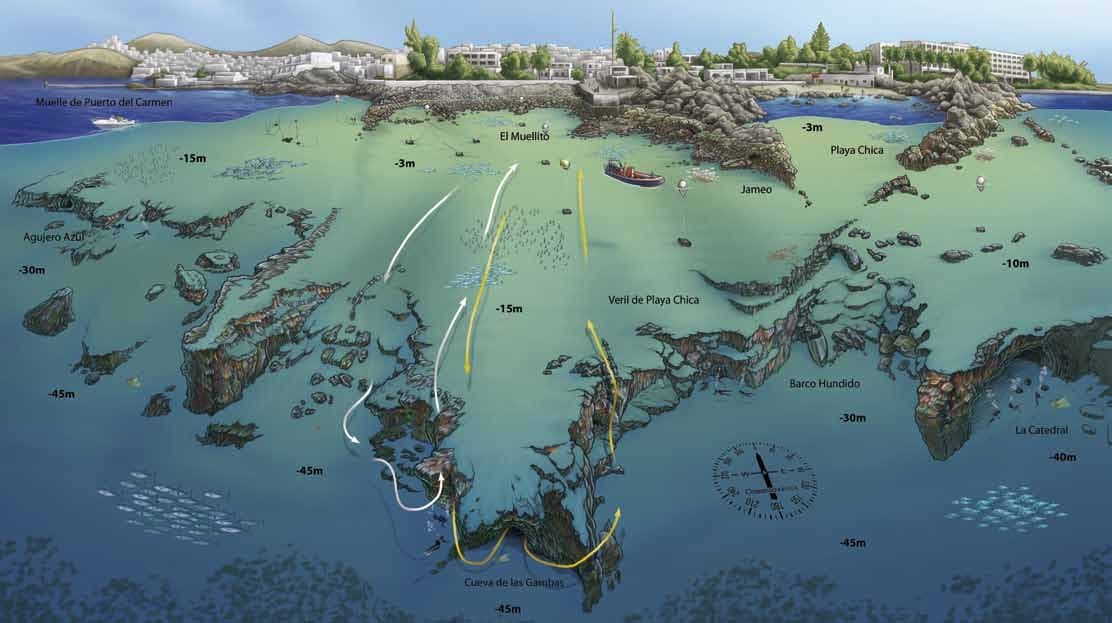
AOW divers wanting a single-shore-entry dive that combines a sand-flat approach, a short overhead swim-through, and a deeper cliff-face exploration
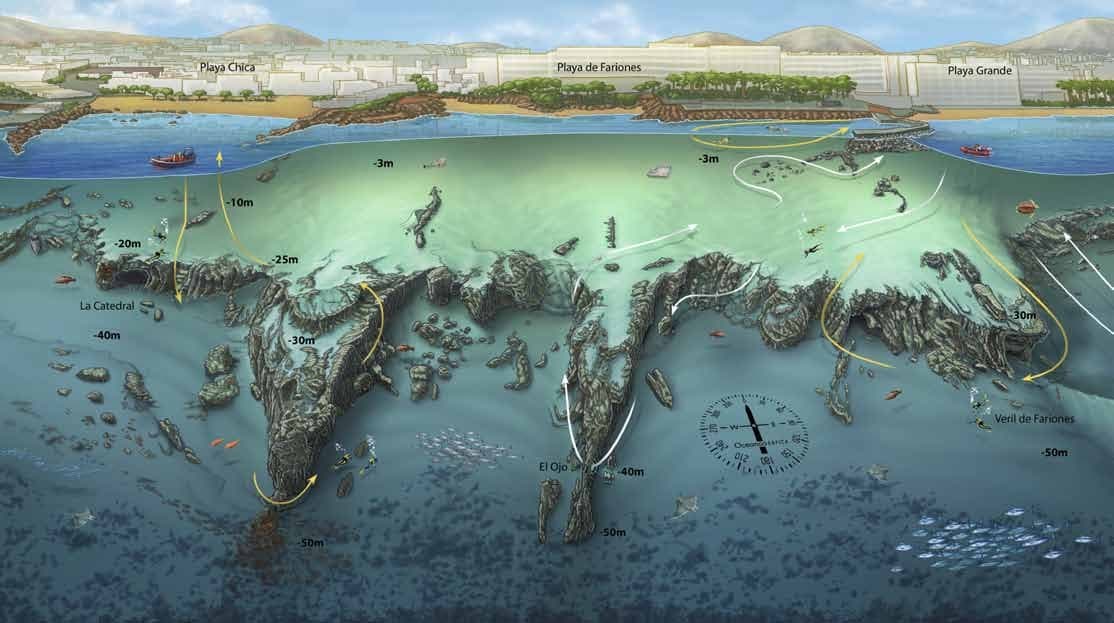
Lanzarote's deep-cavern shore dive, with its own trapped-air bubble garden
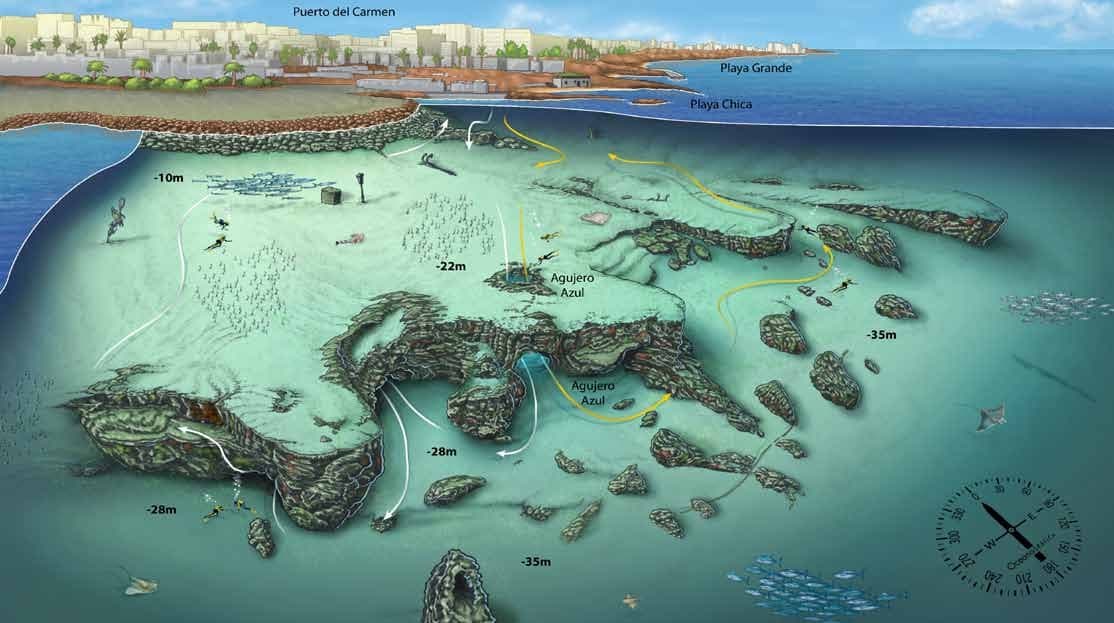
Divers wanting multiple wreck hulls on one boat dive, with a depth ladder from OW to deep recreational
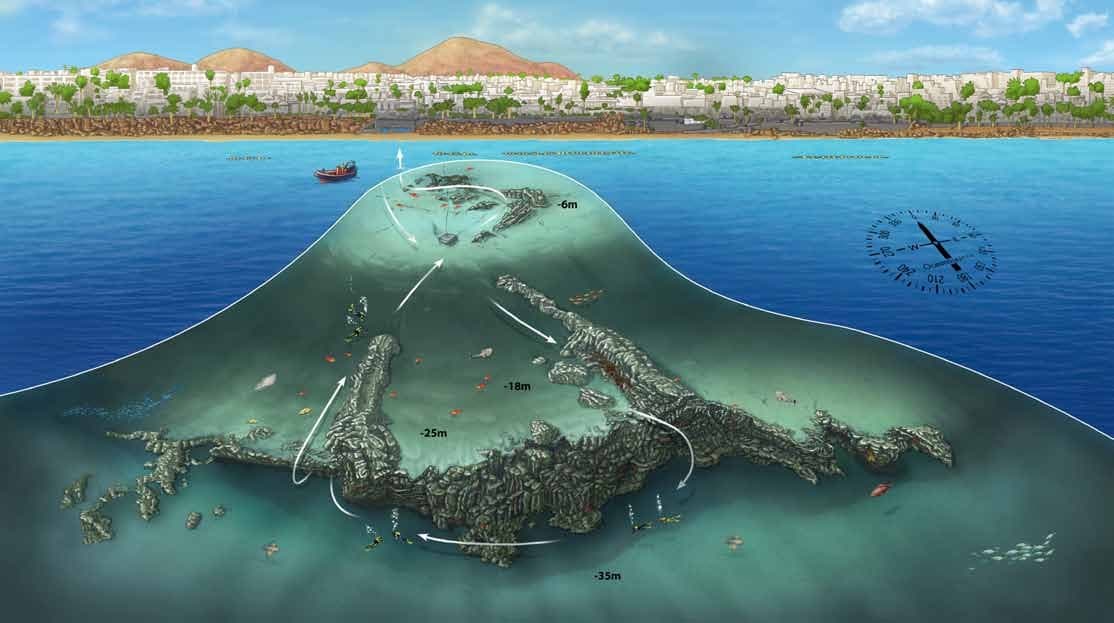
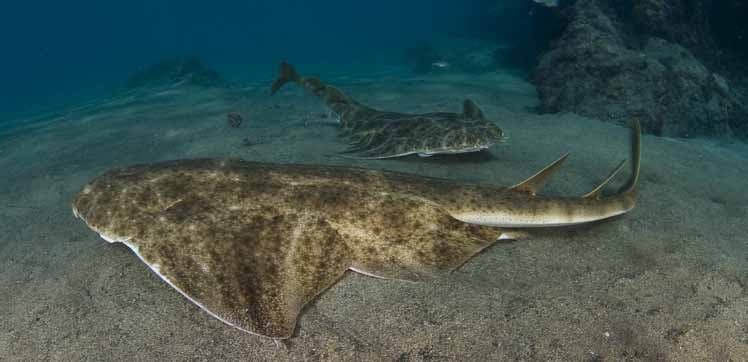
AOW divers wanting a deeper Puerto del Carmen landscape dive with orange coral, narwhal-shrimp and angel sharks
Book online or contact a centre that dives this area.
Family-run PADI 5-Star IDC in Playa Blanca with beachside pool, house reef, 12 rotating dive sites, and a formal partnership with Safari Diving.
PADI 5-Star CDC in Playa Blanca with 5.0 rating across thousands of reviews, daily shore and boat dives at 30+ sites, and full IDC training pathway.

SSI Diamond, PADI 5-Star, and BSAC centre 100 m from Playa Chica with free Nitrox 30%, free boat dives, and a custom trimaran hard boat.

SSI Diamond ITC in Playa Blanca with boats across two sectors, daily Museo Atlantico excursions, technical diving from 40m, and an SSI Mermaid School.

PADI 5-Star Dive Resort on Playa Chica, Puerto del Carmen, MOD ComMac-approved with 40+ years of local history.

PADI 5-Star IDC in Puerto del Carmen, the only Halcyon dealer in the Canary Islands, with 5.0/5 across 386 reviews and Playa Chica shore-diving access.
Get in touch to add or claim your dive center listing on DiveCodex.
Official winter averages sit at 18 C, but divers measured 15-16 C in February 2016, so pack for the lower figure. The sheltered south and east coasts dive almost daily; the trade winds shut the north-east and the Chinijo on many winter days.
What can go wrong here, and what divers do about it. Conditions change - take the briefing from the operator on the day.
Official decree on dive centresDive-centre authorisation procedureCompiled decree PDF with annexesChecked: Oct 2026
National rules also apply: Rules and permits in Spain
On biodiversity, possibly: visitors used to the Red Sea or Southeast Asia find fewer fish here. The draw is volume and ease: caves, arches and walls from a beach, mild water most of the year and enough routes to fill a week.
Plan for a thick suit with hood and gloves from winter into spring. Official winter averages sit around 18 C, but divers measured 15 to 16 C in Lanzarote and La Graciosa in February 2016, and that gap decides between a mid-weight suit and a thicker one. Many local guides wear drysuits, and wind at the surface chills divers between dives even when the water is mild. Summer is comfortable in a lighter suit.
Playa Chica is the usual self-guided choice. Centres hire out tanks and weights to certified divers, the entries are straightforward and the wall stays in view. A rental car makes the other shore sites and the Orzola jetty easier to reach.
The sheltered bay and its sandy shallows suit Open Water, and octopus and seahorses turn up there. The wall beside it drops well past Open Water depth, so the full routes do not stay within that limit. Agree a turn depth with your buddy and let the guide set the route.
Divers disagree. First-time visitors often find the sculptures about the refugee crisis moving and recommend one dive, while repeat divers call it a single-visit curiosity. The installation lies at 12 to 15 m on sand at Playa Blanca and is dived through authorised centres, usually at a higher price than a standard guided dive.
Puerto del Carmen suits the shore rotation and has most of the centres. Playa Blanca is shallower and calmer, with the sculpture installation close by, and Puerto del Carmen centres run day trips there, so either base reaches both. Divers who want a quiet family stay alongside the diving tend to pick Playa Blanca.
The south and south-east, around Puerto del Carmen and Playa Blanca, are sheltered and dive almost every day. Mala and the north-east shut when the wind builds, and the Chinijo trips depend on a calm sea, so book those for early in your stay and keep spare days.
When weather allows. Boats go from Orzola or La Graciosa, and Lanzarote centres usually run a La Graciosa day in good conditions. Buceo La Graciosa was reported still operating in late 2023, though its current schedule is worth confirming. La Burrera is the reason to try: the algal forest there has survived the urchin grazing that stripped it elsewhere in the archipelago.
Log your dives - notes, photos, conditions and the marine life you saw - and share them as one public diver profile. What you share helps the next diver, too.
Log every detail
Depth, duration, conditions, gear, buddy, notes — all in one place. Import from Suunto and other dive computers.
Track marine life
Record species sightings on each dive. Build a personal catalogue of everything you've seen underwater.
Your public dive profile
Share your dive history, stats, and experiences with a profile page you control. Show the world where you've been.