
Dunraven

1876 British steamship lying upside down at Beacon Rock, with cathedral-like hull penetration and coral-encrusted interior at 15-29m.

Last updated April 2026

The dive

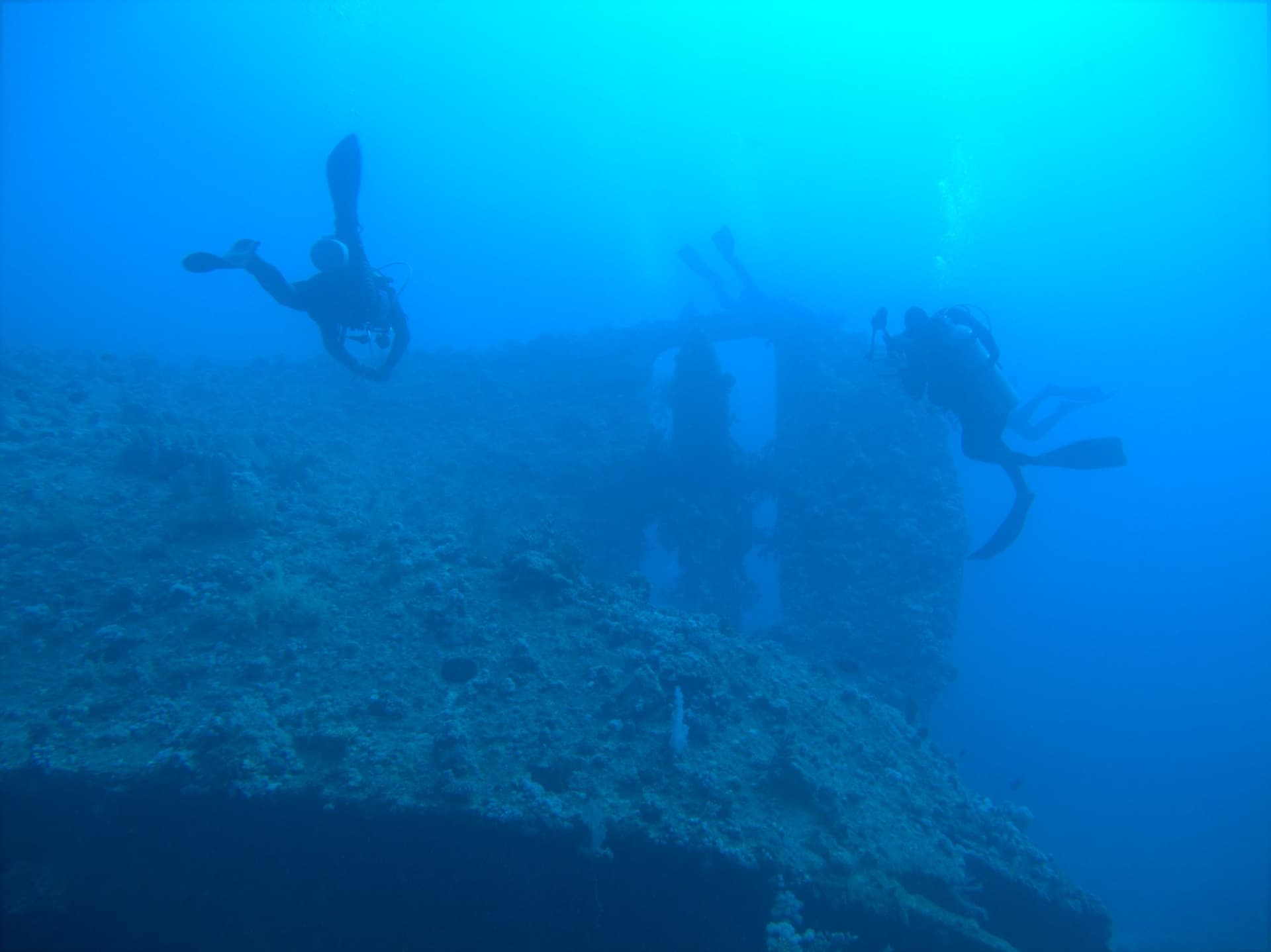
Bow first, at around 15 metres. The forward section is intact enough to peer into from multiple angles, though there is no penetration here. Follow the hull south toward deeper water. The wreck's upside-down geometry becomes apparent as you fin along the coral-encrusted keel, now the topmost feature of the wreck.

At 28 metres, the stern section opens up. Enter through one of three large gaps in the hull. Inside, the space inverts your expectations. What was the ceiling is now the floor. Enormous boilers loom overhead, and an emergency stop valve, a broken mast, and a ladder to the engine room mark the route through. Hessian ropes and wooden cargo boxes have survived since 1876. Light pours through the portholes in wide beams.

The exit is the payoff. Where the hull broke in half, thousands of glassfish hang in a shimmering curtain. Fin through them and out onto the surrounding reef, where the safety stop at 5-9 metres doubles as a second dive on Beacon Rock's own coral wall.

What makes it special

The Dunraven is the wreck that put Sharm El Sheikh on the diving map. Howard Rosenstein found it in 1977 following a Bedouin fisherman's directions involving three cigarettes and the setting sun. A BBC documentary two years later gave it international fame. Before that, Rosenstein and graphic artist Shlomo Cohen had invented a story about Lawrence of Arabia transporting gold on a lost ship to lure divers to an unknown Sinai coast. The real wreck turned out to be 60 years older than their fiction.

No other Red Sea wreck offers this combination. The Thistlegorm is a military museum. Shark and Yolanda is a current-driven adrenaline ride. The Dunraven is neither. It is atmospheric and slow, a place where 150 years of coral growth have turned a Victorian steamship into something closer to a natural cavern than a dive on steel and rivets.

Know before you go

The boat ride takes one to two hours past Ras Mohammed, and the site is weather-dependent. Rough seas can cancel the trip entirely, and even with Sha'ab Mahmoud's reef protection the surface can be choppy. Book it early in your trip so you have backup days.

A dive light is essential for the interior. A cutting tool is sensible for emergencies. Nitrox extends your bottom time at the stern's 28-30 metre depth. Buoyancy control matters inside the wreck. Disturbing silt reduces visibility fast, and touching the coral-encrusted hull damages growth that has been building since the 1870s.

Why Dive Dunraven

What makes this dive site stand out.

  1. 1
    Inverted hull penetration

    Upside-down orientation creates a cathedral-like interior with light beams through portholes

  2. 2
    150 years of coral growth

    Hard and soft corals fully encrust the hull after nearly 150 years on the seabed

  3. 3
    Glassfish exit cloud

    Thousands of glassfish fill the hull break exit point, a signature visual moment

  4. 4
    Compelling discovery story

    Found in 1977 using a Bedouin fisherman's three-cigarette navigation method

  5. 5
    Adjacent reef wall

    Surrounding reef at Beacon Rock provides a worthwhile second half to the dive

Depth & Profile

15m
Min depth
29m
Max depth
18–30m
Typical range
WreckReefSandRockCoral

Location

27.7047°N, 34.1239°E

Conditions

Temperature
19°C29°C
Visibility
20–40m
Current
variable

Difficulty & Certification

ModerateMin cert: AOWNitrox recommended

Exterior swim is straightforward for experienced divers. Interior penetration requires good buoyancy control. Inverted orientation can be disorienting inside.

Frequently Asked Questions

Is the SS Dunraven suitable as a first wreck dive?
Yes. The inverted hull is easy to navigate with large openings and natural light inside. Silt levels are manageable with decent buoyancy. It is often recommended as an introduction to wreck penetration before attempting Thistlegorm or the deeper Abu Nuhas wrecks. Most centers require AOW certification and at least 20 logged dives.
How does the Dunraven compare to the Thistlegorm?
They are very different experiences. The Thistlegorm is an underwater military museum with motorcycles, trucks, and locomotives on the seabed. The Dunraven is smaller and older, but its upside-down hull creates a unique interior atmosphere with light filtering through portholes. Many divers find the Dunraven more contemplative and the Thistlegorm more spectacular.
What is the discovery story behind the Dunraven?
Howard Rosenstein found the wreck in 1977 following a Bedouin fisherman's directions: sail toward the setting sun, smoke three cigarettes, and look for a reef at the southwest point. Before finding the actual wreck, Rosenstein had fabricated a marketing story about Lawrence of Arabia and gold to attract divers to Sharm. The real ship turned out to be from 1876, not 1917.
What will I see inside the wreck?
The inverted hull creates a cathedral-like space. Inside you will find the enormous boilers, an emergency stop valve, a broken mast, and a ladder to the engine room. Old hessian ropes and wooden cargo boxes are visible. The exit at the hull break is filled with thousands of glassfish, creating one of the Red Sea's most photogenic underwater moments.
Do I need a dive light for the Dunraven?
A dive light is essential for the interior sections. While portholes let in natural light that creates the cathedral effect, darker corners around the boilers and engine room need artificial illumination to appreciate the details and the marine life hiding in the structure.
When is the best time to dive the Dunraven?
The site is diveable year-round, but March to May and September to November offer the calmest seas for the boat trip. Visibility averages 30m and can exceed 40m in winter. Water temperature ranges from 20-23C in winter to 27-29C in summer. The main limitation is weather, as the site can be inaccessible in rough conditions.
How do I get to the Dunraven from Sharm El Sheikh?
By boat only. Day boats from Sharm take 1-2 hours, sailing past Ras Mohammed National Park. The trip is offered as a special excursion, separate from standard Ras Mohammed or Tiran rotation dives. Liveaboards on northern Red Sea itineraries also include it, often early in the trip.

Photos

Log your dives

Track every dive with depth, duration, conditions, and marine life sightings. Join a club and share your underwater experiences.

Try DiveLog — it's free