

SubLimits Diving Center
SSI Instructor Training Center in Sant Feliu de Guixols, open year-round, running boat dives and the full professional training pathway on the Costa Brava.
SSI7 services4 languages
Also known as: El Jardín i la Red, La Red, The Garden and the Net
Port Salví reef route from an 8-12m anemone garden through a 2m sand corridor to a yellow-covered rock, a wall and a fishing net grown into the reef.
Last updated October 2026
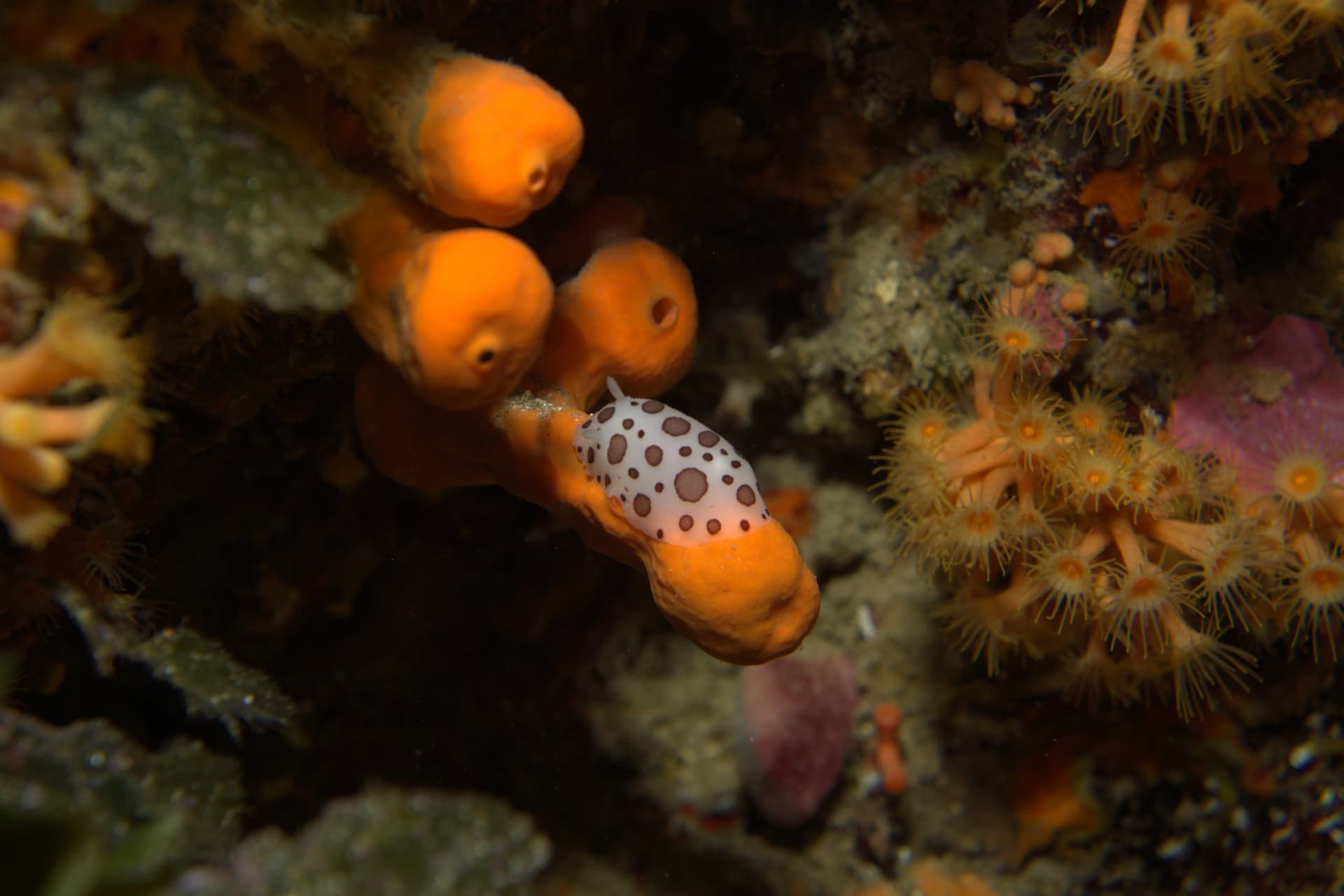
The descent follows the headland to about 18 metres, where a corridor of sand barely two metres wide leads to the Cabeza del Camello, a small rock between 18 and 24 metres covered in encrusting yellow anemone (Parazoanthus axinellae). At the end of the corridor the bottom falls away in vertical walls to around 32 metres. Past the wall the reef stays on your right-hand side and the net comes next, set into the rock. The shallow half, El Jardín, is an extensive area at 8 to 12 metres, busy with nudibranchs and gobies. Local centres advertise scorpionfish, spiny lobster and conger along the deeper section.
The net that gives the dive its name is no longer separate from the reef: both centres describe it embedded in the rock, and one lists algae, sponges and corals growing over it. It is the one feature here that is a piece of fishing gear turned into seabed.
The two centres that run the dive give different depths: one puts La Red at 20 to 37 metres, the other gives 12 to 32 for the whole site. One of them calls the 8 to 12 metre garden ideal for beginners or for finishing the dive. How much of the route your certification covers is for the centre to settle when you book.
What makes this dive site stand out.
Small rock at 18-24m covered in yellow encrusting anemone
A passage of sand about 2m wide at 18m leads to the rock
Remains of a fishing net among algae, sponges and corals
Beyond the corridor the bottom falls away in vertical walls
Extensive area at 8-12m with nudibranchs and gobies
41.7790°N, 3.0330°E
The 8-12m garden is described as ideal for beginners; the wall and net lie deeper. One centre lists the dive as multilevel and advanced, another as all levels.
Gentle in the shallow garden; the deeper section is where centres grade the dive differently.
Book a guided dive at this site.
SSI Instructor Training Center in Sant Feliu de Guixols, open year-round, running boat dives and the full professional training pathway on the Costa Brava.
Get in touch to add or claim your dive center listing on DiveCodex.
Dive centres in Catalonia must require insurance from every diver on their dives, and must be able to offer a policy to anyone who has none.
One centre lists it as multilevel and advanced, the other as suitable for all levels. The centre that grades it advanced also calls the 8-12m garden ideal for beginners, which fits the shallow top of the dive. On the route the wall drops to 32m at the end of the sand corridor and the net comes after it, so what your certification allows on the full route is a question for the centre taking you out.
Log your dives - notes, photos, conditions and the marine life you saw - and share them as one public diver profile. What you share helps the next diver, too.
Log every detail
Depth, duration, conditions, gear, buddy, notes — all in one place. Import from Suunto and other dive computers.
Track marine life
Record species sightings on each dive. Build a personal catalogue of everything you've seen underwater.
Your public dive profile
Share your dive history, stats, and experiences with a profile page you control. Show the world where you've been.