
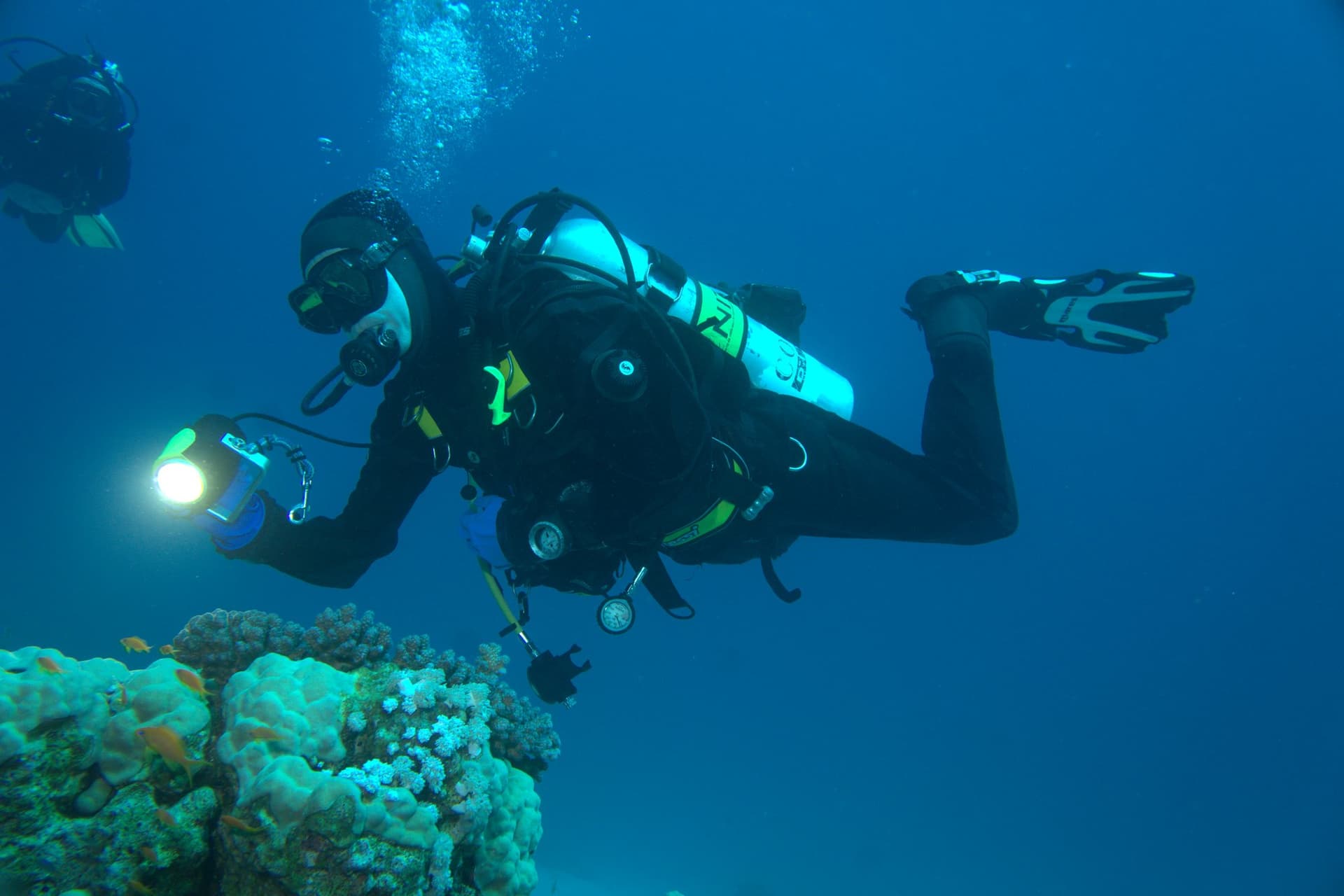

Colona Divers
PADI 5 Star IDC in Hurghada tracing to a 1977 Red Sea liveaboard, with daily boat dives, a house reef to 30+ m, and liveaboard safaris.
PADI5 services3 languages
Also known as: El Malag, El Marek, El-Malag
Drift dive north of Makadi Bay: a coral plateau breaks into a steep coral wall that falls to 40 m.
Last updated October 2026
The dive is a drift, and the plateau sets its pace. It slopes, with its top at 8 m or about 20 m depending on the account, and a gentle current carries the group down it toward the edge, where a steep coral wall drops to 40 m. The profile deepens steadily as the drift goes on.
A coral plateau that rolls into a wall falling to 40 metres, all in one drift at the northern end of Makadi Bay. Tuna, mackerel, reef sharks and turtles are the animals to watch for along the wall, with stingrays, trevallies and groupers also reported. It is a quiet site, little visited, and its corals are reported in very good state.
The group travels with the current, and on the sloping plateau both slope and current pull downward: check your depth against the plan often and send up a DSMB with the group. Surface conditions are roughest when the wind blows from the north or north-northeast, and shelter improves from the south-west and west-south-west. Listings grade the dive from beginner-friendly to intermediate, and the one first-person report calls the profile demanding, so plan for the depth the group will actually reach.
What makes this dive site stand out.
A coral plateau gives way to a drop-off reaching 40 m
A steep coral wall dived as a drift
Tuna, reef sharks and turtles are the animals to watch for
About 30 minutes by boat from Makadi Bay
27.0707°N, 33.8942°E
Open Water is our low-confidence call: it holds only if the plateau top is the shallow 8 m, and a plateau at about 20 m is Advanced Open Water depth. The wall to 40 m is beyond Open Water limits.
Summary
Graded Beginner to Medium by listings, demanding and deep in the one first-person report.
Safety considerations
What can go wrong here, and what divers do about it. Conditions change - take the briefing from the operator on the day.
Book a guided dive at this site.
PADI 5 Star IDC in Hurghada tracing to a 1977 Red Sea liveaboard, with daily boat dives, a house reef to 30+ m, and liveaboard safaris.
Get in touch to add or claim your dive center listing on DiveCodex.
One operator lists the plateau as running from 8 to 20 m; other listings place it at about 20 m. The difference crosses the Open Water limit of 18 m. If the top is 8 m, an Open Water diver can stay shallow on the plateau; if the whole plateau sits near 20 m, the dive starts at Advanced Open Water depth. Either way the wall to 40 m is beyond Open Water limits, so ask the centre for the planned maximum depth before you book.
The listings disagree with the one first-person account. One centre calls the site beginner-friendly, another rates it medium, a directory says all levels and another intermediate, while a 2025 guest report calls the profile demanding and deep, with a gentle current that keeps sliding the group toward greater depth. The plateau can be dived shallow and the wall cannot, so the experience depends on how far down the group follows the slope.
The reef-wall sites described by Makadi operators have no wreck. One centre's listing under the name El Malek describes a different dive, an upright fishing trawler at 18 m on sand called El Malek El Saghier, and that description does not apply to this reef. If a boat briefing mentions a trawler, it is that separate site.
Log your dives - notes, photos, conditions and the marine life you saw - and share them as one public diver profile. What you share helps the next diver, too.
Log every detail
Depth, duration, conditions, gear, buddy, notes — all in one place. Import from Suunto and other dive computers.
Track marine life
Record species sightings on each dive. Build a personal catalogue of everything you've seen underwater.
Your public dive profile
Share your dive history, stats, and experiences with a profile page you control. Show the world where you've been.