

Emperor Superior
13-cabin, 26-guest wooden liveaboard running Emperor's northern Red Sea wreck-and-reef weeks from Hurghada, plus offshore Brothers, Daedalus and Elphinstone.
Liveaboard26 guestsHurghada
Also known as: El Minia, El Miniaya, El Miniya, El Minja, El Minya, Miniya, The Harbour Wreck
Warship wreck on her port side just outside Hurghada port, with a glassfish-filled blast hole and winches and sonar gear still in place.
Last updated October 2026
She lies on her port side on a rocky seabed that slopes from about 25 m under the bow to 32 m under the stern. Most of the hull sits somewhat shallower than that, and its shallowest point is given as around 19 m. The stern is twisted to port with the decking facing the seabed, and the mine-sweeping sonar gear and winches are still in place, with an anchor chain snaking across the seabed.1 Operators describe an aft section bristling with winches and anti-aircraft guns while the fore-deck guns have been sheared off, bullet holes through the hull plating, cable rolls and torpedo-like mine-sweeping devices on deck.
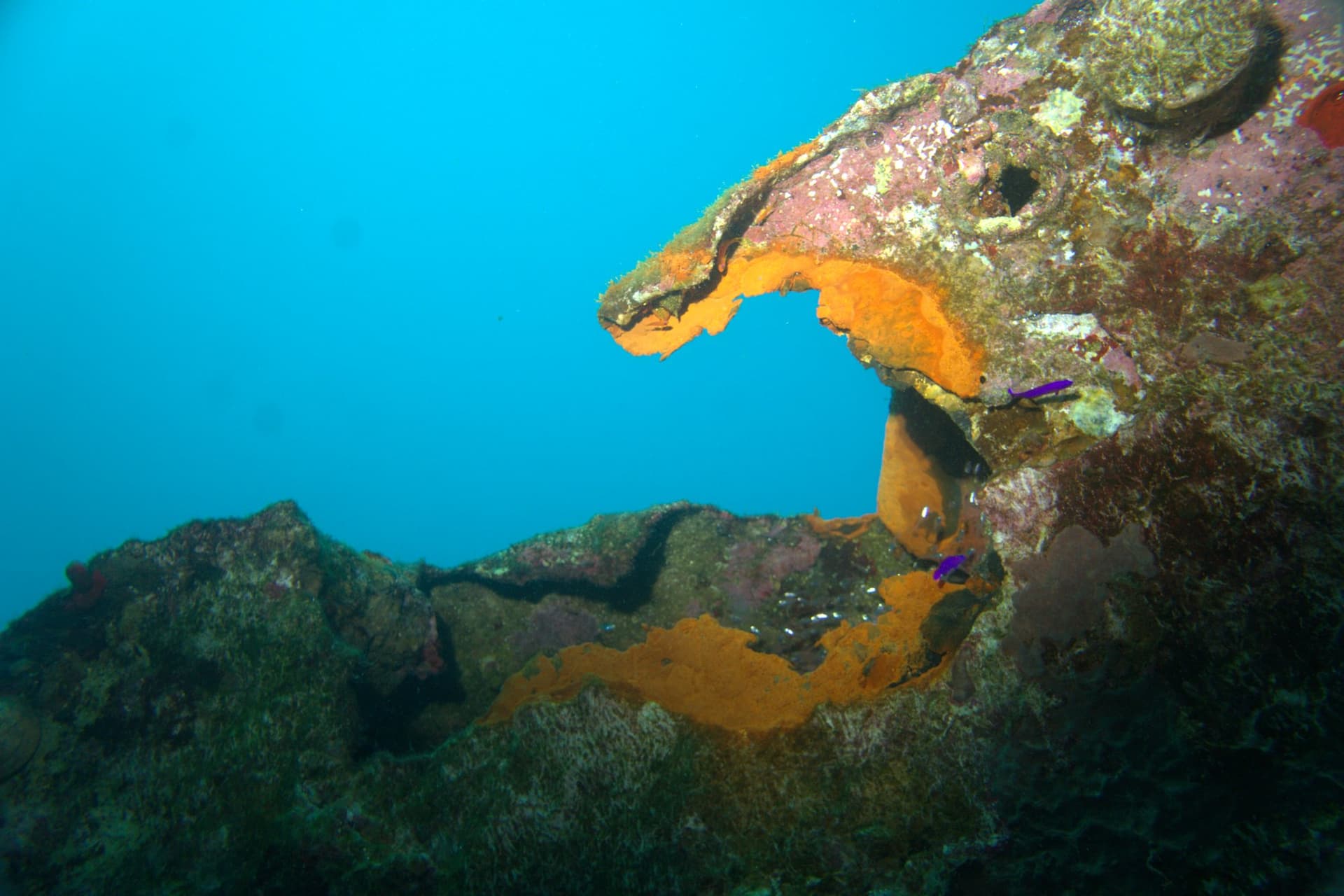
Divers go down a line onto the wreck, where the radio room and bridge can be seen without going inside. Glassfish mass in the blast hole, and lionfish and moray eels live on the hull. Black urchins and cleaner shrimps sit under the flukes of the anchor, and red sponges and pyjama slugs colour the bow. A fishing-boat wreck lies next to her, so a single trip can take in both.
A blast hole in the hull is the feature operators single out: the one place they call suitable for penetration, and a refuge where glassfish shelter from marauding lionfish and jackfish. Around it she is a compact wreck, a warship whose winches, guns and sonar gear are still in place.
Her place beside the port is a practical draw. Day boats and liveaboards both reach her, and one operator keeps her as a very good bad-weather alternative for crews turned back from a blown-out trip to Abu Nuhas.
The wreck is the Miniya, a Soviet-built T 43 type minesweeper of the Egyptian Navy.123 She was listed in Jane's Fighting Ships from 19604 and was sunk by Israeli air attack in the Gulf of Suez on 6 February 1970.567
Israeli jets sank her within 15 hours of an attack on two Israeli naval vessels moored in Eilat harbour, an attack a wire report of 6 February put down to Egyptian frogmen.89 The New York Times called her a 700-ton minelayer with a crew of 80 and put the attack about 35 miles south of Shadwan, while Tel Aviv, in the Associated Press report, placed the sinking near Hurghada, south of Shadwan Island.810 Tel Aviv called her a Soviet-built minelayer and Cairo a supply ship.11
Visibility runs 10 to 20 m and sits below normal Red Sea reef water, because harbour sediment hangs in the water. The wreck lies in an active harbour area, so ascend along the boat's line and surface beside it.
Inside the hull the passages are narrow and silt up fast. Operators call only the blast-hole area suitable for penetration, and only for experienced wreck divers with training, lights and a guideline. On its own El Mina trips, Scuba World Divers asks for Advanced Open Water. One operator calls her a genuine war grave and a memorial that asks for a respectful approach, and divers leave every fitting where it lies.
A 3 mm suit does in summer and 5 to 7 mm in winter, as elsewhere around Hurghada.
Operators report live shells on the seabed all around the wreck. Look, do not touch.
What makes this dive site stand out.
The one area operators call suitable for penetration, and a shelter for glassfish
Winches, cable rolls and mine-sweeping devices on deck, per operators
Stern twisted to port with the decking facing the seabed, sonar gear and winches in place
The Soviet-built minesweeper Miniya, listed in Jane's Fighting Ships from 1960
Day boats and liveaboards reach her, and a fishing-boat wreck lies alongside
27.2255°N, 33.8474°E
No part of the wreck is shallower than about 19 m, below the 18 m Open Water limit
Safety considerations
What can go wrong here, and what divers do about it. Conditions change - take the briefing from the operator on the day.
Multi-day safari boats with this site on their itinerary.
Book a guided dive at this site.

PADI 5 Star IDC in Hurghada tracing to a 1977 Red Sea liveaboard, with daily boat dives, a house reef to 30+ m, and liveaboard safaris.
Get in touch to add or claim your dive center listing on DiveCodex.
Two sets of works are joined. Jane's Fighting Ships and Conway's All the World's Fighting Ships give the ship and her loss: the Egyptian T 43 type minesweeper Miniya, sunk by Israeli air attack on 6 February 1970, and a 1970 wire report has Tel Aviv placing the sinking near Hurghada. Fodor's Egypt and DIVER magazine describe the wreck at Hurghada port as a Soviet-built minesweeper sunk by Israeli attack, and Footprint's Egypt handbook mentions an Egyptian minesweeper wreck at the port. Type, cause, place and name line up: a Soviet-built minesweeper, an Israeli attack, Hurghada, and Fodor's spelling of the wreck as El Minya beside the Miniya of the naval references.
Jane's Fighting Ships prints Miniya, the name the naval references use. Other published works spell it differently. The Egyptian state news agency was reported in 1970 as calling the ship El Minia, a New York Times report from the same week gives El Menia, Fodor's Egypt prints El Minya, and DIVER magazine calls the wreck El Mina (Harbour Wreck). Divers and operators book the dive as El Mina.
The sources written at the time give 6 February 1970. Jane's Fighting Ships records that date, and the New York Times of 7 February and a wire report dated 6 February carry the attack itself. In dive and travel print, a 2015 DIVER feature says 1969, Fodor's Egypt says the late 1960s, and Footprint's Egypt handbook describes an unnamed Egyptian minesweeper wreck at Hurghada port sunk in 1973 by friendly fire. Those three disagree with each other as well as with the 1970 reports.
The two capitals described her differently on the day. Israeli accounts called her a Soviet-built minelayer, a 700-ton ship with a crew of 80 in the New York Times and a 711-ton ship in a wire report. Cairo called her a 139-ton supply vessel named El Minia in the Associated Press report, and a 120-ton supply craft named El Menia in the New York Times. Jane's lists a ship named Miniya among Egypt's T 43 type fleet minesweepers, a class it gave in 1960 as 410 tons standard and 530 tons full load; those are class figures, not measurements of this hull.
The reports of 7 February 1970 carry two statements. Cairo's news agency said all members of the crew were rescued, and the New York Times noted that Israel had given no immediate report of how many Egyptian sailors might have survived. Both are attributed statements from the day of the attack.
Operators give opposite accounts. One says current can run hard from the north, with shelter behind the decks of the ship. Another describes the site as sheltered, with very mild currents even in windy periods. Ask the guide on the day and take the line down.
Log your dives - notes, photos, conditions and the marine life you saw - and share them as one public diver profile. What you share helps the next diver, too.
Log every detail
Depth, duration, conditions, gear, buddy, notes — all in one place. Import from Suunto and other dive computers.
Track marine life
Record species sightings on each dive. Build a personal catalogue of everything you've seen underwater.
Your public dive profile
Share your dive history, stats, and experiences with a profile page you control. Show the world where you've been.