

Posidonia Dive
SSI Instructor Training Center at Port Balis marina, 35 km north of Barcelona, running 24 boat dive sites on the Maresme coast year-round.
SSI8 services3 languages
Deep Port Balis rocky ridge at 25-29m off the Maresme coast, with dense yellow tree-sponge clusters and a longer boat transit than its neighbours.
Last updated April 2026
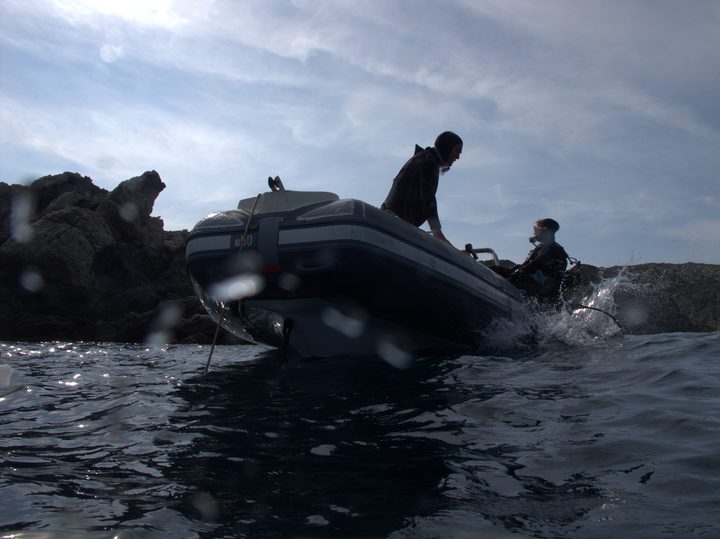
The transit east from Port Balis runs about fifteen minutes — further than the centre's usual ten-minute hops to the closer ridges, and a small reset for divers used to a quick boat ride. The ridge sits at 25-29m, and the boat anchors directly on it without a fixed mooring buoy. Down the line, the structure runs roughly parallel to the coast, with a deeper, rockier west flank and a softer east edge that fades into sand. Most groups follow one side first and return shallower along the other, working back to the anchor along a guideline the centre lays across the rock at the start.
The west flank is where the dive earns its name in the local rotation. Dense clusters of yellow tree-sponge (Axinella verrucosa) cover stretches of rock. Tens of individuals, some unusually large, in numbers that mark this site out from the neighbouring ridges. A green-leafed algae stand grows alongside the sponges, dense enough to be worth flagging though the species is not yet positively identified. East of the highest section, the rock breaks down into mixed rock-and-sand transition where Flabellina nudibranchs sit on round sponges and the occasional dusky grouper holds station off the structure.
Macro is the working mode. Torches reveal Mediterranean moray and conger in the cracks. One unusually large red scorpionfish was observed in the open on a recent owner dive, a memorable encounter rather than a regular feature. Bottom time is tight on air at this depth, which is why Nitrox 32 is the local default for full coverage.
The yellow-sponge facies is the strongest single visual signature of El Pico. Axinella verrucosa is common across the Maresme, but the density seen on the west flank here lifts it from background decoration to a genuine framing feature for the dive. Combined with the green-algae stand, the result is a small ecological pocket that doesn't quite match what local divers find on the closer Port Balis ridges. The morphology, deeper west and softer east, also tracks closely with La Virgen, which makes the two natural macros-and-crevices companions on a two-dive day rather than redundant choices.
This is a Nitrox-friendly site, not a Nitrox-optional one. At 25-29m on air, no-stop bottom time is short and the dive ends before the divers are warmed up. EAN32 is widely available locally and meaningfully extends what a diver can see. A torch belongs in the kit because most of what makes this site distinct sits inside cracks. Compass and SMB stay standard practice on every dive at this depth. A centre line across the ridge eases return navigation but should not replace independent skills.
The 15-minute transit is long enough that Garbi (SW) days can make the boat ride uncomfortable; a calmer forecast is worth waiting for if the surface is up. Calibrate the suit to the bottom band, not the surface — the summer thermocline drops bottom temperature 3-4C below the surface reading at 25m. A 5mm with hood is the safer choice through the warm months; from November through April a drysuit or 7mm semi-dry is the right call. When diving with mixed gas in the group (some divers on air, some on Nitrox), confirm everyone's mix and NDL profile before descent. At this depth the no-stop windows for air and Nitrox 32 diverge enough to matter.
What makes this dive site stand out.
Dense Axinella verrucosa aggregations on the west flank stand out against neighbouring barras
25-29m bottom puts this in the Nitrox-helpful band, beyond the OW depth limit
About 15 minutes east from Port Balis, further out than most of the centre's rotation
Flabellina nudis, scorpionfish, moray and conger work best with a torch and time
41.5453°N, 2.5561°E
Warmest above-thermocline water and best visibility windows. Bigger fauna sightings concentrate July-October.
Posidonia Dive 2026 published rates. 5-dive packages reduce per-dive cost. Verify current rates directly.
Bottom 25-29m exceeds the 18m OW limit. Both the operating centre and third-party catalogs categorise the site as advanced-only.
Summary
Depth is the main demand. No significant currents reported. Navigation is straightforward along the ridge with the centre's anchor line for return.
Safety considerations
What can go wrong here, and what divers do about it. Conditions change - take the briefing from the operator on the day.
Book a guided dive at this site.
SSI Instructor Training Center at Port Balis marina, 35 km north of Barcelona, running 24 boat dive sites on the Maresme coast year-round.
Get in touch to add or claim your dive center listing on DiveCodex.
Dive centres in Catalonia must require insurance from every diver on their dives, and must be able to offer a policy to anyone who has none.
Advanced Open Water minimum. The bottom sits at 25-29m, beyond the OW depth limit, and the operating centre lists it as suitable only for advanced or Deep-specialty divers. Nitrox is strongly recommended for useful bottom time.
Three things stand out. The west flank carries dense yellow tree-sponge clusters in numbers not seen on the neighbouring ridges. The transit is longer at about 15 minutes from port. The depth band sits comfortably in the Nitrox-helpful 25-29m bracket without pushing into max-depth territory like El Pujola.
Yes, with a macro setup and a torch. The Axinella sponges, Flabellina nudibranchs perched on round sponges, scorpionfish, and crevice life all reward time. The depth band limits the bottom time on air, so plan for shorter focused sessions or run Nitrox.
June to October for warmest above-thermocline water and the best visibility windows. The bigger fauna sightings (moray, octopus, occasional grouper) concentrate July through October. Diving runs year-round, but the bottom can drop to 12C in late winter and visibility crashes after rain.
A 5mm wetsuit with a hood is the safer choice. The bottom band at 25-29m sits below the seasonal thermocline and reads 15-18C even when the surface is 20-22C. A 3mm only works above the thermocline, which is not where this dive happens.
Log your dives - notes, photos, conditions and the marine life you saw - and share them as one public diver profile. What you share helps the next diver, too.
Log every detail
Depth, duration, conditions, gear, buddy, notes — all in one place. Import from Suunto and other dive computers.
Track marine life
Record species sightings on each dive. Build a personal catalogue of everything you've seen underwater.
Your public dive profile
Share your dive history, stats, and experiences with a profile page you control. Show the world where you've been.