

Easy Diving
Port-based SSI club in Mataró, 30 km from Barcelona, running year-round boat dives on the Maresme barras with adaptive and technical training.
SSI / CMAS7 services2 languages
Also known as: El Pujolar, El Pujole, La Llosa d'en Pujola, Pujoia
Outermost Mataro deep dive at 26-29m (max 34m), with discontinuous wall-like slab structure, episodic current exposure and a metal beam on the seabed.
Last updated April 2026
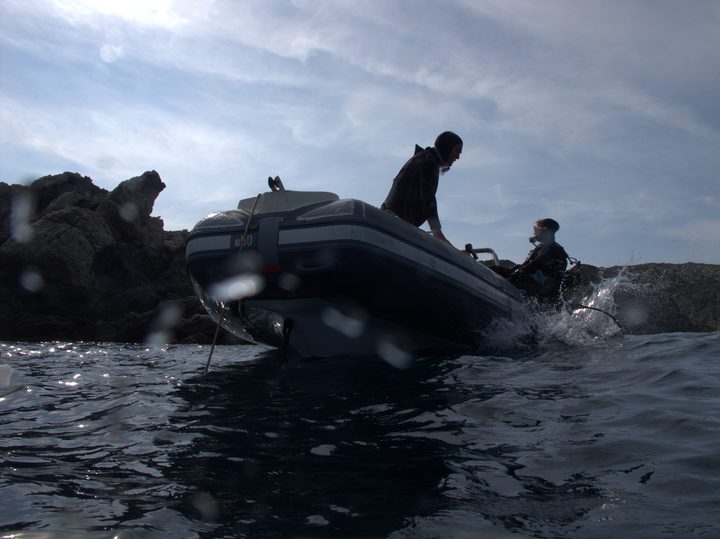
Boat transit out of Port de Mataro to El Pujola is short on the clock, ten or fifteen minutes, but the position is the outer-row, the farthest of the Mataro rotation, and the open Mediterranean tells you so. Surface chop builds in here, mar de fondo can run, and the boat is not anchored against a fixed buoy: each dive begins with the centre dropping anchor onto the slab and running a return line across the rock. Down the anchor line, the structure feels different from the inner barras. Discontinuous wall sections rather than a single ridge. A flat-slab character broken into segments. Owner notes call it "more like a wall with discontinuous parts," the morphology that earns the local term llosa rather than barra.
Pick a direction along the slab and follow it counter-current first. Current is episodic on this dive; calm visits are common, but when it runs strong enough to dictate direction, the choice is one-way until the line back to the anchor. The bottom holds rock fauna in the cracks — Mediterranean moray, flabellinid nudibranchs, the occasional flatworm. The deeper outer face turns toward the blue, where larger fish may pass and pelagic potential is real because the slab sits at the outer edge of local rocky habitat. A metal beam runs along part of the structure and reads as a useful navigation marker rather than a destination.
Bottom time is the operational limit. Twenty to twenty-five minutes of no-stop time on air at 26-29m is the working envelope, less if the diver works into current. EAN32 is the standard local mix. Return on the opposite face shallower or back along the slab depending on gas, ascend on the anchor line, and deploy an SMB on the safety stop if the boat has drifted off or surface visibility is poor.
El Pujola is the deep dive in the Mataro rotation. Closer ridges sit at 14-22m; this one bottoms at 26-29m with a surrounding profile to about 34m. The slab morphology is the only break from the otherwise uniform ridge pattern of the area, and the open-water position gives the dive an exposed-coast feel that does not exist at the inshore barras. For divers who want a 25-30m profile twenty minutes from Barcelona without driving to Tossa or the Costa Brava, this is the local answer.
Nitrox 32 makes the difference at this depth, with the air-tank version of this dive ending before the diver has settled in. A drysuit or 7mm semi-dry is the right call from November to April, and even in summer the bottom band reads 15-18C below the thermocline. Hood and gloves help. Watch the swell forecast: outer-row position means the surface can be lumpy when the inner barras are calm. The metal beam on the slab is a feature you may encounter; it is not a wreck dive and the deeper aircraft loss associated with this stretch of coast is intentionally not a published dive site. Standard kit applies: SMB, dive computer, cutting device, and a torch for the slab cracks. Skill prerequisites read as solid buoyancy at 30m, comfort with mid-water current, and competent SMB deployment from depth.
What makes this dive site stand out.
Row 6 of the Mataro stratigraphy, 26-29m on top with surrounding profile to about 34m
Discontinuous wall-like sections rather than the continuous ridge typical of the closer barras
Flagged with Canons and Montseny as one of the area's three current-exposed sites
A documented viga metalica sits along the slab, used as a navigation reference
41.5350°N, 2.4800°E
Calmer surface and warmer above-thermocline water. Winter dives are documented but cold and weather-sensitive.
Area-typical 38-50 EUR per boat dive with own tank. Site-specific pricing not published. Verify current rates with the operating centre.
AOW is the operational minimum. A Deep specialty (PADI Deep or equivalent) is recommended for the 30m+ portion of the surrounding profile.
Summary
Depth, occasional current, and seasonal low visibility raise the demand. Bottom-time management is required to avoid decompression obligation on a 26-29m profile.
Safety considerations
What can go wrong here, and what divers do about it. Conditions change - take the briefing from the operator on the day.
Book a guided dive at this site.
Port-based SSI club in Mataró, 30 km from Barcelona, running year-round boat dives on the Maresme barras with adaptive and technical training.
Get in touch to add or claim your dive center listing on DiveCodex.
Dive centres in Catalonia must require insurance from every diver on their dives, and must be able to offer a policy to anyone who has none.
Advanced Open Water minimum, with a Deep specialty recommended if you want the 30m+ portion of the surrounding profile. The site is documented as advanced-only across multiple sources, with depth, episodic current and variable visibility together making it the most demanding regular dive in the Mataro rotation.
Local geology classifies it as a llosa (slab) rather than a barra (ridge). Where the inner Mataro rows are continuous linear ridges parallel to the coast, El Pujola breaks into discontinuous wall-like sections. One owner observation describes it as 'more like a wall with discontinuous parts' than the continuous spine of the closer ridges.
The site is on the area's short list of current-exposed dives, alongside Canons and Montseny. Current is episodic rather than constant. One personal dive logged it strong enough that there was 'not much choice but head towards it'. Treat current as a planning factor and start any dive counter-current.
Older forum threads describe a metal beam (viga metalica) on the slab. Whether it relates to a wartime aircraft loss off this coast is unresolved in the sources reviewed. Treat it as a navigation reference you may encounter, not as a wreck dive.
Yes, but it picks its days. Bottom temperature has been documented at 12C in February with heavy underlying swell and visibility of barely a metre. Drysuit or 7mm semi-dry is needed. Calm-water windows are rarer but the dive runs year-round in centre rotations.
Both sit at the deeper end of the Mataro rotation. El Vell is a continuous ridge at 25-26m with classic crevice fauna and easier conditions. El Pujola is deeper, slab-structured, and current-exposed, and reads as the local answer for divers who want a 25-30m profile without driving to Tossa or the Costa Brava.
Log your dives - notes, photos, conditions and the marine life you saw - and share them as one public diver profile. What you share helps the next diver, too.
Log every detail
Depth, duration, conditions, gear, buddy, notes — all in one place. Import from Suunto and other dive computers.
Track marine life
Record species sightings on each dive. Build a personal catalogue of everything you've seen underwater.
Your public dive profile
Share your dive history, stats, and experiences with a profile page you control. Show the world where you've been.