

Posidonia Dive
SSI Instructor Training Center at Port Balis marina, 35 km north of Barcelona, running 24 boat dive sites on the Maresme coast year-round.
SSI8 services3 languages
Also known as: El Santuario, La Piscifactoría, Piscifactoría de Arenys
Sunken fish farm turned artificial reef at 13-26m off the Maresme coast, with two distinct ecosystems and a resident seahorse colony since 2018.
Last updated April 2026
Down the mooring line lands you on a steel grid at 13 metres, the upper deck where fish-farm workers once walked. The grid is wide and easy to swim through, with a small crane-like fixture still in place and clouds of damselfish over algae and sea squirts. Most guides route divers along this level to the far end of the cage, then drop the last column to sand at 26 metres. That keeps the deeper, life-richer ground for the front half of the dive and the slow return for off-gassing.
At 26 metres the character flips. Vertical iron columns stand on sand, connected by horizontal bars that frame open cube-shaped compartments with no roof above them. Some columns are hollow tubes that morays and small congers shelter inside. Bryozoans, gorgonians, and false coral coat the deeper metalwork. Long-snouted seahorses cling to columns and net edges in colours that match whatever they are on, and finding two or three on a single dive is achievable but takes a guide's eye. Spiny lobsters are common across the lower level and sometimes sit out in the open rather than tucked under cover. Remnant aquaculture netting drapes parts of the framework.
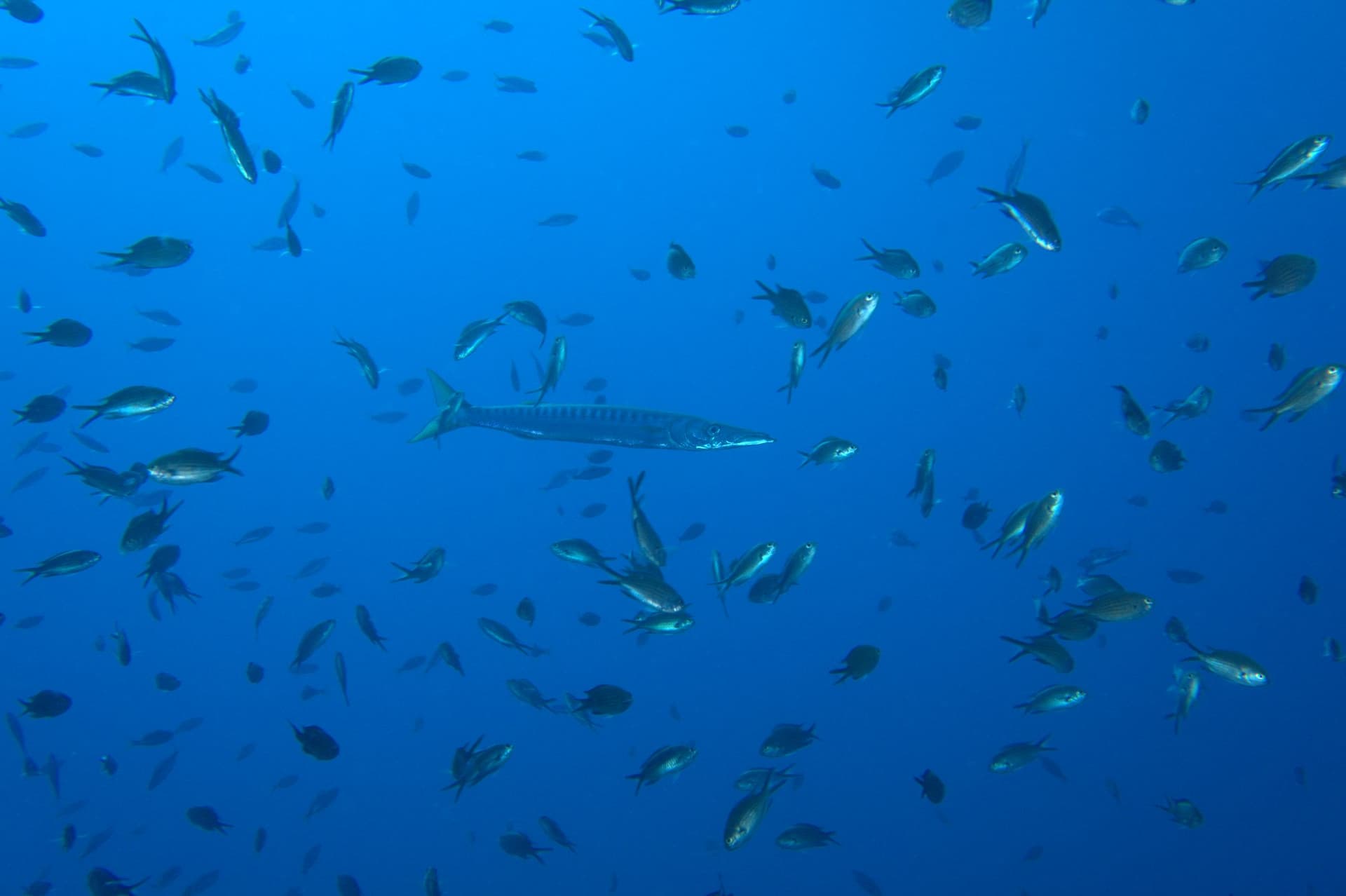
The signature comes at the end. Castañuelas, sargos, sardines, mojarras, salpas, and lisas converge on the shallower deck on the way back. In summer and early autumn, barracuda hunt those bait schools through the open water around the structure. Local divers call it fish soup and treat it as the site's signature moment. The footprint is roughly 50 by 50 metres, compact enough to work the whole cage in a 50 to 60 minute dive.
Three things separate the cage from the natural rocky ridges that define the rest of this coast. First, the geometry: a 13 metre walkway tier and a 26 metre sand tier in one dive deliver two distinct biological communities without leaving the same footprint. Second, the seahorse colony, documented since 2018 and verified through 2026 winter dives. Few accessible Mediterranean sites near Barcelona reliably hold them. Third, the end-of-dive pelagic convergence is close to a guarantee, and macro density per dive runs higher than most natural ridges at comparable depth. None of this combination exists at any other site in the Maresme rotation.
The cage was a working dorada (sea bream) farm from the mid-1990s. Storms in 1999 and 2001 broke the containment nets and lost roughly half a million kilos of fish. Production wound down, and by 2003 the structure was abandoned afloat. In 2009 the operator was authorised to sink it, and the steel framework settled at 26 metres on sand. A planned relaunch as a grouper and turbot grow-out site never happened. The diving community absorbed it instead. The original maritime concession is still privately held, which is why a 5 EUR per-diver fee runs alongside the standard boat price. It is a private commercial fee, not a marine reserve charge.
Old aquaculture netting still hangs from sections of the cage, so a cutting tool is standard kit and gloves cover the unintentional brush against oxidised steel. Trim and buoyancy matter near the framework — stay off the structure, and juvenile scorpionfish on the upper deck are a non-issue. The deeper part of the dive sits at 20 to 26 metres, well within the AOW envelope but tight on air alone. Nitrox 31 to 32 buys real bottom time and is the local default. Standard ascent runs back up the mooring line with an SMB and a computer, both mandatory at this depth. The 5 EUR concession fee is paid directly through the dive centre alongside the dive price.
What makes this dive site stand out.
Hippocampus guttulatus documented since 2018, year-round in multiple colour variations
Iron walkways at 13m and columns to sand at 26m create separate habitats
50m x 50m fish farm framework unlike any natural or wreck site on this coast
Juvenile octopuses, lobsters, and brittle stars emerge after dark
41.5543°N, 2.5457°E
Warmest water and maximum pelagic activity. September highlighted as peak month.
2026 rates. 5 EUR concession fee per diver on top of dive centre price. Verify current rates directly.
OW divers can stay at 13m walkway but miss the main biodiversity at 26m.
Summary
Easy at 13m walkways, moderate at 26m due to depth and entanglement hazards. No significant currents. Geometric structure easy to navigate.
Safety considerations
What can go wrong here, and what divers do about it. Conditions change - take the briefing from the operator on the day.
Book a guided dive at this site.
SSI Instructor Training Center at Port Balis marina, 35 km north of Barcelona, running 24 boat dive sites on the Maresme coast year-round.
Port-based SSI club in Mataró, 30 km from Barcelona, running year-round boat dives on the Maresme barras with adaptive and technical training.
Get in touch to add or claim your dive center listing on DiveCodex.
Dive centres in Catalonia must require insurance from every diver on their dives, and must be able to offer a policy to anyone who has none.
The seahorse colony is resident year-round, but visibility and water temperature peak July through October. September is considered the best month overall. The seahorses are well-camouflaged, so ask your guide. They know the current spots.
Since 2009, when the abandoned fish farm was deliberately sunk. It operated as a dorada breeding platform from roughly 1995 until storms and economic losses shut it down around 2003. The 50m x 50m iron framework now sits on sand at 26 metres.
Thirty minutes by car to Port Balis, then 20-30 minutes by boat. The combination of artificial reef structure, resident seahorse colony, and pelagic hunters in summer is not found at other sites this close to the city. A day and night dive on the same trip is the best use of the journey.
Advanced Open Water recommended. Open Water divers can stay at the 13m walkway level, but the seahorses, scorpionfish, and best marine life concentrate at 26m. Nitrox extends your time at the bottom level significantly.
A single dive with your own tank runs 38 EUR (air) or 44 EUR (nitrox). Full equipment hire brings it to 72-78 EUR. Add 5 EUR per diver for the concession fee. Multi-dive packages reduce per-dive costs. Night dive supplement is 6 EUR.
Log your dives - notes, photos, conditions and the marine life you saw - and share them as one public diver profile. What you share helps the next diver, too.
Log every detail
Depth, duration, conditions, gear, buddy, notes — all in one place. Import from Suunto and other dive computers.
Track marine life
Record species sightings on each dive. Build a personal catalogue of everything you've seen underwater.
Your public dive profile
Share your dive history, stats, and experiences with a profile page you control. Show the world where you've been.