

Posidonia Dive
SSI Diamond Instructor Training Center at Port Balis marina, 35 km north of Barcelona, running 24 boat dive sites on the Maresme coast year-round.
SSI7 services3 languages
Also known as: El Temple
Lightly-visited rock at 23-35m off Port Balis, an advanced-only boat dive with reliable rock fauna and an autumn barracuda chance.
Last updated May 2026
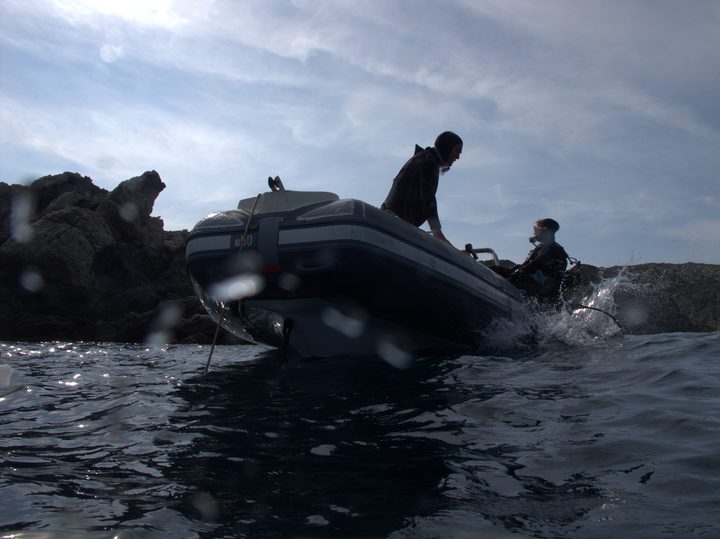
The boat anchors above the rock in open water with no fixed mooring buoy, and the descent runs down the anchor line straight into the working range at 23 metres. From there the dive is about reading the rock. The structure sits in the 23 to 35 metre band, and the day's interest concentrates in the crevices and overhangs of the porous Mediterranean rock. A torch earns its place here because the site's value is what lives inside the cracks: morays peering out, lobster tucked in cavities, conger in the larger overhangs, scorpionfish pressed against the rock in summer. The water column above the structure holds the day's pelagic chance, and that chance is real but seasonal. October and November concentrate the barracuda action, with schools working over the top of the rock; amberjack pop up opportunistically, often late in the dive when nothing else is happening. The dive runs roughly 45 to 60 minutes on a 15-litre Nitrox 32% cylinder, with the typical loop tracing the rock face and returning to the anchor line for a conventional safety stop or an SMB ascent if the boat has drifted.
El Templo is the quieter, advanced-only option in the Port Balis rotation. Where Canons and La Virgen offer a shallow flank that absorbs the Open Water and beginner-mixed groups, El Templo has no shallow zone to fall back on, which both narrows its market and keeps the traffic down. The site sees noticeably less traffic than its more popular cluster siblings, and that is its character: a working advanced dive without the headline status, reliable for what it does (rock fauna, depth practice, the autumn pelagic chance) without pretending to be more. It earns its slot for the Deep specialty cohort and regulars rotating through the cluster's depth-cert options.
Bring a torch and an SMB. The whole interest of the dive is inside the cracks, and the boat anchors without a fixed mooring, so the safety stop often runs off-line on an SMB while the boat repositions. Calibrate the suit to bottom temperature, not surface: summer bottom is 15 to 18 degrees at 25-plus metres, so 5mm with hood is the right call from June through September. Winter wants a drysuit or 7mm semi-dry with hood and gloves. Nitrox is recommended on the depth profile and Posidonia Dive fills on-site. Visibility risk to plan for is the winter rierades runoff after heavy rain, which can drop the working range below useful in a single weather window. Garbi (SW) wind days raise surface chop and seasickness on the transit; pre-dose any motion-sickness medication before leaving port, not on the boat. Arrive about 45 minutes before scheduled departure for the standard pre-dive prep window at the centre.
What makes this dive site stand out.
Working range 23-35m with no shallow flank; rated valid for advanced divers only
A quieter slot in the Posidonia rotation than La Virgen or El Santuari nearby
Morays, lobster, conger and scorpionfish in the cracks; a torch earns its place
Pelagic action concentrates around October and November; not guaranteed
41.5650°N, 2.5200°E
Late spring through early autumn for cleaner water and warmer surface temps. Autumn (October-November) brings the seasonal barracuda and amberjack chance, partly offsetting the cooler dives.
Standard Posidonia Dive boat-dive rate plus Nitrox supplement when applicable. No site-specific access fee. Verify current rates with the centre.
Advanced Open Water minimum. There is no shallow flank to fall back on, so the dive plan is essentially descend, work the rock, ascend. Open Water divers should book a shallower Port Balis site instead.
Summary
Depth-fixed at 23-35m. Profile is straightforward but the bottom time budget is tight on air; Nitrox is the standard call.
Safety considerations
What can go wrong here, and what divers do about it. Conditions change - take the briefing from the operator on the day.
Book a guided dive at this site.
SSI Diamond Instructor Training Center at Port Balis marina, 35 km north of Barcelona, running 24 boat dive sites on the Maresme coast year-round.
Get in touch to add or claim your dive center listing on DiveCodex.
Advanced Open Water. The working depth runs 23 to 35 metres with no shallower flank to fall back on, so Open Water divers exceed their 18m limit on this dive. The site is rated for advanced divers only. Open Water divers should book a shallower Port Balis site such as La Virgen or the inshore flank of Canons.
No documented temple structure, arch, column, or similar named feature exists at this site. The name most likely refers to a visual aspect of the rock formation, but the specific shape is undocumented in available material. Treat the name as evocative rather than literal until a dive description fills in the structure.
Macro is opportunistic rather than a defining draw. Nudibranchs are documented but in single-digit sighting counts, with autumn picking up the most. The site's reliable interest is the larger crevice fauna (moray, lobster, conger, scorpionfish) rather than a documented macro reputation.
El Templo is the advanced-only deeper option. Canons and La Virgen both offer a shallow flank that lets Open Water divers stay in their certification range; El Templo does not. The fauna is similar Maresme rock fauna across all three, with El Templo trading the depth-flexibility for less traffic and a deeper bottom-time profile.
Autumn (October to November) is the realistic window for barracuda schools in the water column above the rock. Amberjack pop up opportunistically, often late in the dive, with pelagic encounters at close range having been observed in December as well. Neither is guaranteed and both depend on the day, but autumn is when the chance is best.
Less so than its sibling sites Canons, El Pujola and Montseny, which the area calibration explicitly flags as current-exposed. El Templo does not carry the same flag in available material. Apply standard Maresme current planning, watch the conditions on the day, and carry an SMB for the safety stop.
Log your dives - notes, photos, conditions and the marine life you saw - and share them as one public diver profile. What you share helps the next diver, too.
Log every detail
Depth, duration, conditions, gear, buddy, notes — all in one place. Import from Suunto and other dive computers.
Track marine life
Record species sightings on each dive. Build a personal catalogue of everything you've seen underwater.
Your public dive profile
Share your dive history, stats, and experiences with a profile page you control. Show the world where you've been.