

Posidonia Dive
SSI Instructor Training Center at Port Balis marina, 35 km north of Barcelona, running 24 boat dive sites on the Maresme coast year-round.
SSI8 services3 languages
Also known as: El Vell
Long rocky ridge off Sant Andreu de Llavaneres at 25m, with crevice fauna, an exceptional ascent view on calm days, and a strong summer thermocline.
Last updated April 2026
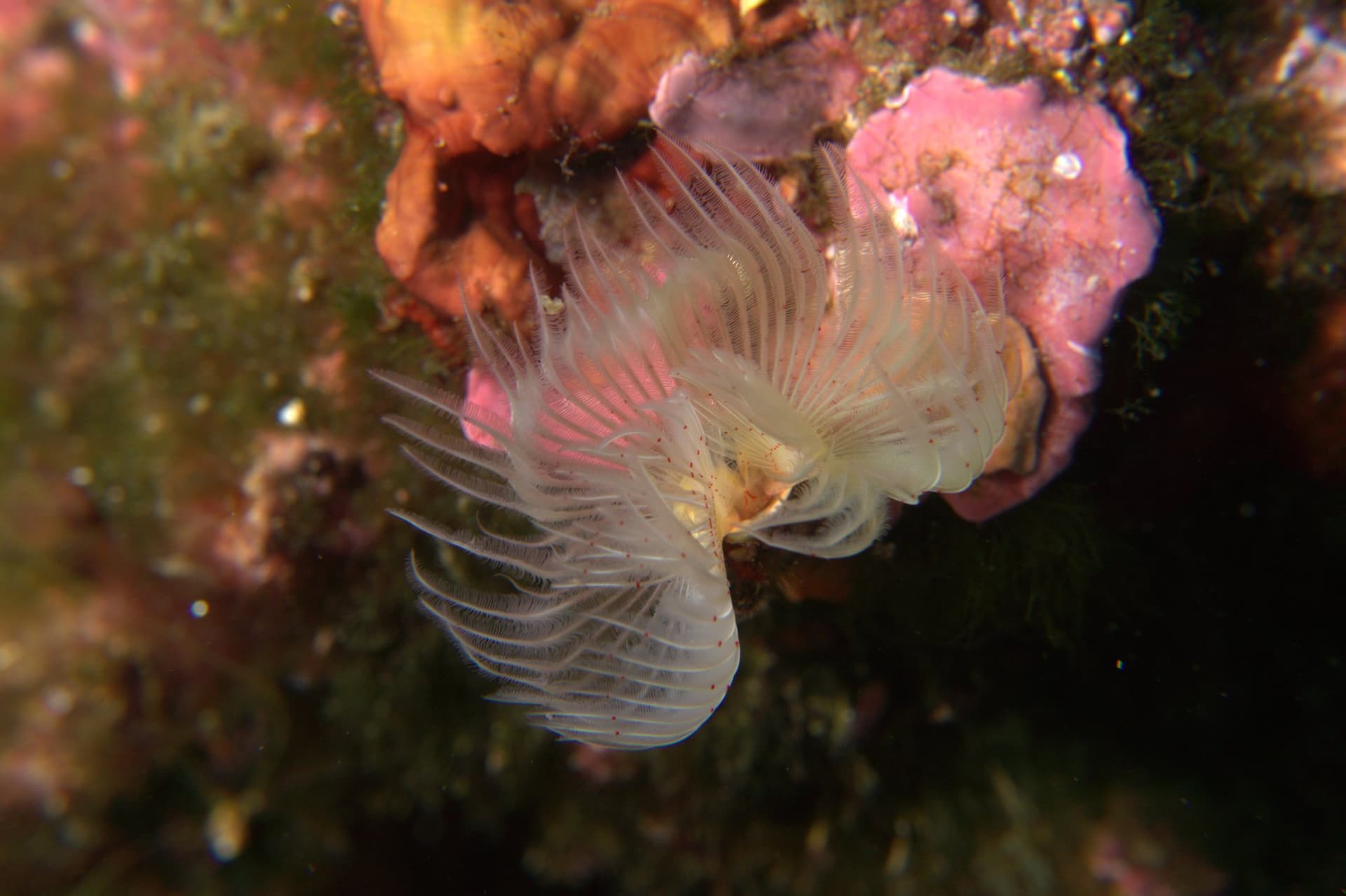
Ten to fifteen minutes out from Port de Mataro, past the Llavaneres breakwater into open water, the boat anchors over a long, narrow ridge whose line tracks the shore. The structure rises off a sandy floor at about 25m, with the top of the ridge sitting in the 10-15m range. There is no permanent buoy here; centres lay a guideline across the barra from the anchor so the way back is straightforward. Down the line, the ridge opens out in two directions and the standard Mataro convention applies: pick the deeper or counter-current side first, work along the structure with a torch into the crevices, and return on the opposite flank at shallower depth toward the anchor.
The ridge is what you look at, and it is what you swim past. Crevices and overhangs run the length of the structure and concentrate the resident fauna in tight pockets. Mediterranean moray heads sit at the lip of cracks. Conger eels rest deeper in (often with cleaner shrimps). Spiny lobster antennae poke from holes, and the occasional sizeable dusky grouper holds station off a deeper section. Macro is the working mode for most of the dive; nudibranchs, scorpionfish camouflaged into reddish algae, and crevice-shrimp portraits are the photo subjects regulars come back for. In late summer, Rhizostoma barrel jellyfish drift over the structure and a basket star (Astropartus mediterraneus) has been recorded once on a daytime dive in the rock detail.
What changes the dive on a calm summer day is the ascent. At 10-15m above the ridge top in 25m visibility, the whole barra is visible end to end, and the safety stop becomes the structural reward. That is the version of El Vell divers remember. The other version (winter post-rain, 12C bottom, visibility down to a metre) is usable but reduces the dive to a torch-and-crevice exercise close to the structure. Both are El Vell, and which one the diver gets is the day's decision more than the operator's.
El Vell sits at the deep end of the Mataro rotation, closer in feel to El Santuari (20-26m) or the deeper El Pujola (26-29m) than to the shallow Row 3-4 barras. That depth band is the operating fact: it is far enough that a 5mm wetsuit feels the bottom band's 15-18C in summer, and that Nitrox 32 reliably extends a useful working time. The fauna inventory is conventional Mataro crevice life rather than anything dramatically distinctive. What lifts the dive is the structural reward on calm days, with the long ridge readable end-to-end from 10m above, together with the variability that makes each dive a different site. Older accounts also describe an unusually dense lobster patch on this same ridge and a Pinna nobilis fan mussel photographed here, both historical baseline observations rather than current features.
This is a macro site that earns its reputation across multiple decades of community photography. Older photo threads document Flabellina egg-laying, conger-and-cleaner-shrimp portraits, scorpionfish camouflage tight enough to vanish in the rock, and lobster-portrait studies along the crevice line. The light at 25m is dim by Mediterranean standards, and the ridge channels suspension when too many fins work the same patch — historical accounts specifically describe particulate stirred by inattentive finning. A snoot for nudibranch portraits and wide flash arms for the crevice mid-shots both pay back. The most productive sections concentrate where overhangs face away from the prevailing surge, which on this site tends to be on the lee side of the ridge.
Calibrate the suit to the bottom, not the surface. The 3-4C summer thermocline at this site is the area's anchoring data point and a 5mm with hood is the safer choice through the warm months; from November through April a drysuit or 7mm semi-dry is the right call. Air supply is the recurring practical complaint at this depth, which is why most regulars run EAN32 here. Carry a torch — much of what makes the site rewarding sits inside cracks. Hover, don't settle; the ridge silts up quickly when too many divers work the same crevice line. Standard Spanish kit applies (SMB, dive computer, cutting device, valid insurance) and the regulator-and-buoyancy work matters more than at the shallow barras because there is less margin if something is off.
What makes this dive site stand out.
Long, narrow barra with overhangs concentrating moray, conger, lobster and scorpionfish
Bottom at 25m drops 3-4C below the surface band; suit must calibrate to the cooler floor
From 25m on summer-calm days to a single metre after winter rain on the same site
Sister feature at similar depth allows the centre to pair the two on a single outing
41.5297°N, 2.5165°E
Warmer water and best-odds visibility. August offers the best chance of the exceptional 25m days but also the strongest thermocline.
Area-typical 38-50 EUR per boat dive with own tank. Site-specific pricing not published. Verify current rates with the operating centre.
AOW for the 25m sand floor. OW divers can stay on the upper barra above 18m on a guided profile.
Summary
Structurally easy with a defined ridge and anchor-to-anchor profile. Depth-management for OW divers and air supply for AOW divers wanting useful bottom time are the practical complications.
Safety considerations
What can go wrong here, and what divers do about it. Conditions change - take the briefing from the operator on the day.
Book a guided dive at this site.
SSI Instructor Training Center at Port Balis marina, 35 km north of Barcelona, running 24 boat dive sites on the Maresme coast year-round.
Port-based SSI club in Mataró, 30 km from Barcelona, running year-round boat dives on the Maresme barras with adaptive and technical training.
Get in touch to add or claim your dive center listing on DiveCodex.
Dive centres in Catalonia must require insurance from every diver on their dives, and must be able to offer a policy to anyone who has none.
Advanced Open Water for the full profile to 25m. Operators take Open Water divers on this site too, with the dive limited to the upper barra above 18m. Either way, Nitrox 32 is widely recommended for useful bottom time at this depth.
At 25m bottom on air, no-stop time is tight enough to cut the dive short before the diver has settled into the ridge. Nitrox 32 extends bottom time meaningfully and the area centres fill it locally. The recurring complaint in personal logs is short bottom times on air at this site.
Variable is the honest answer. On summer-calm days the ridge can be distinguished from sandy seabed from the boat, visibility reaches 25m, and the ascent at 10-15m above the structure becomes the structural payoff. After rain or in winter the same site can crash to a metre. Pick the day.
Historically yes: one was photographed here in October 2006. From 2016 onwards a Mediterranean-wide mass mortality event devastated the species across its range. Modern divers should treat this as a heritage record rather than a current expectation. Sightings now would be remarkable rather than routine.
May through October for warmer water and the best-odds visibility. August has the strongest chance of the exceptional 25m days but also the strongest summer thermocline. Bottom at 25m can read 15-18C while the surface is 22C. Winter dives are entirely possible with drysuit or 7mm semi-dry, accepting cold bottoms and weather sensitivity.
El Vell ('the old one') is the local skipper short-name and is what divers actually use on the boat. El Plaer del Vell is the longer formal name on operator websites. Same dive.
Log your dives - notes, photos, conditions and the marine life you saw - and share them as one public diver profile. What you share helps the next diver, too.
Log every detail
Depth, duration, conditions, gear, buddy, notes — all in one place. Import from Suunto and other dive computers.
Track marine life
Record species sightings on each dive. Build a personal catalogue of everything you've seen underwater.
Your public dive profile
Share your dive history, stats, and experiences with a profile page you control. Show the world where you've been.