

Buceo La Restinga
SSI center in La Restinga, El Hierro, highly rated by divers, with 24+ volcanic sites, a 30m depth cap, and the top recommendation on Spanish dive forums.
SSI2 languages
Also known as: El Venil
Vertical volcanic drop-off at 23-40m off La Restinga, named for the Canarian term for submarine cliff, with dense groupers and passing pelagics.
Last updated April 2026
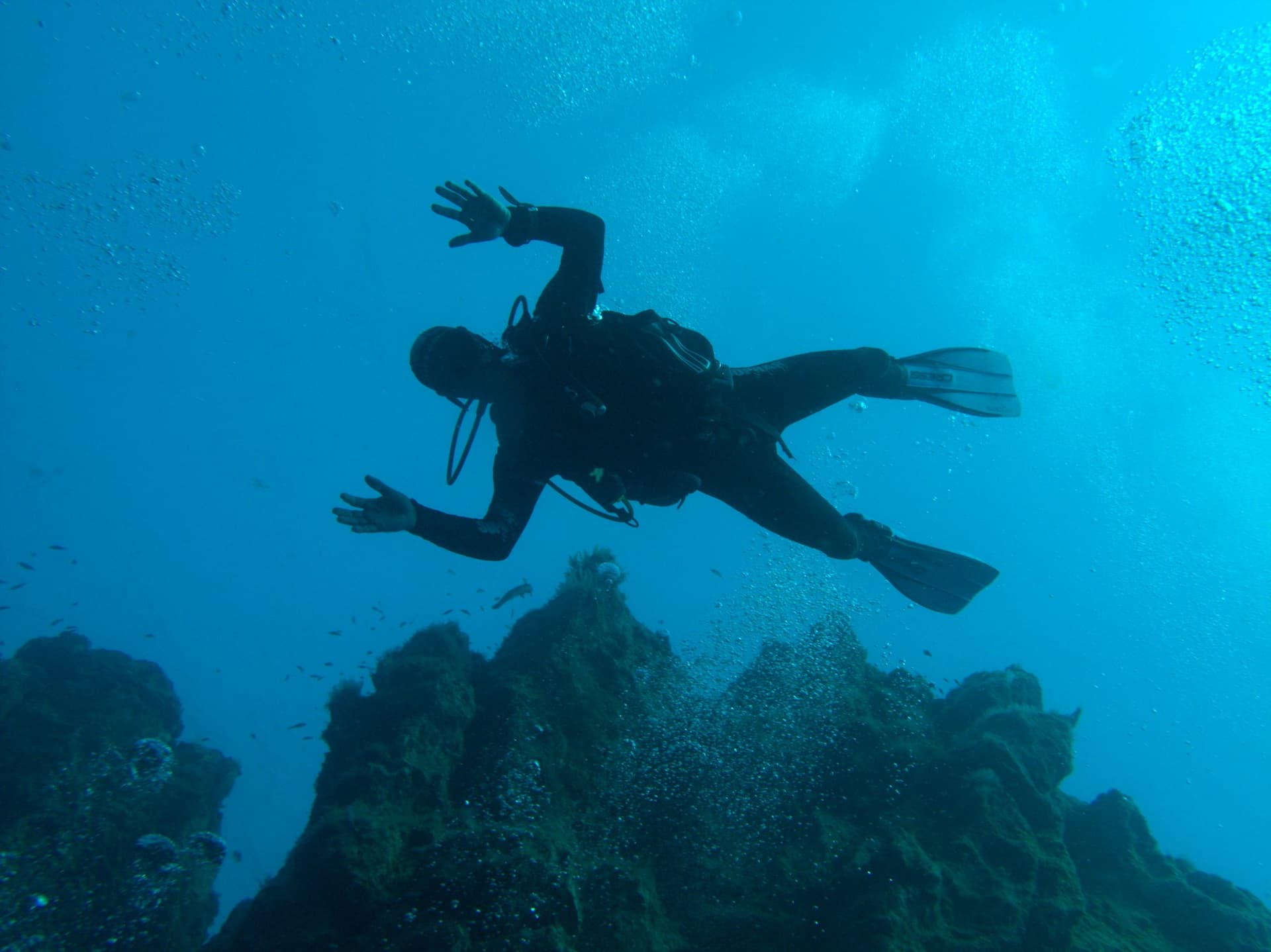
Thirty metres of vertical volcanic rock is the dive at El Veril. The mooring drops you onto a reef platform and the wall begins immediately — no slope, no gradual transition, just the edge and then open water falling away to 40 metres below. Groupers hold territory in the recesses of the face, and trumpetfish hang motionless against the dark rock, using their needle profiles as camouflage. The technique is simple: pick a depth along the wall and traverse it horizontally, watching the face for resident fish and the blue water beyond the drop-off for what moves past. Spanish divers call it "ojo en el azul" — keep an eye on the blue — and at El Veril that instinct occasionally pays off with amberjack or barracuda sweeping through from the open ocean.
El Veril's name tells you what it is. In Canarian Spanish, veril means submarine cliff — and the Canary Islands are full of geological drama that the Mediterranean doesn't offer at equivalent certification levels. At 23 to 40 metres, this is a wall at recreational depth limits, with Canarian visibility that frequently exceeds 30 metres and can reach 50 in optimal conditions. You can see the entire vertical face at once. The reserve protection has been in place since 1996, and the fish density along the wall reflects that: groupers here are not shy. The site also differs from the most sheltered reserve dives in one key way. El Veril faces the open ocean, which means it draws pelagic traffic that calmer interior sites rarely see. The current is the price for that exposure, and also the reason the pelagics show up.
Check conditions on the day — El Veril is the reserve site most likely to be closed in trade wind conditions. Unlike El Desierto or El Rincón, it has no topographic shelter, and surface swell makes both entry and ascent more demanding. A surface marker buoy is essential rather than optional. The wall base sits at exactly 40 metres, the recreational limit. Vertical faces are deceptive: without a slope to track, depth increases faster than expected, and there is nothing to grab. A depth alarm helps, but attention to the computer throughout the dive matters more. The site pairs naturally with Baja Rosario, which is close by and operates from the same mooring zone. On a good day in autumn, a morning at El Veril followed by Baja Rosario in the afternoon is a standard two-dive itinerary at La Restinga.
What makes this dive site stand out.
Clean volcanic drop-off from 23m to 40m, one of the reserve's most dramatic profiles
Dense resident population along the wall face, confirmed across multiple independent sources
Site faces open ocean, channelling amberjack and barracuda along the wall
Exposed to trade winds unlike the sheltered interior reserve sites
27.6400°N, 17.9900°W
Trade winds calmer, excellent visibility, and peak pelagic activity. Year-round diving possible when surface conditions allow.
General reserve pricing for El Hierro; verify current rates with your dive centre
The wall top at 23m already exceeds Open Water limits. Full descent to 40m requires gas planning and depth awareness. OW divers can participate with a guide if kept above 18m.
Summary
Depth reaching the recreational limit at 40m, vertical wall requiring precise buoyancy, and exposure to ocean current and swell. Access may be refused on windy days.
Safety considerations
What can go wrong here, and what divers do about it. Conditions change - take the briefing from the operator on the day.
Book a guided dive at this site.
SSI center in La Restinga, El Hierro, highly rated by divers, with 24+ volcanic sites, a 30m depth cap, and the top recommendation on Spanish dive forums.
Get in touch to add or claim your dive center listing on DiveCodex.
Dive centres in the Canary Islands check that you hold the certification the dive needs.
Veril is a Canarian Spanish term for a submarine cliff or drop-off. The word describes exactly what this site is: a vertical underwater face created by El Hierro's volcanic geology. It also appears in other Canary Island dive site names and on official reserve maps.
El Bajón is the more famous and more demanding dive, with twin pinnacles, unpredictable strong currents, and walls dropping past 80 metres. El Veril offers a similarly dramatic vertical profile at comparable depth but with more consistent conditions. Divers often do both in the same trip to El Hierro.
Groupers are the defining encounter, present in high density along the wall face year-round. Trumpetfish are numerous, hanging vertically against the volcanic rock. The wall position also channels passing pelagics from open water, including amberjack and barracuda, particularly in autumn.
The site sits within the marine reserve but faces the open ocean, making it more exposed than the sheltered interior sites like El Desierto or El Rincón. It can be closed on any given day due to wind or swell. September to November offers the most reliable access alongside the best pelagic activity.
El Hierro's insular shelf is exceptionally narrow — within 300 metres of shore, ocean depth exceeds 200 metres in many places. The reef platform begins at 23m where the volcanic substrate meets the drop-off, leaving no shallow section. This is not a site where you can dip a toe in before committing to depth.
Open Water divers can participate if a guide keeps the group above 18 metres on the upper reef platform. The wall itself, and the experience the site is known for, begins at 23m and requires Advanced Open Water. Most dive centres will assess conditions and diver experience before agreeing to take any group to El Veril.
Log your dives - notes, photos, conditions and the marine life you saw - and share them as one public diver profile. What you share helps the next diver, too.
Log every detail
Depth, duration, conditions, gear, buddy, notes — all in one place. Import from Suunto and other dive computers.
Track marine life
Record species sightings on each dive. Build a personal catalogue of everything you've seen underwater.
Your public dive profile
Share your dive history, stats, and experiences with a profile page you control. Show the world where you've been.