
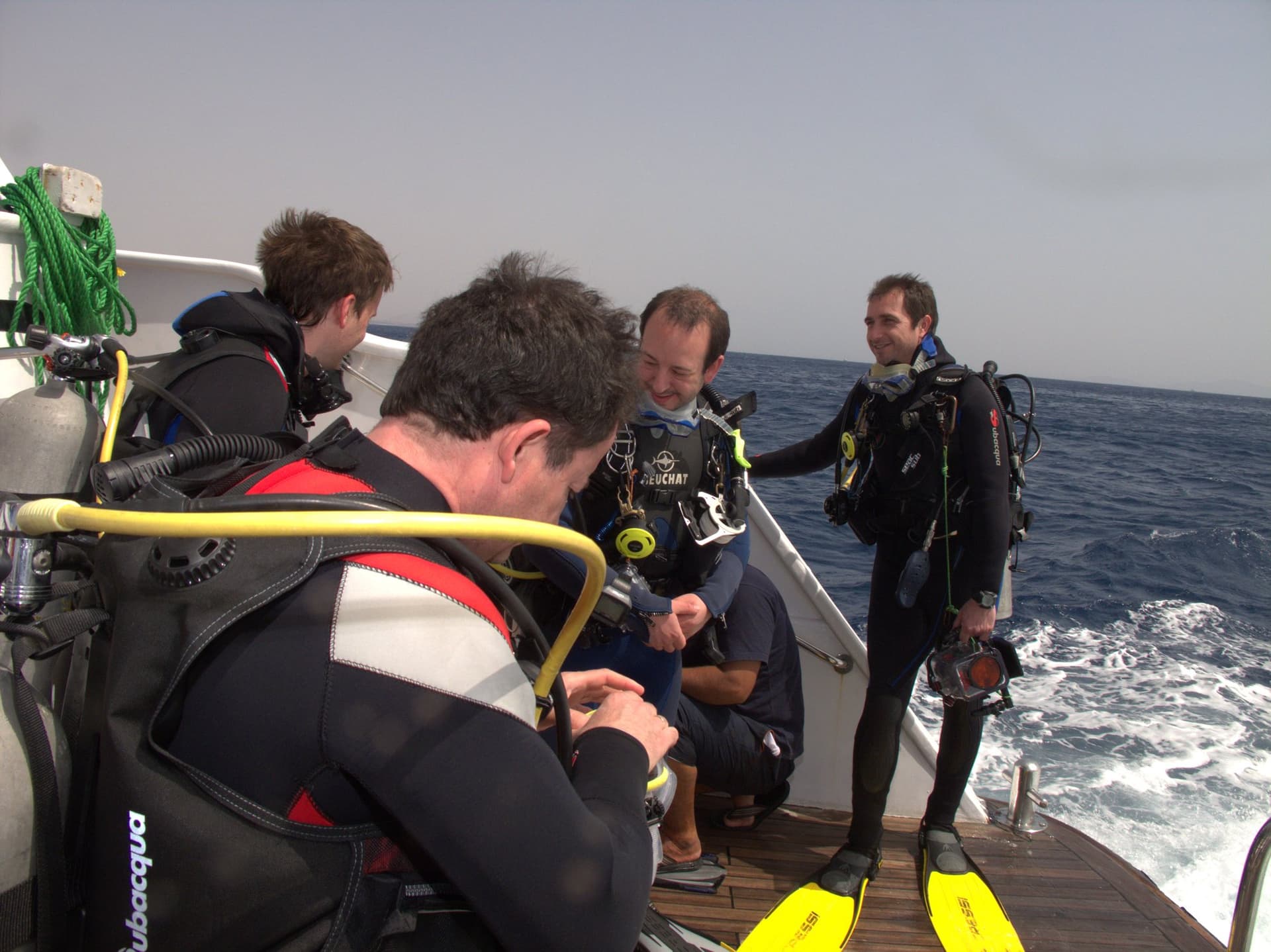

Long Island
Red Sea Explorers' largest liveaboard: 37.5m, 28 guests across 14 cabins, running the same GUE-leaning offshore and deep-south Egypt route catalogue.
Liveaboard28 guestsHurghada
Also known as: Fisherman's Bank, Jack Fish Alley, Stingray Alley
Ras Mohammed plateau split by a sandy alley from a satellite reef, dived as a drift past two swim-throughs and a coral garden.
Last updated October 2026
The drift starts at a white mark on the cliff and drops to a cave in the wall.1 The wall is porous, with small crevices and a couple of caves that each have separate entrances and exits. A dog-leg swim-through sits at 5 m, and a second at 15 m climbs back up to 5 m; it can also be dived in reverse. Past the wall the reef gives way to a sandy plateau and the dive splits into two options.
The alley is the strip of sand between the reef edge and a satellite reef about 50 m off. Jacks school here, which gave the site its name, and blue-spotted, feathertail and eagle rays turn up on the sand. The satellite reef is a run of pinnacles with soft corals and gorgonian fans, reached through a coral garden at 10-18 m. One pinnacle at 12-14 m holds glassfish, scorpionfish and lionfish, and barracuda hang at the cleaning station. The drop-off at the satellite reef's edge usually runs stronger current, which brings the bigger fish in to feed.
Under the drift sits the largest emperor fish spawning ground in Ras Mohammed National Park and in the whole Red Sea.1 Spangled emperors gather over the sandy plateau, which lies around 20 m, and the park patrols the site in the breeding season. The plateau is a working reef as well as a dive.
The plateau was a fishing ground before it was a dive, and the older name Fisherman's Bank records that.1 The later names, Jackfish Alley and Stingray Alley, come from the jacks and blue-spotted stingrays in the alley.
The mooring lines at the site were removed under the park's management, so it is a drift only.1 That arrangement dates from 2007, so confirm with your operator that it still holds, and expect a surface pickup at the end of the drift with a marker buoy deployed.
Current is the variable. It is mild to strong depending on the day, and at the satellite reef's drop-off it usually picks up, so that edge is where to decide with your guide whether to carry on or turn back along the alley.
What makes this dive site stand out.
A sandy channel separates the main reef from a satellite reef about 50 m away
A dog-leg at 5 m and a second at 15 m that climbs back to 5 m
A garden at 10-18 m runs on to satellite pinnacles of soft coral and gorgonian fans
Spangled emperors gather on the sandy plateau to spawn
27.7462°N, 34.2551°E
The spawning aggregation of spangled emperors falls in this window, though one operator describes the mating crowd as an early-spring event of only a couple of weeks. Diver accounts also place the most fish here in July and August.
The 5-18 m route of swim-throughs and coral garden is within Open Water depth, though operators grade the dive from Intermediate to open to all levels, and the current strengthens at the satellite reef edge. A guide-led group is the usual way to dive it.
Summary
A drift with variable current, strongest on the drop-off at the edge of the satellite reef.
Safety considerations
What can go wrong here, and what divers do about it. Conditions change - take the briefing from the operator on the day.
Multi-day safari boats with this site on their itinerary.
Red Sea Explorers' largest liveaboard: 37.5m, 28 guests across 14 cabins, running the same GUE-leaning offshore and deep-south Egypt route catalogue.

Red Sea Explorers' tech flagship: a 37m, 22-guest steel liveaboard with a full trimix/CCR fill station and scooters for offshore and deep-south Egypt safaris.
44m, 28-guest wooden liveaboard and the Sea Serpent Fleet's technical flagship, running the fleet's shared Egyptian Red Sea route pool: offshore Brothers-Daedalus-Elphinstone, northern wrecks and the Strait of Tiran, and southern St John's and Fury Shoals.
40m, 26-guest wooden liveaboard (SS Glorious Miss Nouran) running the Sea Serpent Fleet's shared Egyptian Red Sea pool: Brothers-Daedalus-Elphinstone, northern wrecks and Tiran, St John's and Fury Shoals, with a panoramic suite and rebreather support.

34m, 20-guest steel liveaboard running Tornado's full Egypt spread, from northern wrecks through the Brothers and Daedalus to a Deep South St John's week.
The park's management assessment gives a spawning season of April to July, while one Sharm operator describes the mating crowd of spangled emperors as an early-spring event lasting only a couple of weeks. The two windows overlap only partly, so ask your operator what the fish have been doing in the month you are going and do not plan around a single week.
The two swim-throughs, at 5 m and 15 m, are short passages with an open exit at each end and belong to the normal route. Separately, one cave in the wall is reported to run more than 40 m and to be enterable, a figure that rests on a single account. Treat anything beyond the swim-throughs as the guide's call, and do not enter an overhead without the training for it.
Local fishermen from El-Tur once held permits for the plateau in the breeding season, 40-50 boats at a time, and their anchoring damaged the reef. The park decreed an end to fishing within its boundary and patrols the site in the breeding season. The park's own 2007 assessment also lists fishing permits still being issued inside the park as a barrier, so enforcement was uneven at the time of writing.
Log your dives - notes, photos, conditions and the marine life you saw - and share them as one public diver profile. What you share helps the next diver, too.
Log every detail
Depth, duration, conditions, gear, buddy, notes — all in one place. Import from Suunto and other dive computers.
Track marine life
Record species sightings on each dive. Build a personal catalogue of everything you've seen underwater.
Your public dive profile
Share your dive history, stats, and experiences with a profile page you control. Show the world where you've been.