

Buceo La Restinga
SSI center in La Restinga, El Hierro, highly rated by divers, with 24+ volcanic sites, a 30m depth cap, and the top recommendation on Spanish dive forums.
SSI2 languages
Also known as: Cueva del Diablo, Devil's Cave
El Hierro's largest marine-reserve cavern, where two ceiling skylights light a vaulted chamber at 5-17m above a sandy floor.
Last updated July 2026
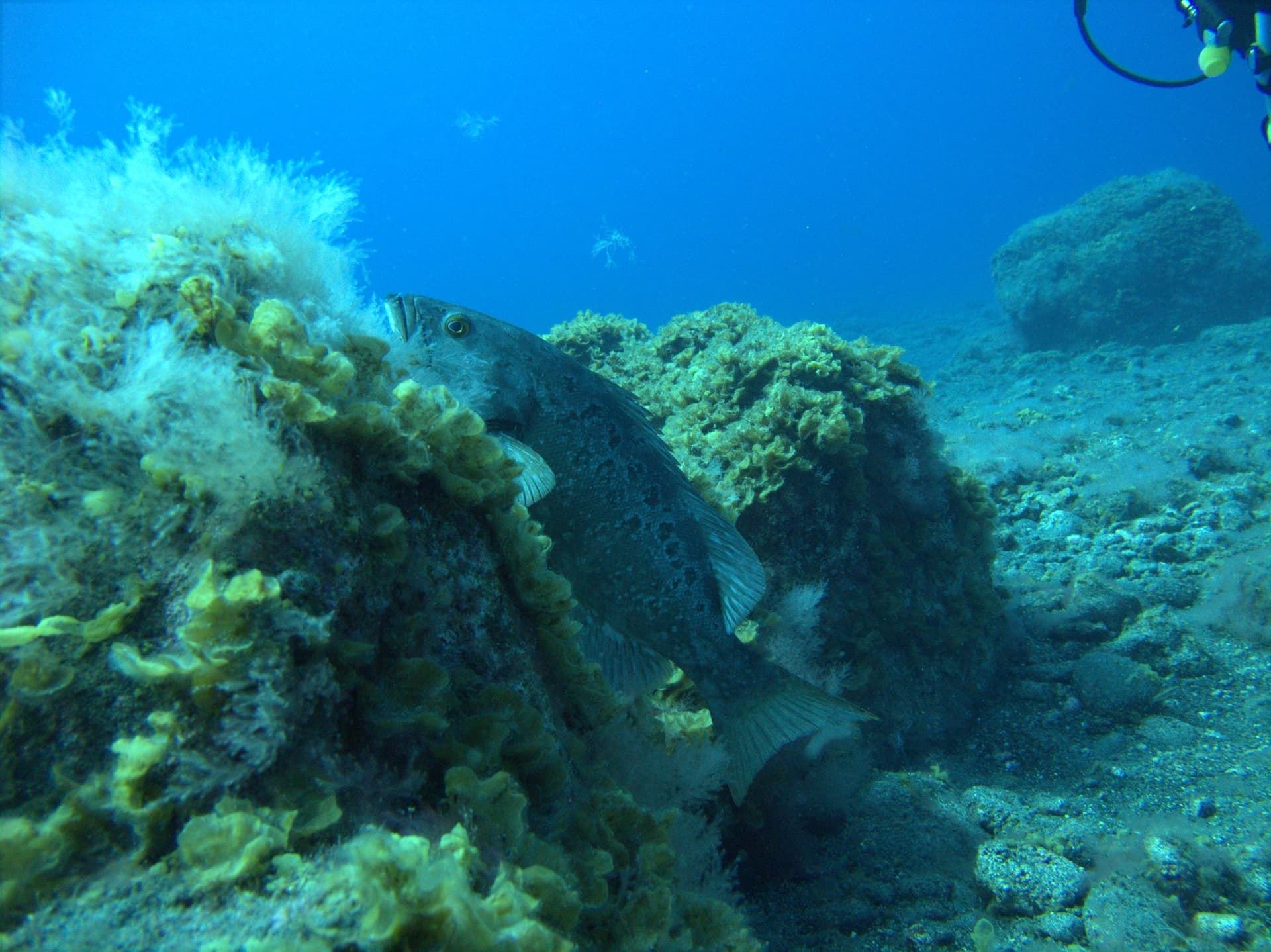
Most boats drop divers on the buoy at the foot of the cantil, the rocky cliff line that defines this stretch of reserve coast. The cliff falls past five metres to a sand-and-stone shelf at 12 to 15 metres, with the cavern mouth visible to one side and a small stone arch on the sand at 5m. Inside the chamber the register changes. The collapsed ceiling forms two wide openings, and after midday these become directional shafts cutting through the vault to the sandy floor at around eight metres. The cavern is large and well-lit enough that natural light reaches every corner; centres run it as an Open Water site, not as an overhead-environment dive. Moray eels work the wall crevices, both lobster species shelter in the deeper recesses where a torch helps, and porcupinefish drift near the entrance. Outside, the sandy exterior stays shallow to 15 metres, with octopus and the occasional grouper on the scattered stone, and the stone arch at 5m doubles as a final feature on the way back to the buoy. No current pushes you through. The dive rewards stillness over distance.
Three things set this site apart inside the reserve roster. It is the largest cavern Mar de las Calmas has, and divers consistently land on the same image to describe it - a church vault. The two skylights in the partially collapsed ceiling are the geometric signature, and the post-midday sun turns them into directional shafts of light rather than diffuse glow. And the cavern is not only an underwater feature: it continues above the waterline as a known cliff cave, and at the right tide the surface entrance can be reached by swimming or by small boat. One 2018 first-person account describes the spatial sensation inside as flying in three dimensions, a great room with the fallen-roof ray of light. That low-stress, photogenic register is the site's role on the El Hierro buoy list, distinct from El Bajón's deep pinnacles, El Saltu's lava-tube circuit, or El Desierto's garden eels. The wider reserve sits inside the El Hierro UNESCO Global Geopark1, and in 2025 the government proposed folding Mar de las Calmas into a national marine park2, recognition that fits the same conditions that make this single chamber worth the dive.
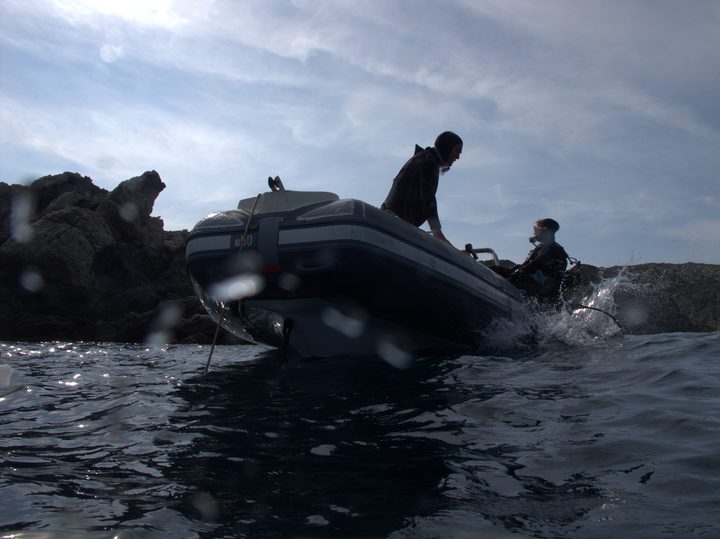
Buoyancy matters more here than at any open-water site. The sandy floor silts easily and ceiling contact dislodges sediment that clouds the chamber for everyone behind. Schedule the dive for the afternoon to catch the strongest skylight effects, and bring a torch for the deeper recesses where the lobsters hide; navigation inside relies on natural light. The boat ride from La Restinga is around fifteen minutes. Shore entry is technically possible but involves a difficult walk with equipment and is not recommended. All diving in the reserve34 runs through licensed centres, with a maximum of ten divers per boat and the instructor not counted5, and no anchoring or drift diving5, so booking with one of the four La Restinga operators is the only way in. Multi-day visitors waiting for an El Bajón weather window often pair this site with El Saltu or La Herradura on the same outing for variety without raising the difficulty.
What makes this dive site stand out.
Centres consistently describe it as the biggest cavern inside Mar de las Calmas.
A partially collapsed ceiling forms two wide openings that send light shafts to the floor at 8m.
A small arch on the sand outside the cavern doubles as a safety-stop landmark.
Herreña lobster and Canary slipper lobster shelter in the deeper recesses.
Sheltered inside Mar de las Calmas, run regularly as a discover-scuba site.
27.6678°N, 18.0209°W
Diveable year-round. Reserve peak window is June-October, with October recommended for visibility. The shallow, sheltered profile makes this one of the most weather-tolerant sites in the reserve.
Single-dive prices across the four La Restinga centres in 2024-2026. Double dives and 10-dive packs are cheaper per dive.
Rated Open Water level. The cavern is wide and naturally lit through two ceiling openings, and is not a technical overhead environment. Centres run discover-scuba dives here.
Summary
Shallow profile, no current inside the reserve, large openings with natural light throughout. One of El Hierro's easiest dives.
Safety considerations
What can go wrong here, and what divers do about it. Conditions change - take the briefing from the operator on the day.
Book a guided dive at this site.
SSI center in La Restinga, El Hierro, highly rated by divers, with 24+ volcanic sites, a 30m depth cap, and the top recommendation on Spanish dive forums.

Dive centre in La Restinga, El Hierro, operating since 1978 and certified under PADI, FEDAS/CMAS and ESA, with a stable, named team and bundled trip logistics.
Get in touch to add or claim your dive center listing on DiveCodex.
Dive centres in the Canary Islands check that you hold the certification the dive needs.
No. Despite the name, this is a wide cavern with two natural skylights and large openings where divers stay within view of natural light. It is rated Open Water level and centres run discover-scuba dives here. No guideline reels or redundant gas are needed.
After midday. Centres time the dive for the post-meridian sun angle, when the two ceiling skylights send defined light shafts down to the sandy floor. Morning dives still deliver the cavern experience but without the strongest illumination.
It is described as the largest cavern inside El Hierro's marine reserve. Divers compare the interior to a church vault, and a partially collapsed ceiling forms two wide skylights. No measured dimensions are published; an area-level estimate is around 100 m squared. The terrestrial entrance can also be reached from the surface by swimming or by small boat at the right tide.
Inside the cavern, moray eels are the most frequently reported species, with both the Herreña lobster and the Canary slipper lobster sheltering in the deeper recesses and porcupinefish near the entrance. The exterior sand and stone bottom holds octopus and dusky grouper, with stingrays and the occasional angel shark on the open sand patches. Tube anemones with arrow crabs are a small macro subject.
Yes. Maximum depth is 17m, there is no current inside the reserve, and the cavern's natural light gives constant visual reference. The site is one of the standard introduction and refresher dives on El Hierro.
No. Angel sharks rest on the sandy exterior occasionally, and the Canary Islands is one of the last strongholds for this critically endangered species, but no source treats sightings at this specific site as reliable. Plan the dive for the cavern and the light, and treat any angel-shark encounter as a bonus.
Both are cavern dives with natural light effects, but the experience differs. La Cueva del Diablo is a single large chamber with two defined skylight beams. El Saltu is a multi-cave circuit with a longer tunnel, an arch, and an optional deeper drop-off. La Cueva del Diablo is shallower and easier; El Saltu has more navigational variety.
Log your dives - notes, photos, conditions and the marine life you saw - and share them as one public diver profile. What you share helps the next diver, too.
Log every detail
Depth, duration, conditions, gear, buddy, notes — all in one place. Import from Suunto and other dive computers.
Track marine life
Record species sightings on each dive. Build a personal catalogue of everything you've seen underwater.
Your public dive profile
Share your dive history, stats, and experiences with a profile page you control. Show the world where you've been.