

Posidonia Dive
SSI Instructor Training Center at Port Balis marina, 35 km north of Barcelona, running 24 boat dive sites on the Maresme coast year-round.
SSI8 services3 languages
Also known as: Inmersión de la Virgen, The Virgen
Asymmetric rocky ridge at 16-27m off the Maresme coast, with documented nudibranch diversity and dense Mediterranean reef life.
Last updated May 2026
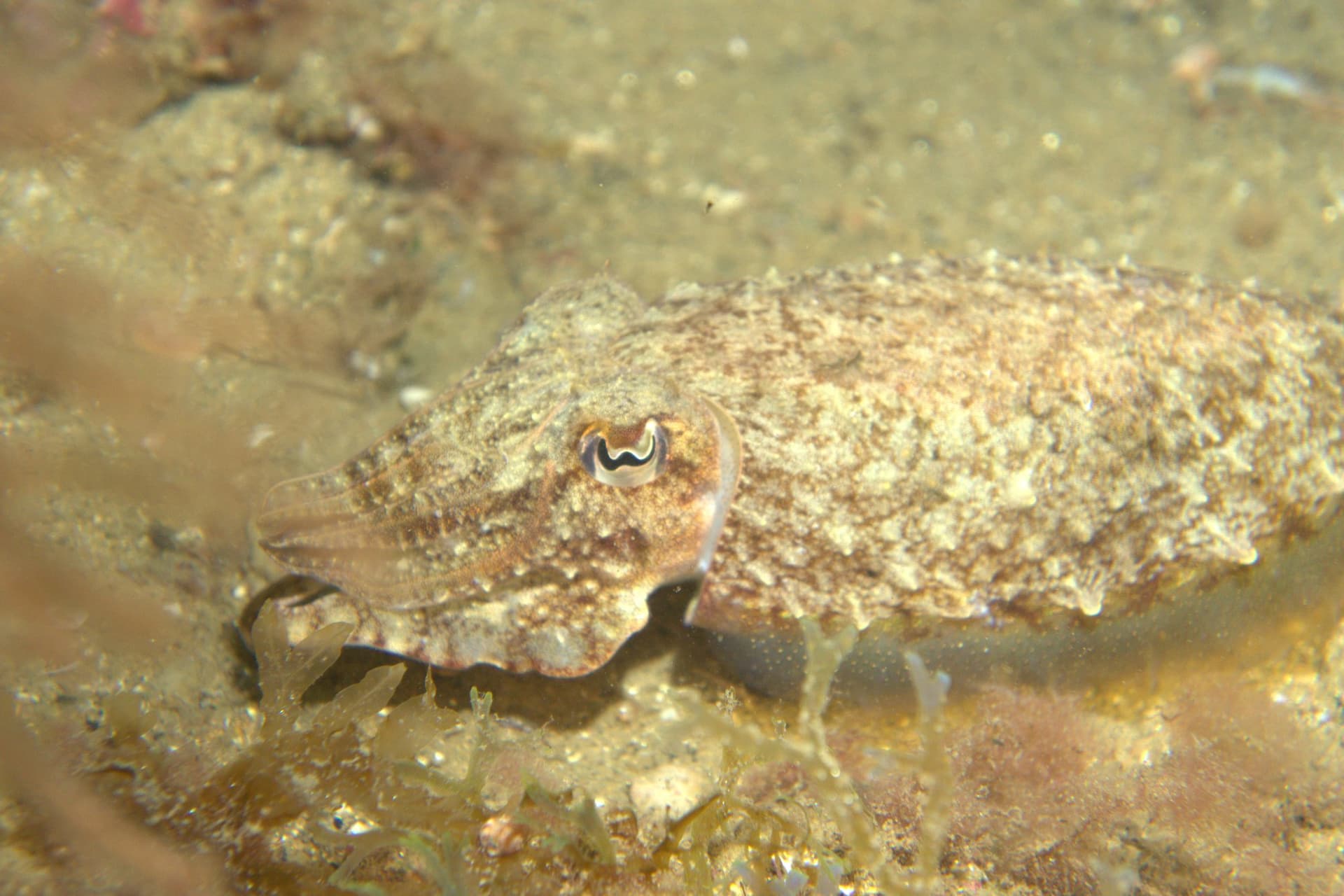
The descent finds the rocky ridge (barra) at around 16 metres, running north-east to south-west along the coast with sand on both flanks. The ridge is asymmetric, and that asymmetry is the practical navigation cue. The west flank is slightly shallower and fades onto sand more gradually - the easier side to slow down over, with octopus and scorpionfish in the rock and the occasional buried ray where it meets the sand. A 2013 sighting of a buried butterfly ray was found in exactly that kind of spot, with only its eyes and tail visible above the sand. The east flank is steeper and deeper - around 25 to 26 metres at the base - with bigger blocks and crevices, and reads better for wide structural photography.
Most groups follow one flank for the outbound leg and return on the other at shallower depth, with the boat's anchor line as a navigational reference. Centres typically run a line across the ridge from the anchor so divers exit on the opposite flank from the one they entered on. Bottom time on a 26 metre profile is typically 48 to 60 minutes, which is tight on air alone. Nitrox is the local norm for full coverage.
Visibility is the variable that matters most on this stretch of coast. A respectable 8 to 10 metres is typical, but it can crash to 4 metres in winter or after rain, and summer-calm exceptions reach 18 metres or more. Conditions on the descent are not always conditions on the safety stop.
The rocky ridge is a documented nudibranch observation site for the local Catalan species record, with Godiva Taronja (Dondice banyulensis) and Hypselodoris picta both photographed here across more than a decade. A diver carrying a macro lens has a reason to slow down here that does not apply to most other ridges in the Port Balis rotation. Spiny lobster density can be unusually high in localised patches: one diver counted five large individuals in a few square metres on a single visit, well above the typical area baseline. Older dive logs and blogs from the early-to-mid 2010s also describe a small religious figure on concrete blocks beside the natural ridge — a nativity-style scene that gave the site its name. Whether that placed feature is still in position today is unclear; recent dives have not confirmed it. The name has stuck regardless.
Surface chop is common on this coast and conditions below are usually unaffected. The typical pattern is calm at the bottom under a building Garbi (south-westerly) wind by mid-dive. Boarding back onto the boat is where the surface state actually matters. Visibility can drop without warning, so a compass and SMB belong on every dive on this profile. There is no fixed mooring; centres typically run a line across the ridge from the anchor to keep return navigation clean. Calibrate the exposure suit to the bottom — the summer thermocline drops bottom temperature 4 to 7 degrees colder than the surface band at 22 to 26 metres. Nitrox extends bottom time at depth and is widely available at both Port Balis and the Mataro port.
What makes this dive site stand out.
Godiva Taronja and Hypselodoris picta on the local Catalan nudibranch species record
West flank shallower and sandier; east flank steeper and deeper with bigger blocks for structural shots
Morays, barracuda, octopus, and lobsters reported across multiple years
30 minutes by car to Port Balis, boat access from two ports
41.5300°N, 2.5100°E
Warmest water and best conditions. Diving occurs year-round with logs from March, June, and November.
Air 38 EUR, Nitrox 32% 44 EUR at Mataro centres. Full equipment adds ~30 EUR. Verify current rates directly.
Ridge top sits at 16-17m, within OW limits with a guide. Full exploration to 27m requires AOW.
Described as 'a simple dive' by multiple reviewers. No significant currents. Straightforward reef navigation.
Book a guided dive at this site.
SSI Instructor Training Center at Port Balis marina, 35 km north of Barcelona, running 24 boat dive sites on the Maresme coast year-round.
Get in touch to add or claim your dive center listing on DiveCodex.
Dive centres in Catalonia must require insurance from every diver on their dives, and must be able to offer a policy to anyone who has none.
The ridge is a documented nudibranch observation site, with Godiva Taronja (Dondice banyulensis) and Hypselodoris picta on the local Catalan species record. That distinguishes it from the half-dozen otherwise similar bars in the Port Balis rotation. Older dive logs also describe a small religious figure on concrete blocks beside the ridge that gave the site its name; whether that placed feature is still in position today is unclear from recent sources.
The ridge top sits at 16-17m, just within OW limits. Dive centres list it as suitable for all levels with a guide, likely on a profile that stays at 16-20m. The full depth range to 27m requires Advanced Open Water.
Yes. The site rewards close-up work, not panoramic views. Typical visibility is 8 to 10 metres, with winter and post-rain dives sometimes dropping to 4 metres and summer-calm windows reaching 18 metres or more. Nudibranch hunting and crevice checking work fine at the lower end of the range.
Dive logs and blog posts from 2012 to 2017 describe a small religious figure (a Virgen statue, sometimes paired with a belen / nativity scene) placed on concrete blocks beside the natural ridge — a Mediterranean coastal tradition where fishing communities position devotional objects on the seabed. More recent dives have not confirmed the figure is still in position. Treat it as a historical feature that may or may not be there today.
Port Balis serves around 20 dive sites on the Maresme barras. Centres routinely schedule two-dive mornings across sites like El Trencat, Canons, Montseny, and El Santuari. La Virgen's moderate depth and relaxed profile make it a popular pairing.
Two species appear in the local Catalan nudibranch species record for this site: Dondice banyulensis (Godiva Taronja, the Orange Godiva) and Hypselodoris picta. Both have been photographed by divers across more than a decade. Slowing right down along the shallower west flank, especially where the rock fades to sand, is the way to find them.
Log your dives - notes, photos, conditions and the marine life you saw - and share them as one public diver profile. What you share helps the next diver, too.
Log every detail
Depth, duration, conditions, gear, buddy, notes — all in one place. Import from Suunto and other dive computers.
Track marine life
Record species sightings on each dive. Build a personal catalogue of everything you've seen underwater.
Your public dive profile
Share your dive history, stats, and experiences with a profile page you control. Show the world where you've been.