
El Marmoler
Also known as: Avvenire, El Marmolero, Marmoler, Marmolero
Italian cargo wreck off the Costa del Montgri at 32-44 m, with Carrara marble cargo still visible in the holds. Advanced to technical.
Last updated May 2026
The dive
The shot line drops to the bow of a 47 m Italian cargo ship lying slightly listed on a mud and sand bottom. The top of the superstructure sits at about 32 m. From there the hull runs back toward the stern, recognisably a ship and not a debris field, with deck plating, holds, and the line of the gunwales still readable. Most guided dives work the 36-40 m band, drifting along the deck and looking down into the open holds. Inside them, slabs of Carrara marble are still stacked: the visual signature of the wreck and the reason most divers come.
A typical AOW-deep profile keeps to the bow and upper deck. Technical outings push into the deepest hull at 42-44 m on a short 20-minute bottom time, then run up the line on accelerated stops. Visibility on the wreck is bimodal. On a calm summer morning a diver can pick out the hull from 15 m above, and one June 2009 dive at 8.30 a.m. described "sea like a plate, blazing sun, great visibility, loads of creatures everywhere". Around the stern in particular, divers report visibility is not always good, so a torch and a guideline through the back end of the dive are routine. The dive ends with a controlled ascent up the line, with the marble cargo as the last image.
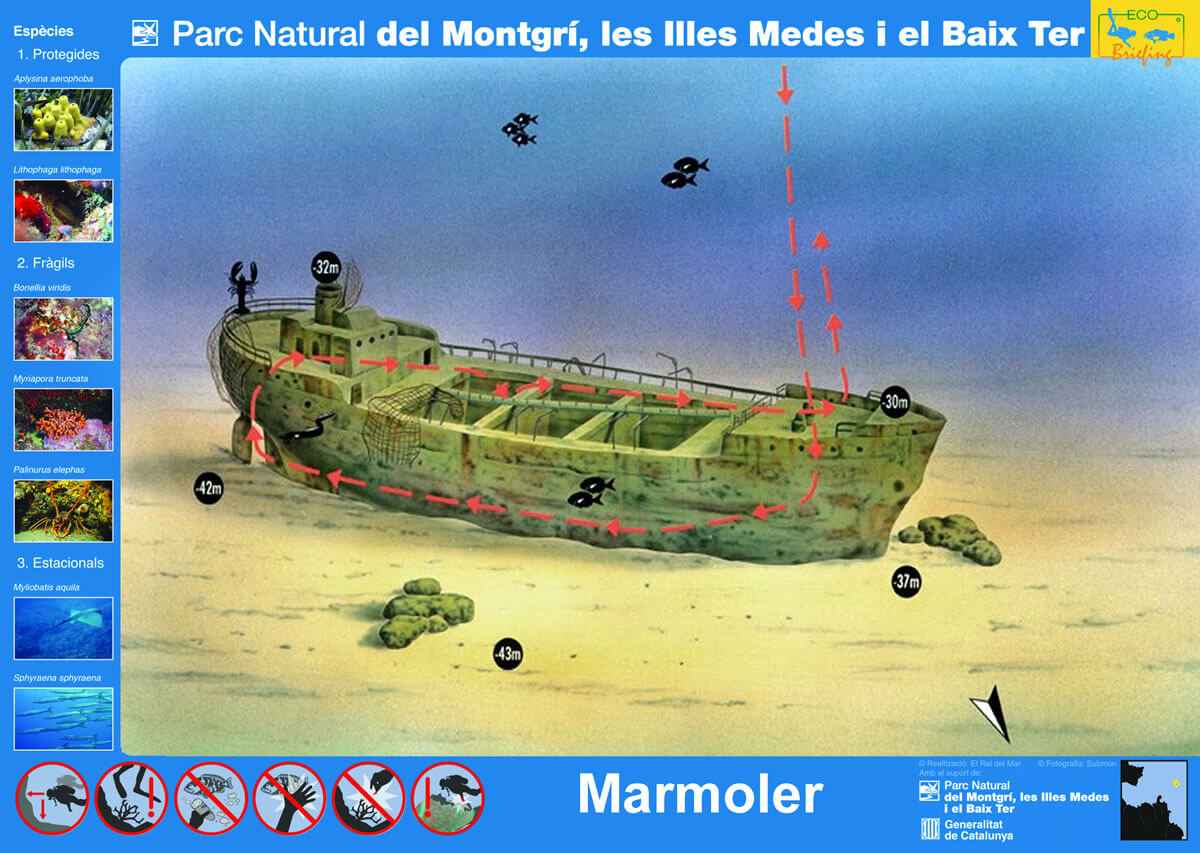
Illustration: Parc Natural del Montgrí, les Illes Medes i el Baix Ter — Generalitat de Catalunya
What makes it special
The marble cargo is the singular thing. No other accessible wreck on this stretch of Costa Brava coast offers the same artefact-rich interior, and the regional dive-association page describes Marmoler as the only wholly conserved wreck in the area. The 32-44 m depth band gives the dive a clear purpose: AOW divers can stay on the bow and upper holds, technical divers can drop into the deepest sections, and either group goes specifically to see the marble. Local centres frame it as the deep half of the area's two-wreck pairing with the shallower Reggio Messina, packaged as the "Pecis del Parc Natural" wreck route.
History and origin
The Avvenire was a 47 m, 389-tonne Italian cargo vessel built in 1930. On 17 May 1971 she was caught in a severe storm off the Costa del Montgri, lost the ability to hold the coast, and was wrecked with her cargo of Carrara marble in the holds. The wreck was cross-referenced to wrecksite.eu (entry 95291) by a local technical centre.
Two community accounts capture the wreck's early life. One El Maresme diver, writing in 2008, recalled descending within weeks of the sinking, when there was no encrustation yet, marble slabs everywhere, and the propeller still in place. Another forum post the same year described pre-GPS sighting marks: align El Cargol rock to the left of Montgo with the drop of the Meda Grande and the Foradada cliff to form a "V", and you sit above the Marmoler. As of the late 2000s those accounts placed a spare propeller from the ship in a garden in L'Escala. Modern wreck descriptions no longer reference a propeller on the site.
Know before you go
Plan the depth band before you descend. Bow and upper deck at 32-36 m is the standard recreational profile; the deeper hull sections at 42-44 m belong to advanced nitrox or technical divers. Nitrox is worth it at the standard band and almost mandatory if you push deeper. Carry a torch for the holds and the lower-visibility stern. Old nets and monofilament can sit on the wreck as environmental substrate; stay off the structure and keep trim. The wreck is 2 nm offshore from L'Escala, about a 30-minute boat ride, or 45 minutes from L'Estartit. Tramontana and levante shut the trip down, so morning departures and a flexible schedule pay off. AOW with a deep speciality is the realistic minimum.
Why Dive El Marmoler
What makes this dive site stand out.
- Carrara marble cargo
Marble slabs from the original 1971 cargo are still stacked in the open holds
- 47 m Italian cargo hull
Avvenire, built 1930, sunk 17 May 1971, lies slightly listed and largely in one piece
- 32 to 44 m depth band
Bow superstructure tops out near 32 m, deepest hull and keel sit at 42 to 44 m
- Two-wreck pairing with Reggio Messina
Local centres run the deep Marmoler with the shallower Reggio as a Costa del Montgri wreck route
- Weather-window dive only
2 nm offshore exposure means trips run mainly in calm July to August conditions
Depth & Profile
Location
42.1080°N, 3.1894°E
Conditions & difficulty
Local centres reserve the trip mainly for July and August because of offshore weather windows. Calm June mornings also work.
Verify current rates with the centre. Boat from L'Escala is shorter (~30 min) than from L'Estartit (~45 min).
AOW with deep speciality covers the bow and upper deck (32-36 m). Tech / advanced nitrox is recommended for the deepest hull at 40-44 m.
Summary
Depth, gas planning, variable stern visibility, and offshore exposure put the wreck on the recreational and technical boundary.
Safety considerations
What can go wrong here, and what divers do about it. Conditions change - take the briefing from the operator on the day.
- Depth: Deepest sections at 42-44 m bring decompression and gas planning into playPlan a turn pressure, use nitrox or doubles where appropriate, run conservative bottom times
- Visibility: Stern visibility is less reliable than the bow end of the wreckCarry a torch and run a guideline through the back of the dive
- Overhead: Old fishing nets and monofilament line can sit on the wreck as environmental substrateStay off the structure, keep trim and buoyancy, hover rather than settle
Rules and permits
Dive centres in Catalonia must require insurance from every diver on their dives, and must be able to offer a policy to anyone who has none.
Frequently Asked Questions
Why is it called El Marmoler?▾
The Spanish and Catalan name means 'the marble carrier'. The wreck is the Italian cargo ship Avvenire, which sank on 17 May 1971 with a cargo of Carrara marble in her holds. Slabs of marble are still stacked in the open holds and remain the dive's visual signature.
What certification do I need to dive El Marmoler?▾
AOW with a deep speciality is the practical minimum for the bow and upper deck at 32-36 m. The deepest hull at 42-44 m sits at the edge of recreational limits and is better suited to advanced nitrox or technical divers carrying gas for accelerated decompression.
Do I need a permit or pay the Medes diving fee here?▾
No. El Marmoler is inside the Parc Natural del Montgri, les Illes Medes i el Baix Ter but outside the Reserva Natural Parcial of the Medes islands. There is no per-diver park fee or quota for the Costa del Montgri coast and no permit needed.
When is the best time of year to dive El Marmoler?▾
July and August are the most reliable months. The wreck is 2 nm offshore, so the dive depends on calm sea state. Some centres reserve the trip explicitly for those two months. Calm June mornings also work, but tramontana or levante cancels the day.
How does El Marmoler compare to the Reggio Messina?▾
Both are wrecks on the Costa del Montgri, but they are different dives. The Reggio Messina is shallower (23-35 m), broken into roughly 20 fragments, and lies five minutes from L'Estartit. El Marmoler is deeper (32-44 m), largely intact, and carries the marble cargo. Centres run them as a paired wreck route over two days.
Is the wreck protected by maritime heritage law?▾
No specific Spanish or Catalan maritime-heritage designation has been verified for this wreck in current sources. The general park rules apply: do not remove artefacts, do not touch or feed marine life, no anchoring on Posidonia.
Photos
Videos
Every dive has a story. Share yours.
Log your dives - notes, photos, conditions and the marine life you saw - and share them as one public diver profile. What you share helps the next diver, too.
Log every detail
Depth, duration, conditions, gear, buddy, notes — all in one place. Import from Suunto and other dive computers.
Track marine life
Record species sightings on each dive. Build a personal catalogue of everything you've seen underwater.
Your public dive profile
Share your dive history, stats, and experiences with a profile page you control. Show the world where you've been.