
Montelivi
Also known as: Montelivi, Roca Montilivi
Offshore 500m rocky formation off Sant Feliu, dropping from 15m to 40m with vertical walls, yellow anemone cover and coralligene at the deeper core.
Last updated May 2026
The dive
The boat run sets the tone before the descent does. Piscis Diving frame Montilivi as a 25-minute trip south, with an entry that drops "into the blue" and the rock visible only as a vague mass below; SubLimits run a more direct line to Punta dels Canyets and a cleaner over-the-top descent. Either way, you are on an exposed offshore rock rather than a sheltered bay reef.
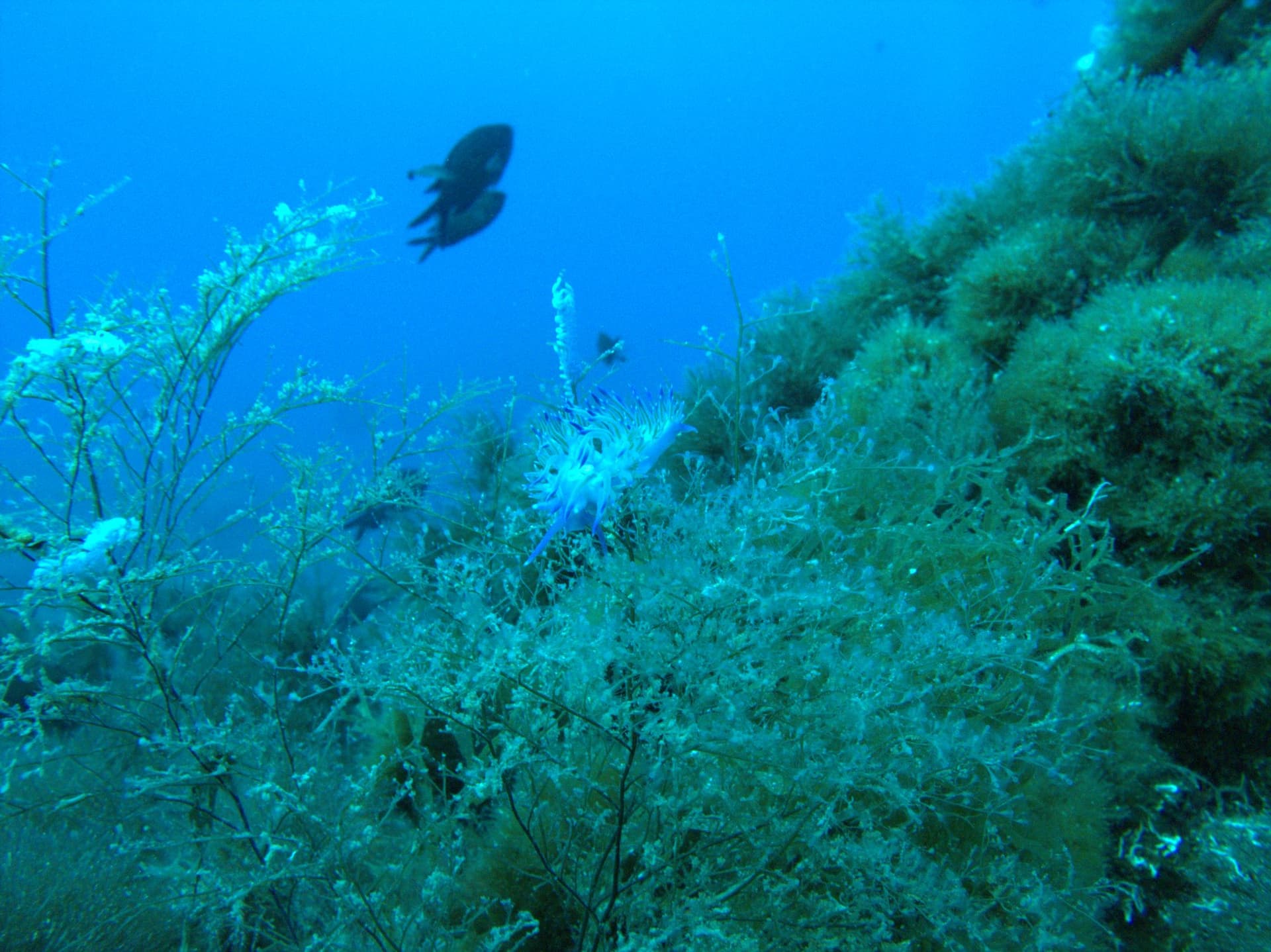
Once on the wall, the dive becomes a long traverse. Centres describe vertical faces between 18 and 33 metres carpeted in yellow encrusting anemone over coralligene rock — the visual signature SubLimits flag in their own write-up. Crevices and holes shelter morays at every depth and conger eels of considerable size deeper in the rock; groupers turn up occasionally in the recesses, calibrated as an open-coastline encounter rather than a reserve fish stock. The 500m extent means a single tank covers one section: an inshore shoulder one day, the deeper outer end on another. Older trip reports describe a sunfish waiting at the mooring on one May descent and a few lobsters tucked into the deeper crevices.
What makes it special
Most of the Sant Feliu rotation is compact: a tunnel system at Port Salví, a two-zone reef at La Llosa, a small islet at S'Adolitx. Montilivi reads as the long offshore alternative — half a kilometre of continuous rock that lets the centre pick a section appropriate to the day and the group. SubLimits flag the yellow-anemone wall cover at the 18-33m core as the visual hallmark; Piscis Diving anchor the dive in the descent itself, into a water colour that reads differently because the bottom composition shifts the tone. Forum reports from a decade and a half ago describe the site in the same key — depth and quiet rather than spectacle, run for AOW divers willing to drive to Sant Feliu for an alternative to the bay sites. No recent community write-ups have surfaced, so the modern feel rests on what the two centres choose to highlight.
Know before you go
Ask which section of the formation the centre is running before you book. SubLimits and Piscis Diving describe the same long rock from different ends, and the profile differs accordingly: a shallower 15-20m start, the rich 18-33m wall middle, or a 26-40m outer end. Nitrox is worth arranging for the wall core, where most of the dive is spent. The offshore position means weak-to-moderate currents are more likely than at the sheltered inshore sites, so keep an SMB ready and watch your gas margin on the deeper end. The dossier records old fishing nets adhered to the rock from a 2009 centre log; treat them as substrate rather than navigation hazard, and stay off the structure rather than reaching into crevices for a closer look.
Why Dive Montelivi
What makes this dive site stand out.
- 500m offshore rock
Continuous formation lets the centre pick a section to match the day and the group
- Yellow anemone wall
Parazoanthus axinellae cover described on the 18-33m vertical faces
- Drop into the blue
Piscis Diving's entry begins in open water with the rock visible only as a vague mass below
- Multilevel depth choice
Profiles from 15-20m shoulders through 18-33m core to a 38-40m outer end
- Quiet site, not a marquee
Older trip reports describe it as little-known and run on calm-weather AOW days
Depth & Profile
Location
41.7820°N, 3.0250°E
Conditions & difficulty
Late summer and early autumn for the calmest offshore conditions. Diveable year-round when weather allows the boat run.
Boat outing pricing applies; verify rates with your centre. Sant Feliu centres include Montilivi/Montelivi in their boat rotation.
AOW for the recommended 18-33m wall core and for the Piscis entry that descends in open water. OW divers can be taken on shallower 15-18m starts when the centre selects that section.
Summary
Multilevel and exposed. Depth management on the deeper outer end and a comfortable open-water descent on the Piscis entry are the main planning factors.
Safety considerations
What can go wrong here, and what divers do about it. Conditions change - take the briefing from the operator on the day.
- Depth: The outer end runs to 38-40m with the rock dropping into open water.Plan gas and depth conservatively. The richest habitat is at 18-33m, so deeper sections are not necessary for the experience.
- Current: Weak to moderate currents possible because of the offshore exposure.Check conditions with the centre before booking the deeper section; ascent typically uses the boat anchor line.
Marine Life
Rules and permits
Dive centres in Catalonia must require insurance from every diver on their dives, and must be able to offer a policy to anyone who has none.
Frequently Asked Questions
How big is the Montilivi formation?▾
Local centres describe it as roughly 500 metres of offshore rock, with depth running from 15-20m at the top to 38-40m at the outer end. Different centres enter at different points along its length, which is why one diver's 'Montilivi' starts at Punta dels Canyets while another's starts near Cala Giverola.
Why are both Montilivi and Montelivi used as the name?▾
Sant Feliu centres use the two spellings interchangeably for the same offshore formation. There is no separate site behind the second spelling; the variants reflect local naming convention rather than two distinct dive sites.
What certification do I need for Montilivi?▾
AOW is the working minimum because the recommended 18-33m wall core sits beyond OW limits and one of the local entries descends in open water. OW divers can be taken on shallower 15-18m sections when the centre chooses that part of the formation, but the dramatic walls and densest cover are deeper.
What does the wall actually look like?▾
Vertical faces between 18 and 33m carpeted in yellow encrusting anemone (Parazoanthus axinellae) over coralligene rock. Crevices in the wall hold conger eels and morays, with the occasional grouper deeper in. The geometry forms an L-shaped wall riddled with holes and shelters.
Is Montilivi a marine reserve?▾
No. The Bio-knowledge Marine Area developing around Sant Feliu covers Cala Ametller, Punta de Garbí and Cala Vigatà. Montilivi sits outside that footprint. Spanish recreational diving rules apply (40m maximum, dive computer and SMB, insurance), but no permit, fee or quota is required for this site.
Should I expect to see eagle rays or sunfish?▾
Both are seasonal Mediterranean visitors, not defining residents. Eagle rays and the occasional stray sunfish are reported here in summer, and one sunfish was observed at the mooring on a May 2011 dive. Treat them as a possible bonus rather than a reason to choose this site.
Photos
Every dive has a story. Share yours.
Log your dives - notes, photos, conditions and the marine life you saw - and share them as one public diver profile. What you share helps the next diver, too.
Log every detail
Depth, duration, conditions, gear, buddy, notes — all in one place. Import from Suunto and other dive computers.
Track marine life
Record species sightings on each dive. Build a personal catalogue of everything you've seen underwater.
Your public dive profile
Share your dive history, stats, and experiences with a profile page you control. Show the world where you've been.