
Punta del Bau
Also known as: La Punta del bau, La Punta del Bau, Punta Bau
Easy wall dive near L'Escala with a hidden cave at 6 m — a crack at 12 m opens into a small chamber with crayfish and spiny lobster in spring.
Last updated May 2026
The dive
The boat moorings on the seaward edge of the headland, and the descent drops onto a slope of stacked limestone blocks against the cliff foot. This is not a vertical wall — it is an irregular staircase of rock from around 12 m down to sand at 20-22 m, with crevices and ledges between the blocks that hold the marine life. Moray eels occupy the holes, octopus press into the darker gaps, and wrasse move alongside through the mid-water. Follow the wall southward.
Before the route reaches Cala Montgó, a crack opens in the rock face at 12 m. It ascends the wall and opens into a small cave at 6 m depth. Inside, crayfish shelter in the low light alongside creatures local divers describe in the crevice walls. A torch helps. In the colder months from March through July, numerous spiny lobsters move into this crevasse — the cold water concentrates them. The cave can be crossed without difficulty and has no overhead restriction that requires special training. It is the defining point of interest on what would otherwise be a standard block wall.
The standard route exits the wall into Cala Montgó, where the boat repositions at Punta Xeric. Divers who want more depth can continue along the wall to Punta Xeric's deeper section at around 25 m — that portion is Advanced Open Water territory.
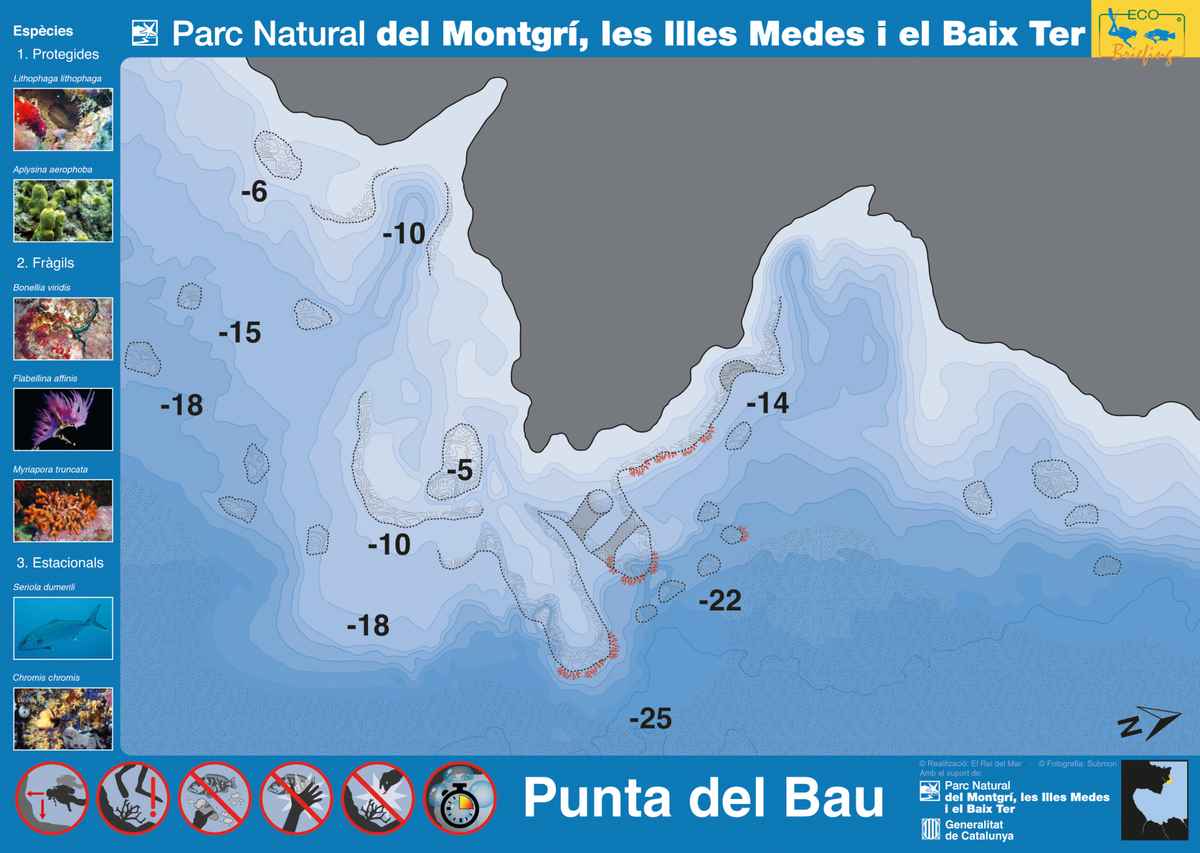
Illustration: Parc Natural del Montgrí, les Illes Medes i el Baix Ter — Generalitat de Catalunya
What makes it special
Punta del Bau earns its place on operator rotation through shelter, not spectacle. When the Tramuntana blows out the north-facing Montgrí walls and the Medes are too rough to consider, this site goes. The headland geometry is the whole reason it exists as a named dive site — centres in L'Escala and L'Estartit know exactly which days to schedule it.
What makes the dive itself worth remembering is the cave. A shallow crack at 12 m ascending to a chamber at 6 m is modest by any measure, but it adds a fixed objective and a reason to slow down. The crevice fauna — including the seasonal lobster concentration — rewards time spent looking. Fish on this stretch run wary, given the consistent diver traffic and the nearby swimming area, but the invertebrate life in the block crevices is reliable.
Know before you go
Summer boat access to the cove is reportedly restricted in some months due to a nearby swimming beach — confirm dates with your L'Escala centre before booking July or August. Otherwise logistics are simple: the site is served by L'Escala-based operators who also cover the Medes, making it easy to combine both coastlines in one trip. Bring a torch for the cave at 6 m and the deeper block crevices. Standard air is appropriate for the 12-22 m core route; if you plan to extend to Punta Xeric, Advanced Open Water certification applies for the deeper section. Diving insurance is compulsory in Spain — centres typically sell day or week cover.
Why Dive Punta del Bau
What makes this dive site stand out.
- Hidden cave at 6 m
A crack at 12 m ascends the wall to a small cave where crayfish and lobster shelter.
- Tramuntana fallback
Sheltered from north wind when exposed Montgrí and Medes sites are unworkable.
- Spiny lobster March to July
Cold-water months drive numerous lobsters into the cave crevasse. Peak spring visit.
- Wall traverse to Punta Xeric
Route continues south along the cliff base to Punta Xeric for AOW divers.
Depth & Profile
Location
42.1250°N, 3.1330°E
Conditions & difficulty
Spring and autumn preferred by locals for fewer crowds. March-July is peak for lobster density in the cave crevasse.
No Medes Islands Tax applies on Montgrí coast dives. Verify current rates with L'Escala-based centres.
OW for the core 12-22 m wall. AOW recommended for the deeper extension to ~25 m at Punta Xeric.
Summary
Easy on the main wall. The cave at 6 m is crossable without difficulty. The extension to Punta Xeric enters AOW-level depth.
Safety considerations
What can go wrong here, and what divers do about it. Conditions change - take the briefing from the operator on the day.
- Surface and boat traffic: Swimming safety zones near the adjacent beach may restrict boat access in summer.Confirm access conditions with your L'Escala dive centre before booking July-August.
- Current: Current can build around the headland point on north-wind days despite wind shelter.Check conditions with operator on departure day.
Rules and permits
Dive centres in Catalonia must require insurance from every diver on their dives, and must be able to offer a policy to anyone who has none.
Frequently Asked Questions
What is the cave feature at Punta del Bau?▾
At 12 m depth on the wall, a crack opens in the rock and ascends to a small cave at 6 m. Inside, crayfish and crustaceans shelter in the low light. Local operators recommend a torch. The passage is short and crossable without difficulty — it is not a cave dive in the technical sense, but it adds a genuine point of interest beyond the standard block wall.
When is the best time to see lobsters at Punta del Bau?▾
March to July, when colder water drives spiny lobster (Palinurus elephas) into the cave crevasse. This stretch of the Costa del Montgrí coast is cold-water Mediterranean — the spring cold is what concentrates the lobsters. By summer the water warms and they disperse.
Is Punta del Bau suitable for beginners?▾
Yes. The main wall runs from 12 to 22 m on stone blocks — a straightforward profile for Open Water divers. The cave at 6 m is within reach of any certification level and adds interest without requiring overhead skills. Centres list it as an initiation and first-of-season dive.
Do I need a permit to dive Punta del Bau?▾
No. Punta del Bau is inside the Parc Natural del Montgrí, les Illes Medes i el Baix Ter, but outside the Illes Medes marine reserve. There is no per-diver permit, no daily quota, and no reserve entry fee. The Medes Islands Tax does not apply here.
Can I extend the dive to Punta Xeric?▾
Yes. The standard route follows the wall south from Punta del Bau and exits into Cala Montgó at Punta Xeric, where the boat repositions. The extension adds depth to around 25 m — Advanced Open Water territory. It is a one-way traverse rather than a return dive.
Why is Punta del Bau used on Tramuntana days?▾
The site sits in the lee of a small headland between Trencabraços and Punta Xeric, protected from the N/NNE Tramuntana wind that closes more exposed sites on this coast. Centres in L'Escala and L'Estartit keep it on rotation specifically for bad-wind days when the Medes and the north-facing Montgrí walls are too rough.
Is there boat access in summer?▾
There may be restrictions. The cove near Punta del Bau is reportedly closed to boats in summer months due to proximity to a swimming beach. The exact dates vary — confirm with your dive centre before booking a July or August trip.
Photos
Every dive has a story. Share yours.
Log your dives - notes, photos, conditions and the marine life you saw - and share them as one public diver profile. What you share helps the next diver, too.
Log every detail
Depth, duration, conditions, gear, buddy, notes — all in one place. Import from Suunto and other dive computers.
Track marine life
Record species sightings on each dive. Build a personal catalogue of everything you've seen underwater.
Your public dive profile
Share your dive history, stats, and experiences with a profile page you control. Show the world where you've been.