
Punta Milà
Also known as: La Punta Milà, Punta Mila
Dual-profile wall and cave dive on the Montgrí coast with a 25 m wall, a European lobster cave at 19 m, and a shallow historic salt-store section.
Last updated May 2026
The dive
Punta Milà runs two profiles on a single boat. The group splits at anchor: advanced divers descend the wall while beginners stay in the shallow Cova de la Sal section. On the wall, rock blocks begin around 18 m — broken fragments of the Montgrí massif, now settled into a complex of crevices. Wrasses work the stones constantly; octopus press into the tighter gaps; a scan mid-column sometimes turns up a grouper. The cave at 19 m is the route's navigation anchor. It is small enough to require a torch and short enough to use as a brief penetration before the turnaround. Inside, a European lobster (bogavante) is reliably found. The return follows depth back up through the rock-block zone to the Cova de la Sal, where the beginner group has been exploring the historic shallows. From here, a 40 m swim along the wall toward the headland reaches a platform where larger species occasionally appear — monitor your air before committing to the extension.
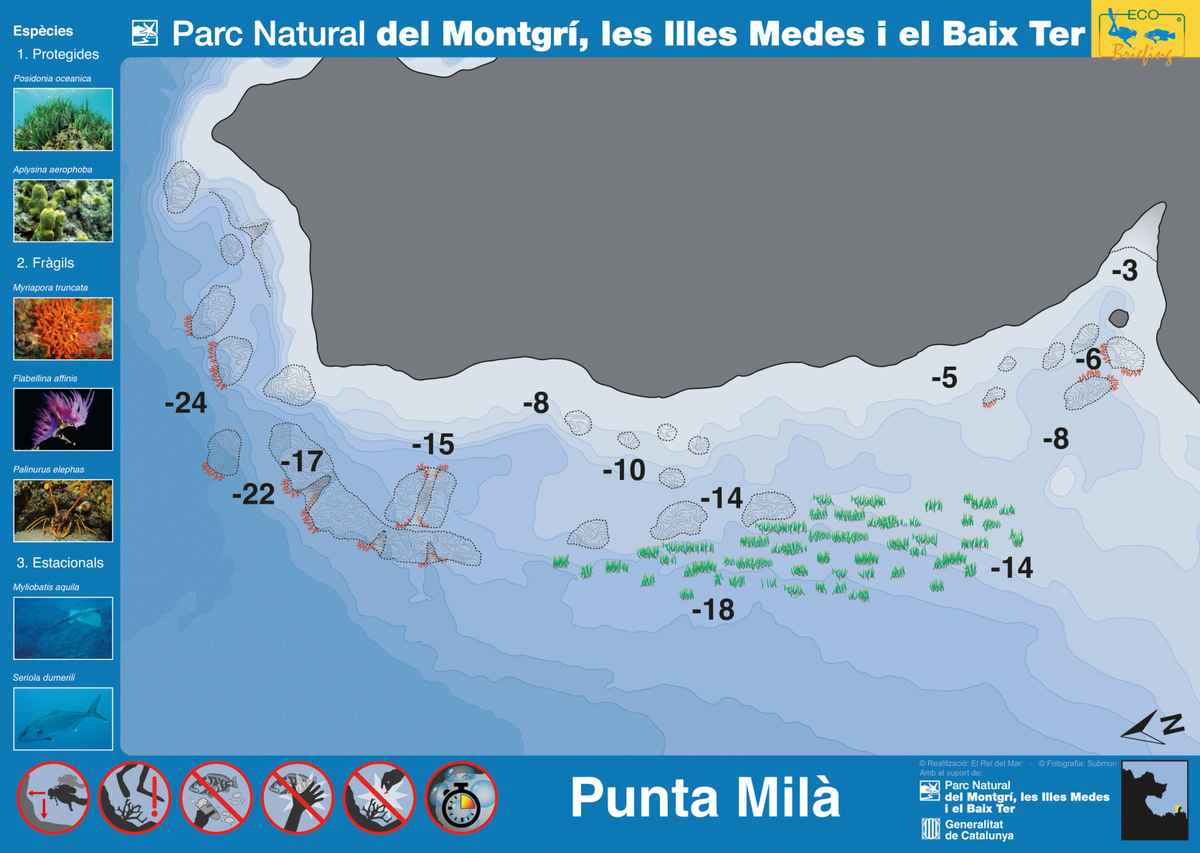
Illustration: Parc Natural del Montgrí, les Illes Medes i el Baix Ter — Generalitat de Catalunya
What makes it special
The Cova de la Sal is the most unusual feature on the Montgrí coast. The cave is named for documented historical use: L'Escala's anchovy fishermen stored their curing salt here, supplying the salazón trade that is still the town's signature export. No other site in the park's 16-site roster pairs an advanced wall with a named cave that doubles as the shallow section and carries that kind of local story. The dual profile is its practical strength — a beginner, a try-diver, and a 25 m wall diver can all share the same boat and the same surface interval without anyone compromising their dive. On bad-weather days, when Tramontana closes the exposed central Montgri headlands, this site absorbs the bookings without sacrificing dive quality.
Know before you go
OW divers must dive guided within the Natural Park; book with a Grupo B centre and the guide is included in the fee. Bring a torch for the cave at 19 m and for the rock crevices on the wall — bogavante spotting is the draw, and it is a dim interior. The park's responsible diving guidelines apply: enter the cave in small groups, limit penetration time (air bubbles damage ceiling organisms), and stay off the rock faces. The surface can be active with snorkel trips and boat traffic approaching L'Escala, so deploy an SMB on the final ascent.
Why Dive Punta Milà
What makes this dive site stand out.
- Cova de la Sal cave system
Historic salt-store used by L'Escala anchovy fishermen; now the beginner and snorkel zone.
- European lobster at 19 m
Bogavante (Homarus gammarus) documented in the cave that marks the wall turnaround.
- Dual-profile one boat
Advanced divers on the 25 m wall, beginners in the shallow cave, same trip.
- Sheltered from two winds
Protected from Tramontana (N) and Garbi (SW); often diveable when other coast sites cancel.
Depth & Profile
Location
42.1053°N, 3.1818°E
Conditions & difficulty
Warm water and good visibility. Shoulder season (May, September) for fewer boats.
No Medes Islands Tax (5.30 EUR) applies to Montgri coast dives. Snorkel trips from L'Escala at 28 EUR. Verify current rates with your centre.
Open Water for the wall and cave at 19 m. Discover Scuba for the shallow Cova de la Sal section. OW divers must dive guided within the Natural Park; book with a Grupo B centre.
Summary
Easy on the shallow Cova de la Sal side (3-10 m). Moderate on the wall to 25 m. No significant current at this sheltered headland.
Safety considerations
What can go wrong here, and what divers do about it. Conditions change - take the briefing from the operator on the day.
- Overhead: Cave at 19 m is a small enclosed environment; stay within natural light per park guidelines.Enter with a torch, small groups only, careful trim to avoid stirring sediment.
- Surface and boat traffic: Boat approaches to L'Escala port pass the site.Surface with SMB on the final ascent.
Rules and permits
Dive centres in Catalonia must require insurance from every diver on their dives, and must be able to offer a policy to anyone who has none.
Frequently Asked Questions
What species is in the cave at Punta Mila?▾
The cave at 19 m is documented as a reliable sighting for European lobster (bogavante, Homarus gammarus). This is the clawed European species, distinct from the spiny lobster (langosta, Palinurus elephas) found at deeper wall sites. A torch helps spot it in the cave interior.
Do I need a permit to dive Punta Mila?▾
No. The site is inside the Parc Natural del Montgri but outside the Illes Medes marine reserve. No permit is required, there are no diver quotas, and the 5.30 EUR Medes Islands Tax does not apply to coast dives.
Do I need a guide at Punta Mila?▾
Open Water certified divers must dive guided within the Natural Park. This is included in the dive fee when you book with a Grupo B centre from L'Escala or L'Estartit. Discover Scuba participants are guided as part of their session.
Can non-divers join a trip to Punta Mila?▾
Yes. Dive Paradis (L'Escala) runs dedicated snorkel trips to the site at 28 EUR. The shallow Cova de la Sal section is genuinely suitable for snorkelling, making this one of the few Montgri coast sites where a mixed certified-and-snorkel group can share a boat.
When should I choose Punta Mila over other Montgri coast sites?▾
On wind-affected days. The headland provides shelter from Tramontana (north-northeast) and Garbi (southwest), which are the two winds most likely to cancel exposed sites like Punta Salines. L'Escala centres often default here when the forecast is uncertain.
What is the Cova de la Sal?▾
Cova de la Sal means 'Cave of Salt' in Catalan. L'Escala's anchovy fishermen stored salt here for salazón, the traditional curing that defines the town's fishing industry. The shallow cave is now the beginner and snorkel zone of the dive, and the name links the dive directly to L'Escala's living anchovy heritage.
Photos
Every dive has a story. Share yours.
Log your dives - notes, photos, conditions and the marine life you saw - and share them as one public diver profile. What you share helps the next diver, too.
Log every detail
Depth, duration, conditions, gear, buddy, notes — all in one place. Import from Suunto and other dive computers.
Track marine life
Record species sightings on each dive. Build a personal catalogue of everything you've seen underwater.
Your public dive profile
Share your dive history, stats, and experiences with a profile page you control. Show the world where you've been.