
Calypso Diving Estartit
Family-run PADI centre in L'Estartit, run by Peter and Jacqueline Lane for nearly 40 years, with PADI Green Star and four other environmental credentials.
PADI5 services8 languages
Also known as: Les Salines, Punta de les Salines, Punta Salinas
Gorgonian wall and chimney exit (8 m in, 3 m out) on the Montgrí coast, beside a gentle sand-and-rock bay used for try-dives.
Last updated October 2026
Two kinds of bottom share this dive. In the bay the rock slopes gently and breaks into tongues that run out into the sand, a forgiving floor that dive schools use for try-dives and courses. At the point the rock turns into a vertical wall and the dive goes deeper. A small gorgonian wall, yellow and red, grows in the coralligenous zone alongside small colonies of red coral, and large rocks full of holes shelter spiny lobsters, moray eels and octopus. Forkbeards, sargo and gilthead bream turn up along the way, with the occasional dusky grouper. One local operator advises looking overhead now and then, because shoals of fish pass above the divers.
The dive can finish through a chimney. The entrance is at about 8 m and the exit at about 3 m, and the shaft is wide enough for four divers, so the last stretch of the profile is spent in the shallows.
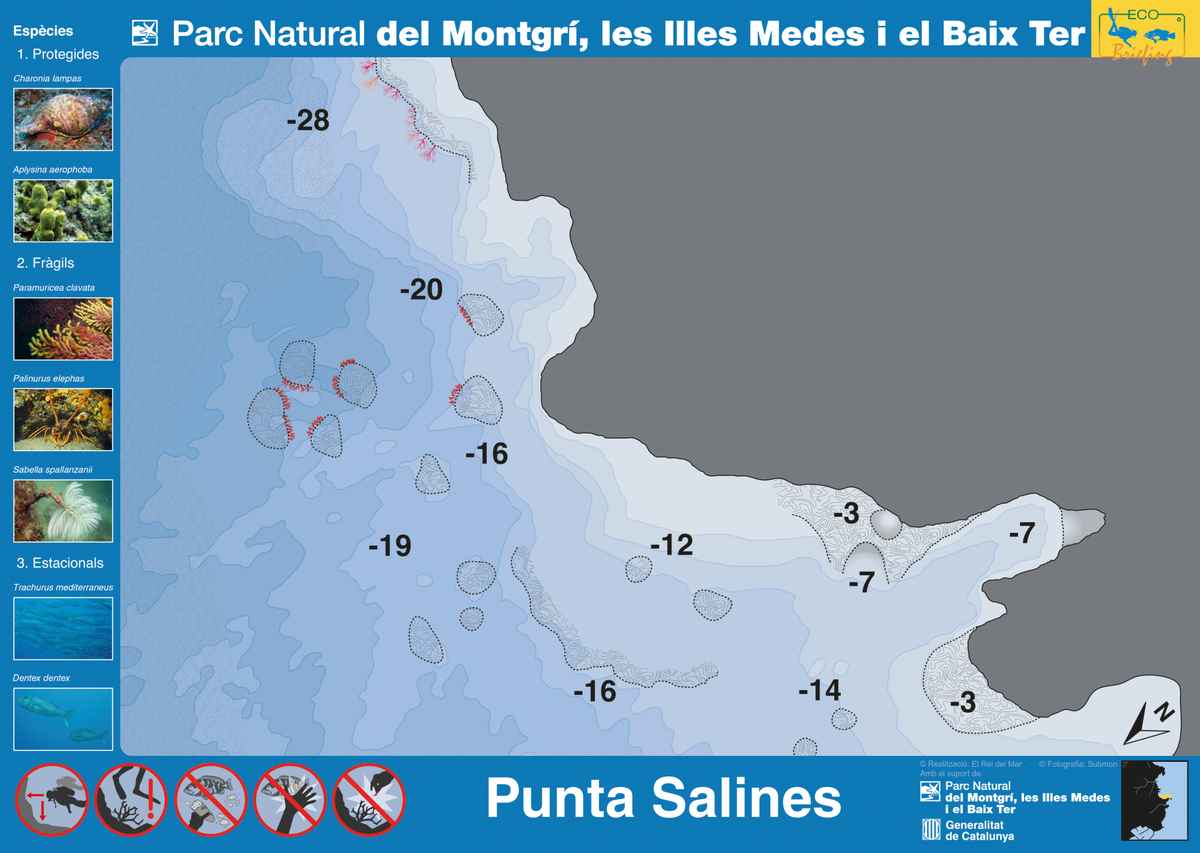
Illustration: Parc Natural del Montgrí, les Illes Medes i el Baix Ter — Generalitat de Catalunya
The bay and the wall belong to the same dive. Schools teach on the sand slope while the wall, in the same bay, gives certified divers a reason to come back, so one site serves a training group and an experienced buddy pair alike.
The chimney gives the dive its shape. It has a defined entrance at 8 m and an exit at 3 m, which turns the end of the dive into a short, shallow passage.
One local operator ranks the wall among the best Paramuricea clavata walls on the Montgrí coast.
Wind decides the day. The point is open to levante, the east wind, while garbí from the southwest leaves the site workable, so it is worth asking the centre which way the forecast is blowing.
In the chimney, treat the passage as overhead: stay inside the daylight, keep trim level so fins stay off the floor, and let the silt settle behind the group.
What makes this dive site stand out.
Yellow and red gorgonians on the vertical rock at the point.
In at 8 m, out at 3 m, wide enough for four divers.
Rock tongues run into a gentle sand slope that schools use for try-dives.
Operators describe the point as sheltered from southerly wind.
42.0612°N, 3.2147°E
The bay slope starts at 3 to 4 m and operators describe the site as suitable for all levels; the wall goes deeper, so keep the plan within your certification's depth limit.
Summary
Easy on the bay slope, more demanding on the wall and in the chimney.
Safety considerations
What can go wrong here, and what divers do about it. Conditions change - take the briefing from the operator on the day.
Book a guided dive at this site.
Family-run PADI centre in L'Estartit, run by Peter and Jacqueline Lane for nearly 40 years, with PADI Green Star and four other environmental credentials.

PADI 5 Star centre on L'Estartit seafront with stay-and-dive packages, four daily boat dives between Illes Medes and Montgrí, plus tec diving.
Get in touch to add or claim your dive center listing on DiveCodex.
Dive centres in Catalonia must require insurance from every diver on their dives, and must be able to offer a policy to anyone who has none.
It lies on the mainland coast south of L'Estartit, not on the Medes islands. Its itinerary sits on the boundary between the Reserva Natural Parcial Perifèrica and the Parc Natural, so the zone rules that apply at the mooring are worth checking with your centre.
Both statements hold, for different winds. The park describes the point as little protected from levante, the east wind, and chop can affect the dive when it blows. Operators describe the zone as sheltered from southerly winds, garbí from the southwest included, and one calls that shelter a real asset on summer afternoons when garbí is strong. Wind direction is the thing to ask your centre about.
Log your dives - notes, photos, conditions and the marine life you saw - and share them as one public diver profile. What you share helps the next diver, too.
Log every detail
Depth, duration, conditions, gear, buddy, notes — all in one place. Import from Suunto and other dive computers.
Track marine life
Record species sightings on each dive. Build a personal catalogue of everything you've seen underwater.
Your public dive profile
Share your dive history, stats, and experiences with a profile page you control. Show the world where you've been.