

Typhoon
34m, 20-guest steel liveaboard running Tornado's full Egypt spread, from northern wrecks through the Brothers and Daedalus to a Deep South St John's week.
Liveaboard20 guestsHurghada
Also known as: Ras Caty, Ras Kati
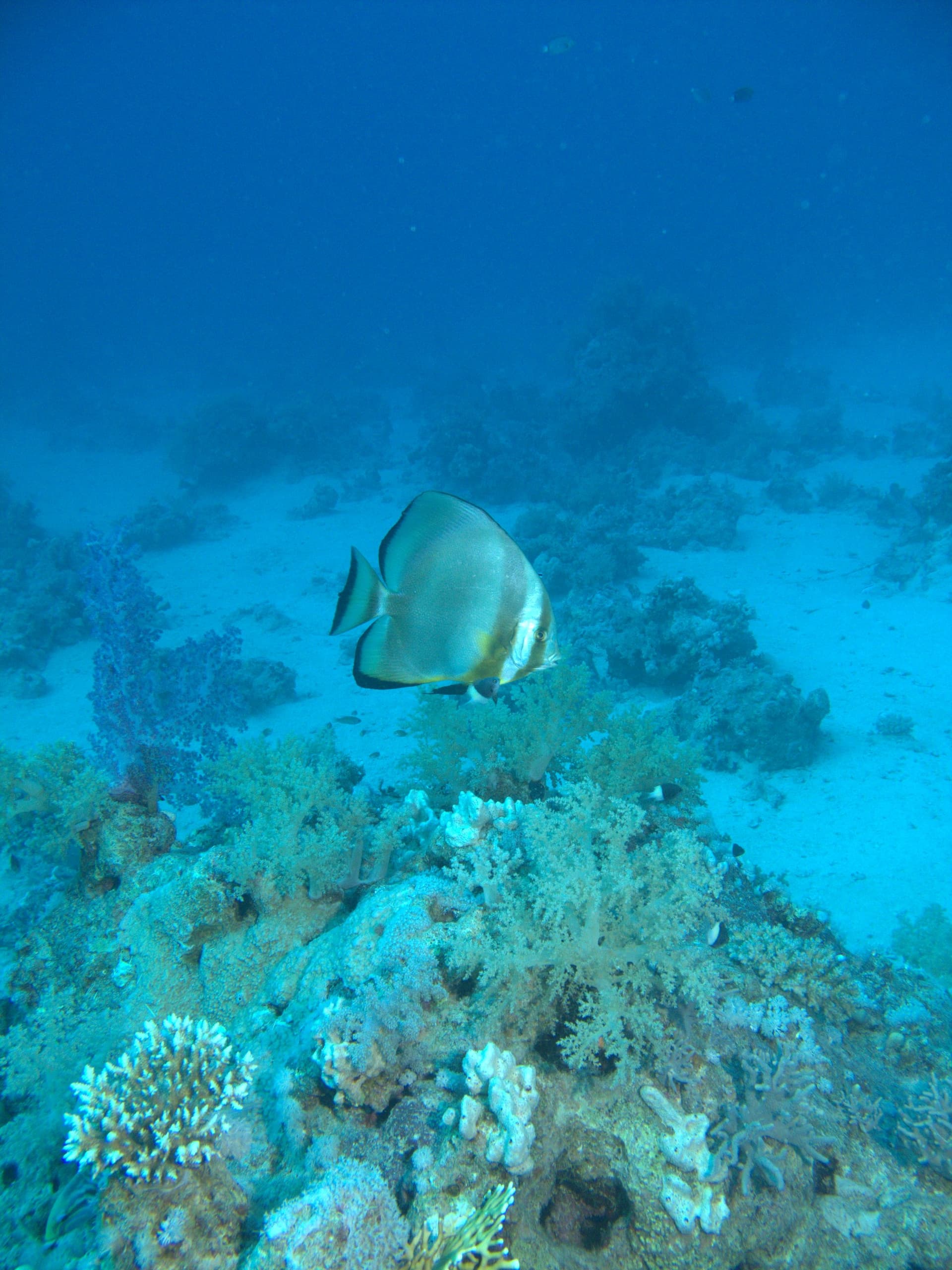
Coral pinnacles in a sheltered Sharm bay, the main one running from 18 m to the surface, with a sandy lane of goby and shrimp pairs beside the reef.
Last updated October 2026
The dive normally starts on the mooring, between the fringing reef and the top of the main pinnacle, and becomes a semi-drift. The standard circuit winds round the large pinnacles, never deeper than 18 m, with glassfish gathered on the gorgonian fans. Between reef and pinnacles lies a sheltered sandy lane with many pairs of gobies and shrimps.
Two extensions go below the circuit, for divers with the depth in hand. At the southern corner the reef juts out near 26 m, where a large group of Red Sea bannerfish and red-tooth triggerfish sits over it, and a big fan coral thick with glassfish waits on the way back. The other is the shark: stay shallow for 10-15 minutes first, then head for the point where one operator reports a resident white tip reef shark at about 28 m.
Pinnacles that reach the surface give Ras Katy its shape, and they are why one structure serves so many people: courses, check dives, night dives, snorkellers swimming out from the beach. The bay position keeps the water sheltered, and the sandy lane at the foot of the reef rewards a slow look for gobies, shrimps and crocodilefish.
Divers who take the shark option are asked not to chase it, and the resident is said to stay in the area when left alone.
Fire coral grows on the pinnacles, and scorpionfish and lionfish sit in the sand and crevices, so hover over the lane. The current is usually mild but can pick up toward the corner in the direction of Temple; check drift and air there before committing to the southern leg. Snorkellers share the pinnacle tops with dive and glass-bottom boats, which is why the swim is recommended early in the morning only.
The site is diveable all year, with water of 20-23 C in winter and 27-29 C at the surface in summer. Divers log white tip reef sharks here mostly from July to November, and eagle rays in late summer and autumn.
What makes this dive site stand out.
The main pinnacle runs from the surface to 18 m, about 30 m off the fringing reef
Sheltered sand between reef and pinnacles holds many pairs of gobies and shrimps
Red Sea bannerfish and red-tooth triggerfish group at about 26 m
One operator places a resident shark near 28 m and asks divers not to chase it
Shore snorkellers enter from Ras Katy Beach at no charge
27.8468°N, 34.3032°E
The pinnacle circuit from the surface to 18 m is the Open Water dive; the southern corner at about 26 m and the shark area at about 28 m lie deeper than that.
Summary
Shallow, sheltered pinnacle circuit; the deeper corner and shark options add depth, not difficulty of terrain.
Safety considerations
What can go wrong here, and what divers do about it. Conditions change - take the briefing from the operator on the day.
Multi-day safari boats with this site on their itinerary.
Book a guided dive at this site.

PADI dive centre in Sharm El Sheikh est. 1993, with beachfront base, daily boats to Tiran and Ras Mohammed, and liveaboard fleet.
Get in touch to add or claim your dive center listing on DiveCodex.
Circle Divers reports one resident white tip reef shark living in about 28 m of water and circling off the reef. Its own listing for the site runs 0-25 m, so the shark sits below that and well below the 18 m pinnacle circuit, which is why the page carries 28 m as the maximum. The operator says to stay shallow on the dive for about 10-15 minutes to reach the point where it lives, and that if nobody chases it the shark normally stays in the area.
Operators describe a main pinnacle about 30 m from the reef that runs from 18 m to the surface, and boats moor between the reef and its top. A snorkelling guide describes several large pinnacles that stay below the surface, 20-30 m from the reef edge. A line of pinnacles of different heights would fit both, so the surface pinnacle is the one boats moor at and the others may sit below it.
Snorkellers are advised to go early in the morning only, because many glass-bottom and dive boats make the area dangerous later in the day. Entry from Ras Katy Beach is free. Strong snorkellers can also swim out 400-700 m from Faraana Beach, which is a long open-water swim.
Log your dives - notes, photos, conditions and the marine life you saw - and share them as one public diver profile. What you share helps the next diver, too.
Log every detail
Depth, duration, conditions, gear, buddy, notes — all in one place. Import from Suunto and other dive computers.
Track marine life
Record species sightings on each dive. Build a personal catalogue of everything you've seen underwater.
Your public dive profile
Share your dive history, stats, and experiences with a profile page you control. Show the world where you've been.