

Costa Brava Divers
PADI 5 Star centre on L'Estartit seafront with stay-and-dive packages, four daily boat dives between Illes Medes and Montgrí, plus tec diving.
PADI6 services5 languages
Also known as: El Reggio, El Reggio Messina, Pecio Reggio Messina
A 122m Italian railway ferry scuttled in 1991 off the Montgrí coast, now broken into ~20 storm-fragmented pieces at 23-35m with barracuda, grouper, and wreck penetration.
Last updated May 2026
The mooring line drops straight to the stern at 23m, the shallowest point and the natural starting position. The hull plates are immediately apparent, the entire structure canted to port, with the mast rising above and schools of sargos orbiting in loose formations. Moving forward along the hull, the depth increases gradually. This is not a sudden plunge but a long traverse as you follow the length of the vessel. At mid-deck around 27m, the structure turns complex. Storm damage has bent and separated sections, and the most rewarding terrain is at the breaks — jagged openings where the interior becomes accessible.
The main penetration entry is a crack in the upper deck, now lying nearly horizontal on the sand. Inside, a corridor runs forward in dim light; a torch is necessary and good buoyancy control is not optional. The silt is deep and undisturbed in the less-trafficked rooms. Exit is through a door hatch. At the separated bow around 35m, the enclosed volume creates sheltered habitat, and groupers have claimed the darker rooms as their own.
The ascent back to the stern, or directly up the mooring line, is straightforward. A safety stop against the rocky coastal slope at 5m offers a productive final few minutes: octopuses, moray eels, and prawns in the rock crevices while the nitrogen clears.
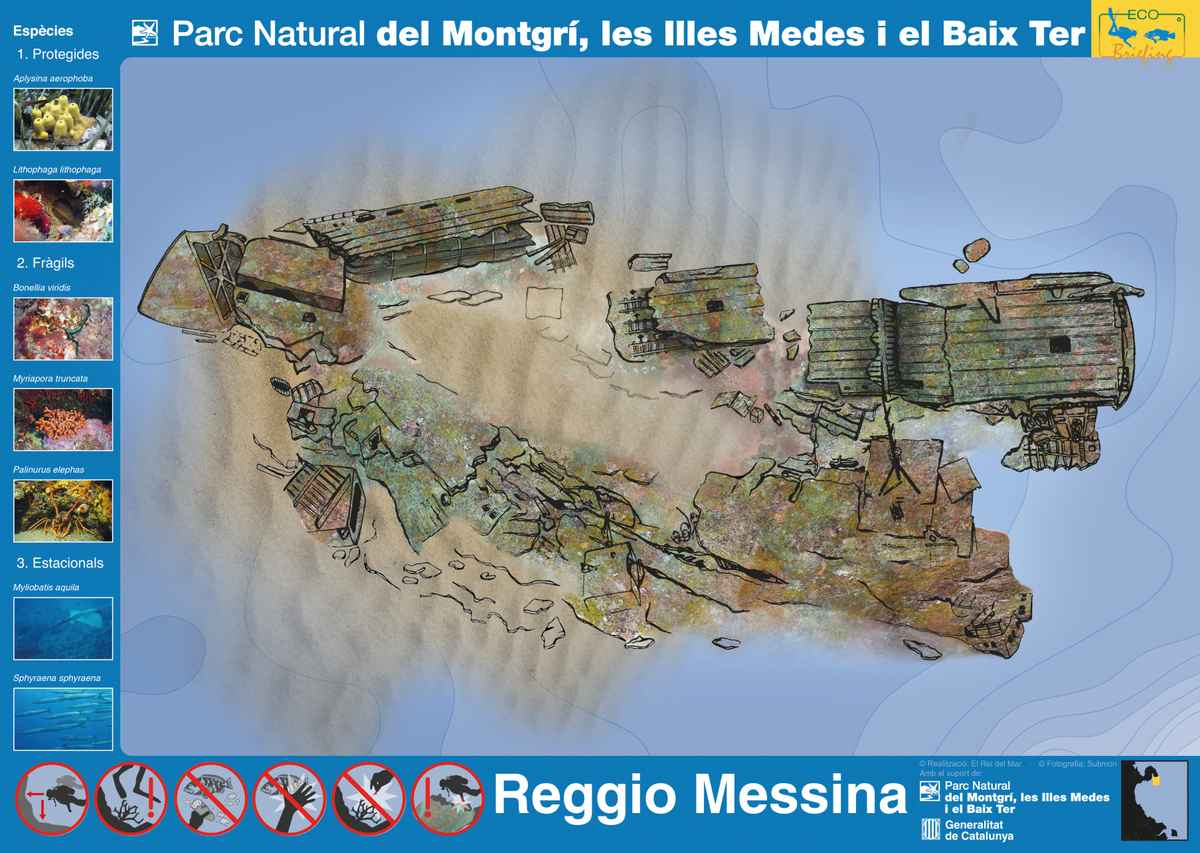
Illustration: Parc Natural del Montgrí, les Illes Medes i el Baix Ter — Generalitat de Catalunya
On a coast of natural reef, wall, and cavern dives, the Reggio is the only accessible wreck at recreational advanced depth. El Marmoler, the other wreck on this stretch, sits at 42m, which puts it beyond practical reach for most recreational visitors. The Reggio at 23-35m is within range for any AOW diver ready to push into the deeper end of the recreational envelope.
The scale matters. Mediterranean dive sites are rarely large. A 122m vessel feels enormous against the rocky features and reef walls that define everything else on this coast. You can spend 50 minutes here and not cover it — a genuinely unusual feeling in Med recreational diving.
The ship's backstory adds something most wrecks lack. Deck rails are still visible beneath the encrusting growth — physical evidence of its original purpose hauling railway carriages across the Strait of Messina. After more than 30 years of colonisation in protected park waters, those rails are overgrown with sponges and hydroids, and large groupers have moved into the rooms the sea created when storms pulled the structure apart.
The Reggio Messina was an Italian railway ferry, one of the vessels that carried train carriages across the Strait of Messina between Sicily and the Italian mainland. After decommissioning it sat semi-submerged and abandoned in Barcelona harbour for several years, familiar to those who watched it slowly deteriorate.
In 1991 the vessel was towed to the Montgri coast and deliberately scuttled to create an artificial reef. What the planners could not control was how the ship would behave under decades of winter tramontana storms. The hull settled canted to port on the sand. The tramontana did the rest. By the mid-2020s, the wreck lay in roughly twenty fragments, the bow separated entirely from the main structure. The fragmentation was not the plan. It has made the site more complex and, for divers, more interesting.
Decide before the dive whether to focus on the stern section or push to the separated bow at 35m. The site is too large to cover both on a single dive. The mooring buoy descends to the stern, so the stern is always the starting point; the question is whether your gas and bottom time allow the deeper push to the bow.
Nitrox matters here. EANx32 meaningfully extends bottom time at 23-35m and reduces decompression risk. Most L'Estartit and L'Escala operators offer it, and bringing a torch is equally important regardless of the interior penetration plan. Visibility runs 5-15m in open water; inside the wreck you need artificial light. The site is a short boat ride from port, around five minutes from L'Estartit, which means less transit time than most Medes island trips.
What makes this dive site stand out.
A train ferry that crossed the Strait of Messina, now lying on its port side at 23-35m.
Broken into roughly 20 pieces by tramontana storms; no single continuous pass is possible.
Enter through a crack in the upper deck, traverse corridors, exit via hatch; heavy silt inside.
Groupers in deep rooms, barracuda banks, conger eels in hull gaps throughout.
42.0807°N, 3.2018°E
Best visibility in summer. May, June, September, October recommended for fewer crowds.
No Medes reserve tax applies here. Cost is the centre's boat dive service fee only.
AOW minimum; the 23-35m depth range and overhead environment demand depth management experience.
Summary
Large wreck at advanced depth with 5-15m visibility, silt penetration, and decompression risk on longer dives.
Safety considerations
What can go wrong here, and what divers do about it. Conditions change - take the briefing from the operator on the day.
Book a guided dive at this site.
PADI 5 Star centre on L'Estartit seafront with stay-and-dive packages, four daily boat dives between Illes Medes and Montgrí, plus tec diving.

Small-group dive center in Tossa de Mar with a year-round boat, max 4 divers per guide, PADI TecRec and CCR training, and on-site accommodation.
Get in touch to add or claim your dive center listing on DiveCodex.
Within Parc Natural del Montgri, les Illes Medes i el Baix Ter. NOT within the Illes Medes Reserva Natural Parcial. No permit fee. Diving insurance compulsory in Spain (typically around 9 EUR/day via centres).
No. The Medes Islands tax applies only to dives within the Illes Medes Reserva Natural Parcial. The Reggio Messina sits on the Montgri coast outside the reserve. The only cost is your centre's standard boat dive fee.
Not recommended. The wreck runs 23-35m, and the combination of depth, decompression risk, and an overhead environment requires the depth management skills of Advanced Open Water or equivalent.
Visibility here runs 5-15m, lower than Medes island sites. In reduced visibility the wreck becomes atmospheric rather than scenic. Interior sections and resident fish remain accessible regardless, but planning a clear route before descending is more important than usual.
Yes. The main entry is a crack in the upper deck, which now lies nearly horizontal on the sand. From there you follow a corridor and exit through a door hatch. Heavy silt is inside; buoyancy control is essential, and following closely behind other divers will end the penetration quickly.
At 23-35m with recreational bottom times, you can cover either the stern section or push to the separated bow. Doing both in a single dive is not realistic. Choosing one target before descent is the practical approach.
May through October is the main season, with the best visibility in summer. May, June, September, and October offer good conditions with fewer boats. July and August are busiest.
Most centres in L'Estartit and L'Escala offer nitrox, and EANx32 is strongly recommended. The extra bottom time at depth makes a meaningful difference on a wreck this large.
Log your dives - notes, photos, conditions and the marine life you saw - and share them as one public diver profile. What you share helps the next diver, too.
Log every detail
Depth, duration, conditions, gear, buddy, notes — all in one place. Import from Suunto and other dive computers.
Track marine life
Record species sightings on each dive. Build a personal catalogue of everything you've seen underwater.
Your public dive profile
Share your dive history, stats, and experiences with a profile page you control. Show the world where you've been.