
Salt del Pastor
Peak-to-wall dive on the Montgrí coast reaching 22m, with a large arch on the southwest wall, gorgonias in the deeper crevices, and resident groupers and morays.
Last updated May 2026
The dive
The boat ties to the mooring buoy and a guide rope leads down through the upper rocky section. On the summit at 5 m, nudibranchs cover the rock faces and sea bream move in loose groups — the dive starts calmer than it finishes. Following the wall southwest, the terrain opens into cavities and crevices: groupers fill the shadows, morays extend from the gaps, and sandy pockets in the deeper crevice floors lift if disturbed. Splitting into buddy pairs in the narrower crevice sections reduces the silt stir for everyone behind.
The arch is on the southwest wall face. Bring a torch. Inside: scorpionfish on the ledges, red coral patterning the walls, crab movement in the corners. It is a limited-overhead feature, not a through-penetration — natural light enters from both ends and the route is not technical. After the arch, the descent continues to the open area at 22m, where most dives turn and begin the return.
The gorgonias are on the return circuit. Paramuricea clavata fans grow in the deeper crevices, not on the main wall — they are not visible unless a diver slows down and shines a torch inside. This is the section most divers miss. The safety stop on the summit at 5m, with nudibranchs on all sides, is not wasted time.
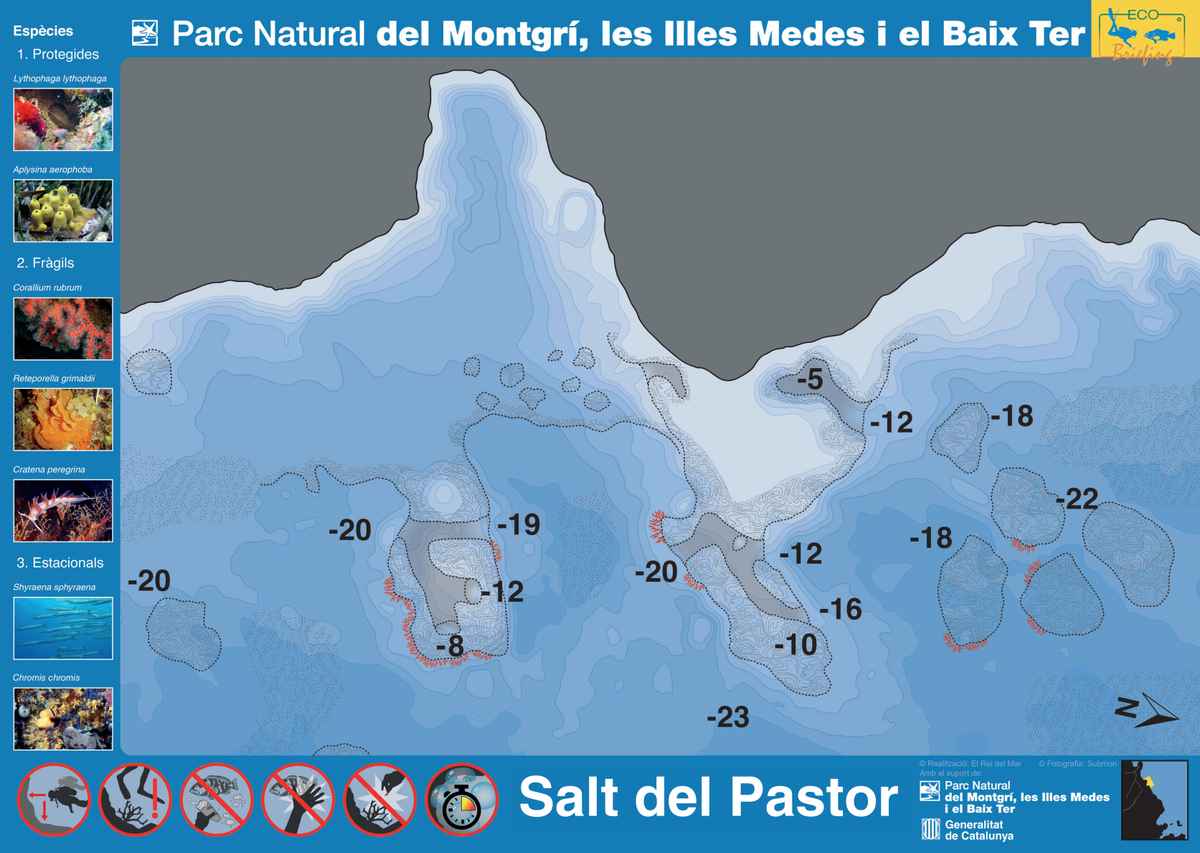
Illustration: Parc Natural del Montgrí, les Illes Medes i el Baix Ter — Generalitat de Catalunya
What makes it special
Salt del Pastor is not the most talked-about site on the Montgrí coast. That is partly why it works. The arch is the feature that separates it from the standard wall-and-reef pattern: a large opening in the wall face, accessible to any diver comfortable with a torch and a partial overhead, with scorpionfish and red coral inside. The gorgonias in the crevices add a second layer that most divers at this site don't reach — they are off the main line, requiring a deliberate search. Puig de la Sardina has gorgonian walls from 14m down; Salt del Pastor has gorgonias hidden in rock cracks at 22m. Different character entirely.
The absence of the Medes crowds is part of it. No quota, no advance booking, no shared mooring. The only people here are the divers in the water.
Know before you go
A torch is not optional. The arch and the gorgonias in the crevices are the reason this site is worth the trip, and neither is properly visible without one. Buoyancy control matters in the cavity sections — poor trim disturbs the sand and ruins visibility for the divers behind you. The Montgrí coast is exposed to tramontana from the north; conditions change without much warning. Confirm with your operator the morning of the dive. Dive Paradís in L'Escala and the major L'Estartit centres all run this site as part of their Montgrí coast rotation.
Why Dive Salt del Pastor
What makes this dive site stand out.
- Large arch on the wall
Cuts the southwest wall face at depth; scorpionfish on ledges, red coral on the walls inside.
- Gorgonias in the crevices
Paramuricea clavata fans in the deeper rock cracks, not visible from the main wall line.
- Peak-to-wall profile
Summit at 5m with nudibranchs and sea bream; wall descends to 22m open southwest area.
- No permit, no quota
Inside the Natural Park but outside the Illes Medes reserve. No per-diver fee applies.
Depth & Profile
Location
42.0885°N, 3.1940°E
Conditions & difficulty
Warmer water, better visibility, calmer seas. September noted as good-temperature month.
Montgrí coast single dive rates vary by operator and season. Verify current prices directly with your centre.
Maximum 22m exceeds the standard OW limit of 18m. AOW recommended for the full profile. OW divers can explore to 18m under dive professional supervision.
Summary
22m depth and the arch/cavity environment suit divers with experience. Buoyancy control required in confined spaces. Torch recommended.
Safety considerations
What can go wrong here, and what divers do about it. Conditions change - take the briefing from the operator on the day.
- Overhead: Arch and rocky cavity sections create partial overhead environments.Buoyancy control required. Torch recommended. Stay with guide in unfamiliar passages.
- Overhead: Sandy pockets in the deeper crevice floors stir easily if disturbed.Move slowly through crevice zones. Allow silt to settle before continuing.
Rules and permits
Dive centres in Catalonia must require insurance from every diver on their dives, and must be able to offer a policy to anyone who has none.
Frequently Asked Questions
What certification do I need to dive Salt del Pastor?▾
AOW is recommended for the full profile to 22m. Open Water divers can access the site to 18m under dive professional supervision. The arch and rocky cavities add an overhead element, so comfort in confined spaces and solid buoyancy control matter as much as the certification itself.
Do I need a permit or advance booking for Salt del Pastor?▾
No. Salt del Pastor is inside the Parc Natural del Montgrí, les Illes Medes i el Baix Ter but outside the Illes Medes marine reserve. There is no per-person diving permit, no diver quota, and no advance booking requirement. Book through any L'Estartit or L'Escala operator as a standard guided dive.
What will I see at Salt del Pastor?▾
The site's resident species are groupers, moray eels, and sea bream confirmed by the official park description. Scorpionfish sit on the arch ledges. Gorgonias grow in the deeper crevices — they require a torch and a slow pace to find. Spiny lobster occupy the shadows further back in the rock. Nudibranchs appear on the summit at 5m.
Why do I need a torch at Salt del Pastor?▾
The arch and deeper rocky cavities are the best parts of the dive. Without a light, the arch reads as a dark gap and the red coral on its walls stays invisible. The gorgonias in the crevices also require a torch to locate. It makes a significant difference to what the dive actually shows you.
How does Salt del Pastor compare to Negre del Falaguer?▾
Negre del Falaguer is a more discussed site with more route options and a busier marine life profile. Salt del Pastor is more compact and geological: fewer divers mention it, but the arch and the gorgonias in the crevices give it a character those sites don't have. They work well as a two-dive day.
Is Salt del Pastor suitable for beginners?▾
Not as a first choice. The 22m maximum and the arch/cavity character suit divers with some experience and solid buoyancy control. First-time divers on the Montgrí coast are better directed to shallower, more open sites. The summit at 5m is an easy safety stop, but the interesting terrain is below 15m.
Photos
Every dive has a story. Share yours.
Log your dives - notes, photos, conditions and the marine life you saw - and share them as one public diver profile. What you share helps the next diver, too.
Log every detail
Depth, duration, conditions, gear, buddy, notes — all in one place. Import from Suunto and other dive computers.
Track marine life
Record species sightings on each dive. Build a personal catalogue of everything you've seen underwater.
Your public dive profile
Share your dive history, stats, and experiences with a profile page you control. Show the world where you've been.