
Trencabraços
Also known as: Trencabrazos
Wall and tunnel dive at the southern end of the Costa del Montgrí Natural Park near L'Escala. A through-tunnel crosses the entire headland SE to NW, leading to Les Cambres.
Last updated May 2026
The dive
The mooring sits on the southeast face of the point at 5-7 m. From there the wall drops in large limestone steps — wide rock shelves broken by crevices, the kind of terrain where you slow down and look into the gaps rather than following a slope. The main wall circuit follows the right side down to 22 m, reaching the tip of the headland where a large free-standing rock block breaks the surface. Conger eels shelter in the lower chambers of this section. Octopuses occupy the crevices on the way down. The route circles the block and returns along the boulder creek bed on the ascent. Total circuit: 12-22 m, well inside Open Water range.
The tunnel entrance opens off the southeast wall near the mooring. It crosses the entire Punta de Trencabraços from SE to NW, emerging near Cala Montgó into a feature network called Les Cambres. Narrow sections are real — this is not a wide arch or a short swim-through, and torch is not optional. The tunnel reaches roughly 27 m in places, making it an advanced component even for divers who found the wall circuit easy. A guide on the first visit is the sensible call.
Both routes finish with a return ascent along the shallow wall at 5-10 m. Deploy an SMB before ascending — boat traffic runs through this stretch of coast.
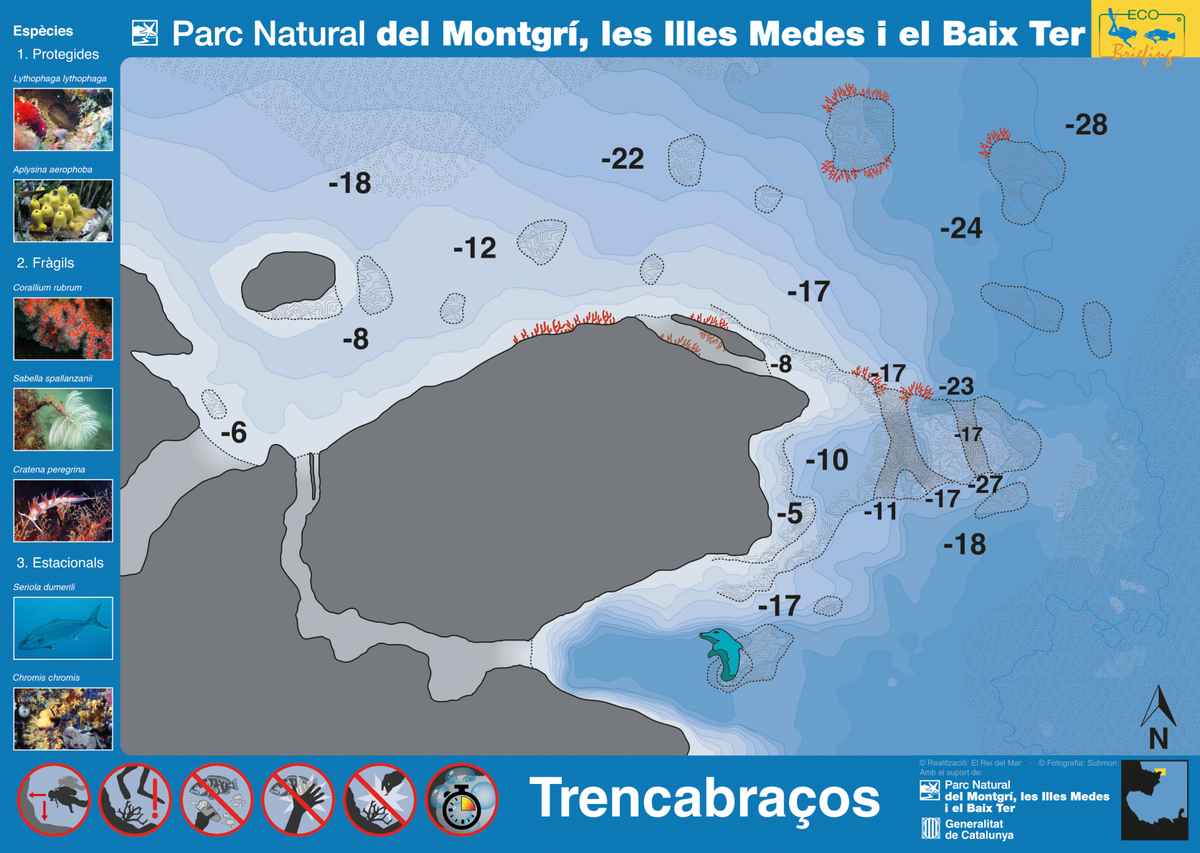
Illustration: Parc Natural del Montgrí, les Illes Medes i el Baix Ter — Generalitat de Catalunya
What makes it special
Trencabraços splits cleanly into two dives that share one mooring. A mixed-certification group can enter the water together: Open Water divers follow the wall to the point and back while advanced divers take the tunnel. The wall circuit is unhurried — the stepping-stone structure rewards slow, attentive diving. The tunnel to Les Cambres is what separates this headland from other Montgrí coast walls.
The site is also the southern gateway to the Natural Park coast, closest to L'Escala port. No reserve permit, no booking system. For divers based in L'Escala, it is the default first coast dive before working north toward more complex sites.
Know before you go
The name is a weather signal. "Arm-breaker" refers to what the exposed tip does in northerly tramontana conditions — swell and surge at the point make the dive uncomfortable or impossible. Check the forecast before the boat leaves.
Torch for the tunnel, always. The narrow sections are committed — no exit mid-passage. Deploy an SMB before ascending. Diving insurance is compulsory in Spain. Centres in L'Escala sell daily cover if needed.
Why Dive Trencabraços
What makes this dive site stand out.
- Through-tunnel across the headland
SE-to-NW passage crosses the entire point, exiting at Les Cambres near Cala Montgó.
- Dual-level site
Wall circuit stays 12-22 m for all levels; tunnel reaches ~27 m for advanced divers.
- Conger eel habitat
Southern rocky formations shelter conger eels in lower chambers at 18-22 m.
- Southern Natural Park gateway
Closest Montgrí coast park dive to L'Escala port. No permit, no quota, no reserve fee.
Depth & Profile
Location
42.1131°N, 3.1781°E
Conditions & difficulty
Peak visibility and temperature June-September. Winter diveable but requires 7 mm or semi-dry.
Typical pricing for a single dive with L'Escala-based centres. Verify current rates directly.
OW for wall circuit (12-22 m). AOW or equivalent overhead-environment experience required for tunnel traverse to Les Cambres (~27 m).
Summary
Easy for the wall circuit. Advanced for the tunnel: narrow sections, torch mandatory, guide recommended.
Safety considerations
What can go wrong here, and what divers do about it. Conditions change - take the briefing from the operator on the day.
- Current: Exposed headland point with variable surge in northerly tramontana windsCheck sea state and wind forecast before departure. Dive only in calm conditions.
- Overhead: Tunnel has narrow sections and requires torch. No natural exit mid-passage.Carry torch. Dive with a guide on first tunnel visit. AOW or overhead experience required.
- Surface and boat traffic: Active boat area near L'Escala portDeploy SMB for ascents.
Rules and permits
Dive centres in Catalonia must require insurance from every diver on their dives, and must be able to offer a policy to anyone who has none.
Frequently Asked Questions
Do I need a permit to dive Trencabraços?▾
No. Trencabraços is within the Parc Natural del Montgrí, les Illes Medes i el Baix Ter, but it sits outside the Illes Medes marine reserve. There is no permit, no diver quota, and no reserve entry fee. The Medes reserve fee does not apply here.
What certification do I need for the tunnel at Trencabraços?▾
The wall circuit is suitable for Open Water divers at 12-22 m. The through-tunnel to Les Cambres reaches around 27 m, has narrow sections, and requires a torch. Advanced Open Water or equivalent overhead-environment experience is recommended, along with a guide on the first visit.
How does Trencabraços compare to the Illes Medes dive sites?▾
Trencabraços has no daily diver limits, no permit requirement, and no booking logistics. Marine life is typical Mediterranean wall and tunnel: eels, octopus, scorpionfish. Not the dense grouper populations of the Medes, but a relaxed and varied dive without the reserve overhead.
What marine life can I expect at Trencabraços?▾
Conger eels in the southern rocky sections, octopus in wall crevices, scorpionfish on the rock face, moray eels occasionally, and chromis schooling in clear conditions. Grouper appear occasionally in the deeper formations but are not a reliable sighting.
When is the best time to dive Trencabraços?▾
May to October for the best combination of water temperature and visibility. Summer visibility averages 15-20 m. Late spring can see plankton blooms that drop visibility temporarily. The site is diveable year-round in calm weather, but winter requires 7 mm or semi-dry.
Is Trencabraços suitable for beginners?▾
The wall circuit is suitable for Open Water certified divers at 12-22 m, with no current on calm days. Centres in L'Escala regularly bring newly certified divers here as a first Natural Park coast experience. The tunnel is a separate, advanced component requiring AOW certification.
What does 'Trencabraços' mean?▾
Trencabraços is Catalan for 'arm-breaker'. The name refers to the exposed character of the headland point — in northerly tramontana conditions, swell and surge develop at the tip. On calm days the wall feels sheltered. Always check sea conditions before leaving the port.
Photos
Every dive has a story. Share yours.
Log your dives - notes, photos, conditions and the marine life you saw - and share them as one public diver profile. What you share helps the next diver, too.
Log every detail
Depth, duration, conditions, gear, buddy, notes — all in one place. Import from Suunto and other dive computers.
Track marine life
Record species sightings on each dive. Build a personal catalogue of everything you've seen underwater.
Your public dive profile
Share your dive history, stats, and experiences with a profile page you control. Show the world where you've been.