
Diving in Anilao
Macro coast on Luzon's Calumpan Peninsula, two to three hours from Manila, where two nudibranchs were described from its dive sites.
Last updated October 2026
Overview
Anilao dives as a guided hunt for small animals over dark volcanic sand, with sanctuary coral reefs a short boat ride from the flats. The Calumpan Peninsula is volcanic, and the seabed runs to sand, silt, rubble, boulder reefs, short walls and a few pinnacles.
Secret Bay and Basura are the sand flats most often named. A guide works as a spotter, finding the hairy frogfish or the mimic octopus and lining it up while you finish with the last animal, and the sand holds more than it shows: blue-ringed octopus, stargazers and scorpionfish all settle into it. Wunderpus and weedy scorpionfish turn up, never on demand. Night dives on the flats, at Arthur's Rock and at Twin Rocks are the usual extra after dark.
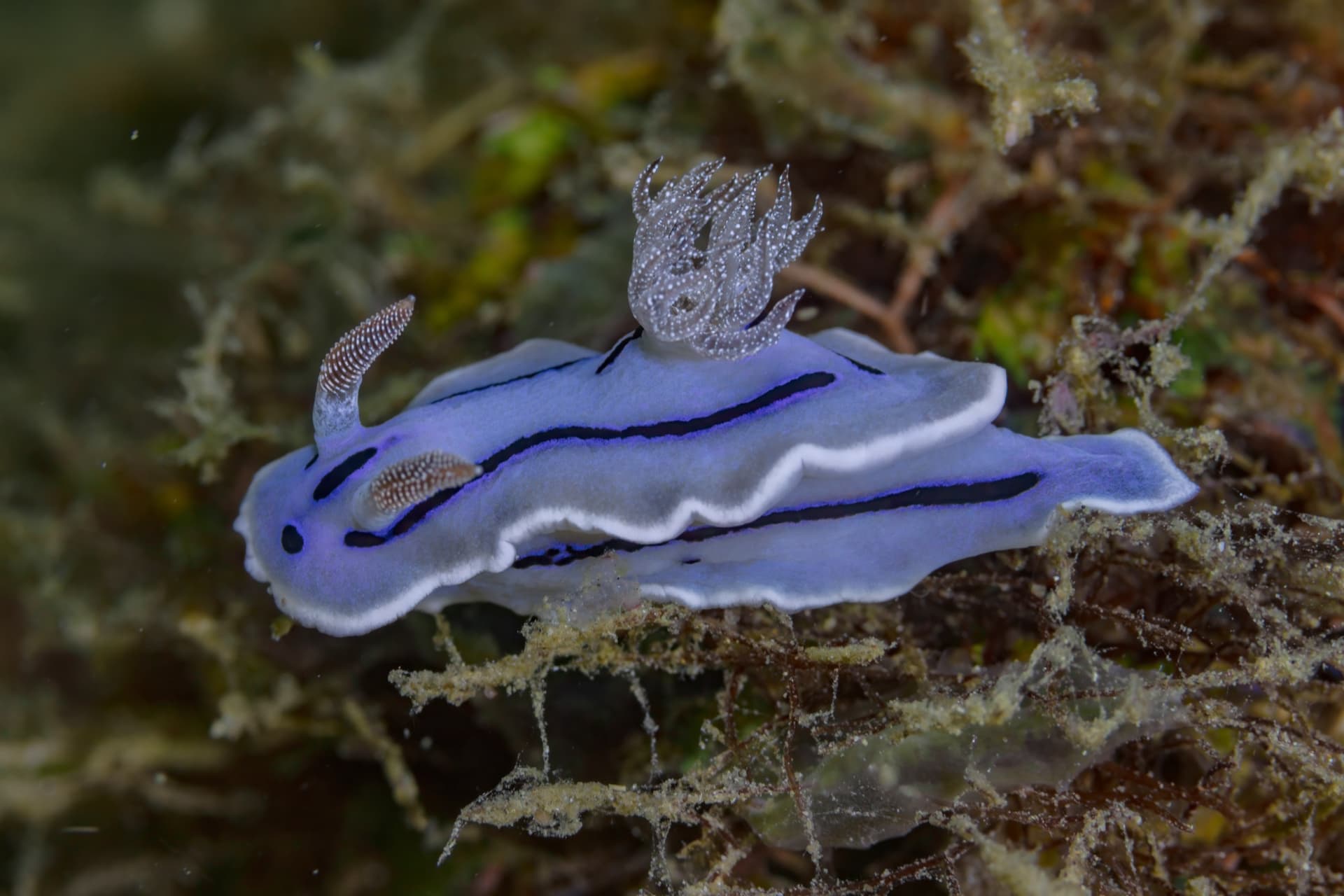
The nudibranch reputation has a published footing. Chromodoris alcalai was described from Kirby's Rock, off Caban Island in Tingloy, and the holotype of Chromodoris dianae (CASIZ 106464) was collected at Arthur's Rock in Mabini in April 19961. The same paper draws further type-series material from Cathedral Rock and from the north end of Ligpo Island in Bauan. A type locality is the place a species was first collected and formally described.
The sanctuary reefs of Mabini give the shallow coral: Arthur's Rock, Cathedral Rock and Twin Rocks, where schooling bigeye trevally work the bommies. Across the strait, Kirby's Rock and Sepok Wall are Tingloy dives, and Beatrice Rock, Bahura and Mapating are the current-swept sites where wide-angle photography is done.
Planning your visit
"Anilao" is a trade name for a coast in three municipalities, Mabini, Tingloy and Bauan, and the barangays called Anilao are in Mabini. Book and route to Mabini, Batangas, or Anilao Port. From Manila airport the drive takes two to three hours depending on traffic, with no domestic flight in between, and the resorts that serve divers are dive-led, self-contained and strung along a steep hillside, several of them reached by boat or by long stair descents. Boat rides between sites run roughly 15 to 30 minutes.
Resorts set their own diving rates, so ask each one for a package. In 2025 three resorts quoted one Filipino traveller about 5,000 PHP in total for a single dive, with gear rental and the conservation fee alone making up 2,000 PHP, and in 2024 one resort quoted US$240 for a return airport transfer from Manila.
The settled months run November to May. April and May are the busiest, and weekends and the dive season fill the coast because Manila is a couple of hours away. Water sits near 28 C for most of the year and drops to 24 or 25 C from January to March, when a 5mm suit helps on a trip spent motionless on the sand. Visibility is typically 10 to 15 metres, reaching 20 on a good dry-season day and a few metres after storms; on a macro dive the subject is a hand's reach away, so the number counts for less.
Open Water is enough for most of the diving. The current-swept sites named above run hard and are dived with a guide who knows how each site runs. The sand you photograph is inhabited, so hover, keep off the bottom and handle nothing.
Geology & underwater terrain
The Calumpan Peninsula is a volcanic headland between Balayan Bay and Batangas Bay. Underwater it gives dark sand and silt slopes, coral rubble, boulder reefs, short walls and isolated pinnacles, with geothermal gas seeping through the sand at Mainit Bubbles.
Dive sites in Anilao
The diving here splits into 3 zones:
- Mabini, the mainland tip
- — The southwestern tip of the Calumpan Peninsula, where the sanctuary reefs of Cathedral Rock, Arthur's Rock and Twin Rocks sit, with the sand flats of Secret Bay and Basura and the current-swept corner of Mainit nearby.
- Tingloy, across the strait
- — Maricaban and Caban islands, about twenty minutes by boat from the southern tip of Mabini, with Kirby's Rock, Sepok Wall, Layag-Layag, Mapating, Beatrice Rock and Bahura, plus Sombrero Island.
- Bauan, to the north
- — The short northern reach of the coast, holding Ligpo Island, which appears in the type-series records of the nudibranch literature.
Mabini, the mainland tip
Arthur's RockTop dive
Divers who want a protected reef they can walk into and dive twice a day
Twin Rocks Marine SanctuaryTop dive
A first-day shallow dive in Anilao that still rewards a macro photographer
Basura
Night divers and macro shooters willing to work a bare, currentless bottom
Cathedral Rock
Training dives, and late-afternoon light between two coral-covered rocks
Secret Bay
Macro photographers after cephalopods on black sand, and long night dives
Tingloy, across the strait
Beatrice RockTop dive
Certified divers with drift experience picking their day by the tide
Kirby's RockTop dive
Experienced divers who want reef and current instead of Anilao's sand
Bahura Reef
Divers who want reef and moving water in an area that sells macro
Layag-Layag
Long shallow coral dives for divers who read a tide table first
Mapating Rock
Deep-qualified divers making a deliberate trip to the far side of Maricaban
Sepok Wall
A first wall dive in an area that is otherwise sand and slope
Sombrero Island
Wide-angle photographers who can pick their day on a current-swept reef
Bauan, to the north
More dive sites
Daryl Laut
A steel frame with resident batfish on a coast known for small animals
Devil's Point
Divers who will trade a long boat run for soft coral instead of sand
Koala Reef
The easy warm-up dive on the Mabini coast, with clownfish on the boulders
Marine life
When to dive
- Best season
- November to May
- Water temperature
- About 28 C most of the year, 24 to 25 C from January to March
June to October is the low season under the southwest monsoon, the habagat, with typhoon risk and mountain run-off that can drop visibility to a few metres. When the sea is rough the coast guard can stop boats going out, and shops switch to shore dives on the sheltered side of the peninsula, which a local diver says holds some of the best macro sites here.
Safety considerations
What can go wrong here, and what divers do about it. Conditions change - take the briefing from the operator on the day.
- Current: Strong, site-specific currents at Mainit Point, Beatrice Rock, Bahura and Mapating.Dive these with a guide who knows how each site runs, and keep super-macro for the calm flats.
- Marine life: Blue-ringed octopus, stonefish, scorpionfish, spiny devilfish, stargazers and bobbit worms live in the sand divers settle into for photographs.Hover, keep hands and knees off the substrate, and handle nothing.
- Surface and boat traffic: In 2011 a reef-monitoring survey recorded anchor damage and called anchor buoys urgently needed at Layag-Layag, Sombrero Island and Sepoc Point.Do not assume a mooring buoy at these sites; ask your operator how the boat is secured and ascend on a line where one exists.
- Conditions: In February 2025 the Department of Tourism and the Philippine Commission on Sports SCUBA Diving said only three hyperbaric chambers in the country were operational: at the Lung Center of the Philippines in Quezon City, in Mandaue City and in Puerto Princesa.Ask your operator which chamber its emergency plan uses; the road to Quezon City takes two to three hours plus the boat leg.
Rules and permits
Marine reserve · Managed by Municipalities of Mabini, Tingloy and Bauan · No permit required
Mabini has charged divers a conservation fee since 2003, normally settled through your resort; the current amount changes, so confirm it with your operator before you travel.
Frequently Asked Questions
Is there more than one Anilao, and where do you tell the driver to go?▾
There are two. Anilao as divers use it is a name for the whole coast of Mabini, Tingloy and Bauan, taken from the barangays called Anilao in Mabini, and there is also an Anilao that is a municipality on Panay Island in Iloilo. Route to Mabini, Batangas, or to Anilao Port, never to the bare word. A private transfer from Manila airport takes two to three hours depending on traffic. By public transport it is a bus to Batangas City, a jeepney signed for Mabini, then a tricycle to the resort.
Is Anilao worth the trip if you do not shoot macro?▾
Yes, if you enjoy finding small animals slowly. A dive here tends to be a guided hunt in which the guide spots and you look, and a camera is optional. Ashore there is very little besides diving, so a partner who does not dive has few ways to fill the days. If what you want is big animals or clear blue water, other coasts do that better.
Where would a diving injury be treated from Anilao?▾
The chamber named as operating that is reachable by road is the one at the Lung Center of the Philippines in Quezon City, which the tourism department and the national scuba commission listed in February 2025 as one of only three working chambers in the country. The others are in Mandaue City and Puerto Princesa. Mabini was handed a chamber in 2014 and appeared on an earlier tourism department list, but it was not among the three named in 2025, so lists disagree. Do not plan around one in Mabini. The transfer to Quezon City follows the road you arrived on, two to three hours plus the boat ride in, so ask your resort which chamber it would use and how it would move you.
Which Anilao sites have current, and can a newer diver dive here?▾
Most of the diving is gentle. The sand flats and house reefs are shallow and slow, and an Open Water diver will be comfortable on them. The exceptions are Mainit Point, Beatrice Rock, Bahura and Mapating, where the current is strong enough to ruin super-macro and calls for experience and a guide who knows how each site runs. Tell your shop what you have actually dived and let it match the site to the day.
Does Anilao have blackwater diving, and how far out is it?▾
Blackwater is a night dive in open water over deep bottom, on a lit line hung from the boat, watching for the larval and juvenile animals that rise after dark. Janao Bay has been used for it, a boat ride of more than half an hour from the resort, so expect a longer evening than a house-reef night dive. Whether a given resort runs it varies, so ask before you book, along with how the line is tended, because it tests buoyancy in water with no reference.
Is it worth pairing Anilao with Puerto Galera?▾
Divers do it often, because Puerto Galera is a short speed-boat or ferry hop across the strait. Anilao is rated highly for nudibranchs and macro, and one diver puts Puerto Galera slightly ahead overall, so the two cover different strengths and the pairing suits a trip long enough for both.
Also known as: Anilao Batangas, Mabini-Tingloy
References
- 1.Philippine Journal of Systematic Biology (Association of Systematic Biologists of the Philippines) — Sleuthing cryptic Chromodorids (Mollusca, Nudibranchia): adding to Philippine marine biodiversity
Every dive has a story. Share yours.
Log your dives - notes, photos, conditions and the marine life you saw - and share them as one public diver profile. What you share helps the next diver, too.
Log every detail
Depth, duration, conditions, gear, buddy, notes — all in one place. Import from Suunto and other dive computers.
Track marine life
Record species sightings on each dive. Build a personal catalogue of everything you've seen underwater.
Your public dive profile
Share your dive history, stats, and experiences with a profile page you control. Show the world where you've been.