
Diving in Gozo
Limestone island diving: scuttled ferries and a tanker at Xatt l-Aħmar, Dwejra's Blue Hole and Inland Sea, caverns and walls on the north coast.
Last updated October 2026
Overview
Gozo's diving comes from two things: a limestone coast eroded into arches, a shaft, a tunnel and caverns, and a run of deliberate ship sinkings off the south shore. The island sorts itself into a few very different dives.
Off Xatt l-Aħmar lie four wrecks, all sunk on purpose as artificial reefs. MV Karwela, scuttled in August 2006, sits upright at about 39 to 41 m and keeps a staircase lit through its portholes. MV Cominoland, a Captain Morgan Cruises passenger ship when it went down that month, was built as the Royal Navy minelayer Miner VI in 1942; it lies upright at about 40 m, between 20 and 60 m from Karwela. MV Xlendi, a former Gozo Channel ferry sunk in 1999, settled upside down and reaches 42 to 44 m, and going inside is hazardous. The fourth is the tanker MT Hephaestus, scuttled on 29 August 2022 at about 45 to 46 m after running aground near Qawra, Malta, in 2018.
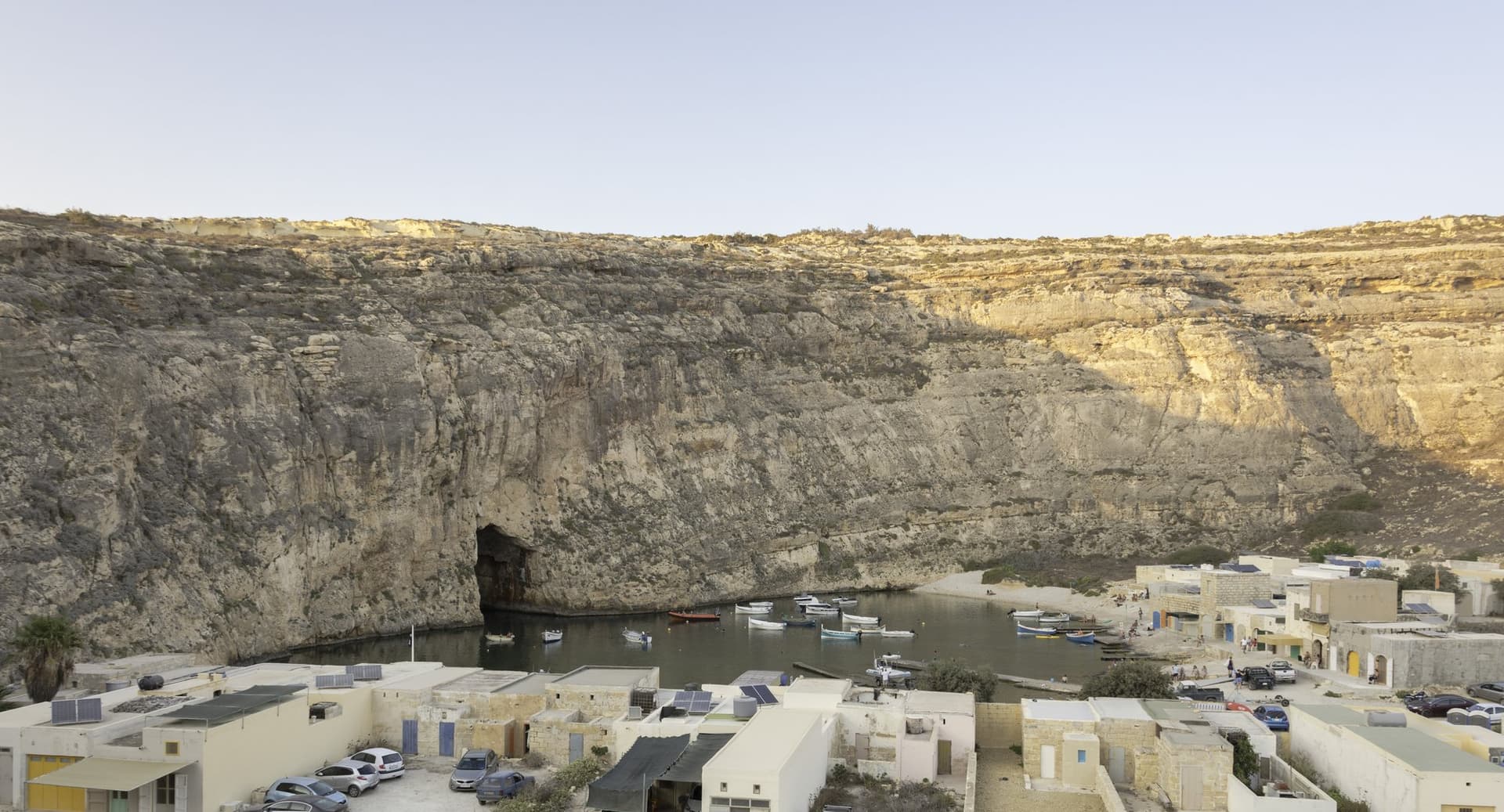
At Dwejra on the west coast, the Blue Hole opens through a limestone arch onto an open-sea wall, beside the boulder field left when the Azure Window arch collapsed in March 2017. The Inland Sea is a natural tunnel from a shallow lagoon out to open water. The north coast has the Reqqa Point wall, the Cathedral and Billinghurst caverns and the twin arches off Xwejni, and the Ras il-Ħobż pinnacle off Mġarr is where technical divers go. Marine life is temperate Mediterranean, and the wrecks, sunk as artificial reefs, give it structure to settle on.
Planning your visit
Fly into Malta International Airport, drive to Ċirkewwa and take the Gozo Channel car ferry to Mġarr. Gozo is small enough that each side is about 20 minutes from the other, so centres react to the wind and swell and choose the coast on the day. Xatt l-Aħmar is protected from the prevailing north-west winds, which keeps the wrecks diveable on most days. Malta requires every dive centre to hold a Malta Tourism Authority licence. Its rule for divers is that you may dive independently only if your certification allows a depth of 30 m; otherwise a licensed instructor must accompany you.1 All four Xatt l-Aħmar wrecks lie below that line, so for a diver certified to 30 m they are guided dives. Karwela and Cominoland sit at the edge of the 40 m recreational limit. MV Xlendi and the tanker pass it, which makes them deep or technical dives that call for training beyond a standard card, and the centre will set its own requirement. The Phoenician wrecks in Xlendi Bay lie far deeper and are reported to need government approval.
The sheltered bays at Mġarr ix-Xini and Ħondoq are the easy end of the island's list. Dwejra's Blue Hole is rated advanced, and its tunnels, like the north-coast caverns, are overhead environments that call for cavern or cave training and a guide.
Geology & underwater terrain
Coralline and Globigerina limestone coast eroded into arches, caverns, tunnels and sheer drop-offs, with Posidonia meadows over sand and no hard coral reef.
Videos
Dive sites in Gozo
The diving here splits into 4 zones:
- Dwejra (west coast) (Port: Dwejra)
- — The Blue Hole, the Inland Sea tunnel, the Azure Window boulder field, Fungus Rock and Coral Cave, all within or beside a Natura 2000 site.
- Xatt l-Aħmar (south coast) (Port: Xatt l-Aħmar)
- — The scuttled ferries Karwela, Cominoland and the upside-down Xlendi, sheltered from the prevailing north-west winds.
- North coast (Marsalforn and Xwejni) (Port: Marsalforn)
- — Reqqa Point's wall, the Billinghurst and Cathedral caverns and the twin arches off Xwejni.
- Mġarr and the east (Port: Mġarr)
- — The Ras il-Ħobż pinnacle, the sheltered cove of Mġarr ix-Xini and the bay of Ħondoq near Qala.
Dwejra (west coast)
Blue Hole (Dwejra)Top dive
Gozo's only shaft-to-arch shore dive linking three zones in one entry
Inland Sea (Dwejra)Top dive
Gozo's easiest overhead-environment dive, a long lit tunnel to open water
Azure Reef (Dwejra)
The dived remains of the Azure Window, a collapsed arch gone since 2017
Coral Cave (Dwejra)
A naturally lit cavern dive; a true cave lies behind it, for trained divers only
Crocodile Rock (Dwejra)
A shallow plateau to ease in, plus a full wall circuit for the confident.
Fungus Rock
One anchor point, two dives: an easy bay circuit or a genuine technical wall
Xatt l-Aħmar (south coast)
MV KarwelaTop dive
Gozo's most penetrable ferry wreck and its signature staircase photo
MV Cominoland
The trio's minelayer, with a stern winch and stripped-hull growth experiment
MV Xlendi
Gozo's original scuttled wreck, an inverted hull for experienced divers
North coast (Marsalforn and Xwejni)
Reqqa PointTop dive
A named deep-tech chimney, the Reqqa Bottle, below a beginner reef and full wall
Billinghurst Cave
Gozo's longest cavern swim, ending in a natural air pocket you can surface in
Cathedral Cave (Gozo)
Gozo's photogenic surfaced-air-pocket cavern, the 'Blue Dome' at Wied il-Ghasri
Double Arch (Xwejni)
Two stacked limestone arches after a long surface swim past a 30m+ wall
Mġarr and the east
Ras il-Ħobż (Middle Finger)Top dive
A shallow guided loop above a rock trimix divers use to train past 100m
Ħondoq ir-Rummien
An easy, sheltered training bay with multiple shore-entry points near Qala
Mġarr ix-Xini
Easy sheltered bay with resident seahorses, flying gurnard and a 1661 watchtower
When to dive
Wind decides which coast is diveable far more than the calendar does, and the south-coast wrecks sit in the lee of the prevailing north-west wind.
Safety considerations
What can go wrong here, and what divers do about it. Conditions change - take the briefing from the operator on the day.
- Surface and boat traffic: Wind decides which coast is workable; an exposed site can be closed while the opposite coast stays calm.Let a local centre choose the day's site from the forecast and keep the itinerary flexible.
- Depth: Every wreck at Xatt l-Aħmar lies below 30 m, the line Malta sets for unguided diving, and the deepest pass the 40 m recreational limit.Match sites to certification, plan gas conservatively and consider nitrox on the deeper wrecks.
- Overhead: MV Xlendi lies upside down, and penetrating it is hazardous.Stay outside the hull unless you hold wreck training and a plan for the overhead.
- Overhead: The Dwejra tunnels and north-coast caverns are genuine overhead environments.Treat any penetration as needing cavern or cave training and a qualified guide.
Rules and permits
National rules also apply: Rules and permits in Malta
Frequently Asked Questions
What are the best dive sites in Gozo?▾
It depends on the diver. The Xatt l-Aħmar wrecks are for divers with depth experience, and the Dwejra Blue Hole is rated advanced, so tunnels and arches there are not a beginner outing. Reqqa Point and the Billinghurst cavern are also advanced, Cathedral and the Inland Sea sit a step lower, and Ras il-Ħobż is the pinnacle for technical divers. Mġarr ix-Xini and Ħondoq are the sheltered bays for newer divers.
Can a newer diver dive Dwejra?▾
Only the gentler end of it. The Blue Hole is an advanced dive, and the Dwejra tunnels are overhead environments, so going through one takes cavern or cave training and a qualified guide. The Inland Sea is the moderate dive of the area and the place to start.
Why is MV Xlendi upside down, and can you go inside?▾
The scuttling in 1999 did not go as planned in strong winds, and the ferry settled upside down on the Xatt l-Aħmar slope. Penetration is hazardous, so most divers explore the outside only.
What certification do you need for the Xatt l-Aħmar wrecks?▾
Malta allows unguided diving only to the depth your certification covers, up to 30 m, so a diver certified only to 30 m needs an instructor for any of the four wrecks, which all lie below it. Karwela and Cominoland sit at the edge of the 40 m recreational limit, while MV Xlendi and the tanker pass it and call for deep or technical training. Check what your agency's card covers and what the centre asks for before booking.
Can you still dive the Azure Window after it collapsed?▾
The arch collapsed on 8 March 2017, so there is no arch left to see. Divers explore the boulder field it left on the seabed at Dwejra, beside the Blue Hole.
How do you get to Gozo to dive?▾
Fly into Malta International Airport, drive to Ċirkewwa at the northwest tip of Malta and take the Gozo Channel car ferry to Mġarr.
When was MV Karwela scuttled?▾
Accounts differ by a day: one says 12 August 2006 and another 13 August 2006. Either way she went down in the same operation as MV Cominoland.
Also known as: Għawdex
References
- 1.Professional Diving Schools Association (Malta) — Rules and Regulations
Every dive has a story. Share yours.
Log your dives - notes, photos, conditions and the marine life you saw - and share them as one public diver profile. What you share helps the next diver, too.
Log every detail
Depth, duration, conditions, gear, buddy, notes — all in one place. Import from Suunto and other dive computers.
Track marine life
Record species sightings on each dive. Build a personal catalogue of everything you've seen underwater.
Your public dive profile
Share your dive history, stats, and experiences with a profile page you control. Show the world where you've been.