
Diving in Malapascua
Dawn dives with Endangered thresher sharks on Kimud Shoal, plus muck minutes off the beach, a whitetip islet and a ferry wreck on a sand plain.
Last updated October 2026
Overview
Cleaner wrasse pick parasites off pelagic thresher sharks at very few places in the world, and two seamounts off Malapascua, an island at the northern tip of Cebu, are among them1. The thresher is listed Endangered. On Kimud Shoal the sharks rise onto the plateau in the early morning and circle slowly while they are cleaned2, usually at 12 to 15 metres, so the dive is a long, still watch from the plateau's edge, and the boats leave between 04:30 and 06:00 to be first on the site.
Around 2022 most of the threshers drifted from Monad Shoal to Kimud, which lies 7 km further out and has a shallower, smaller plateau. Many operator pages and guidebooks still name Monad. It is dived now as the warm-up before Kimud and as the place where a tiger shark sometimes shows, which recent divers describe as perhaps once a week across the whole fleet. Hammerheads once worked Kimud; they are rare there now and mostly below 30 metres.
Closer to the beach the diving is macro. Bantigue and Ka Osting are sand and rubble sites about five minutes out, with frogfish, mimic octopus and fire urchins carrying zebra crabs, and both dive better at night than by day. Deep Slope ends in a sand dune of garden eels, with pygmy seahorses on the fans above it. At dusk the mandarinfish court on the house reefs, under red light only.
Lapus Lapus is a soft coral garden, with total coral cover measured at 76.7% in 2018 and hard coral at only 6.7%, so expect soft coral and fans over stony reef.
Gato Island, 40 to 45 minutes northwest, is a limestone islet with resident whitetip reef sharks and a banded sea krait breeding colony. After the magnitude 6.9 earthquake of September 20253 the island closed to diving for about a month. The traverse under it was still reported closed in mid-2026, while the walls, reef and whitetips are dived as usual.
The Doña Marilyn, a ferry of about 98 metres, lies on its side between about 18 and 35 metres on an otherwise sandy plain. Its hull gives coral a hard surface there and now carries black coral, and the Daanbantayan mayor has said no salvage permit will be issued over it4.
Gato Island, Monad Shoal and Lapus Lapus have been municipal Marine Reserves since 2002, under Daanbantayan Ordinance 07-2002 as amended in 2010, which bans fishing and the extraction of marine life. Five Barangay Logon sites, Bantigue and Dakit Dakit among them, are a separate category of snorkelling and no-fishing zones under Ordinance 07-2010. As of a 2018 reef survey, none of these areas had boundary markers, enforcement was lacking and illegal fishing was seen regularly. Cebu province has also penalised catching, possessing or trading any shark or ray since 2014, and in 2015 Monad Shoal and Gato Island became the country's first shark and ray sanctuary5.
Planning your visit
Kimud Shoal answers to a different local government from the rest of the island, and its rules set how the thresher dive is run. The shoal lies in the municipal waters of Tabango, in Leyte, and Municipal Ordinance 2025-07 declared it a marine protected area, which operators have applied since the turn of 20266. Dives run between 06:00 and 14:00 and last at most 60 minutes. Open Water is the entry certification, every Open Water diver does a buoyancy workshop first, and below 50 logged dives an Open Water diver goes with an instructor or divemaster at capped group sizes. Discovery dives, Open Water training dives, snorkelling and freediving are banned there, as are lights and flash near the sharks, gloves, reef hooks and metal pointers. Bring a certification card and a logbook. Operators pay the shoal's environmental fee, and what else a quoted trip price includes, such as sanctuary and fuel charges, is set out differently by each shop, so ask what yours covers.
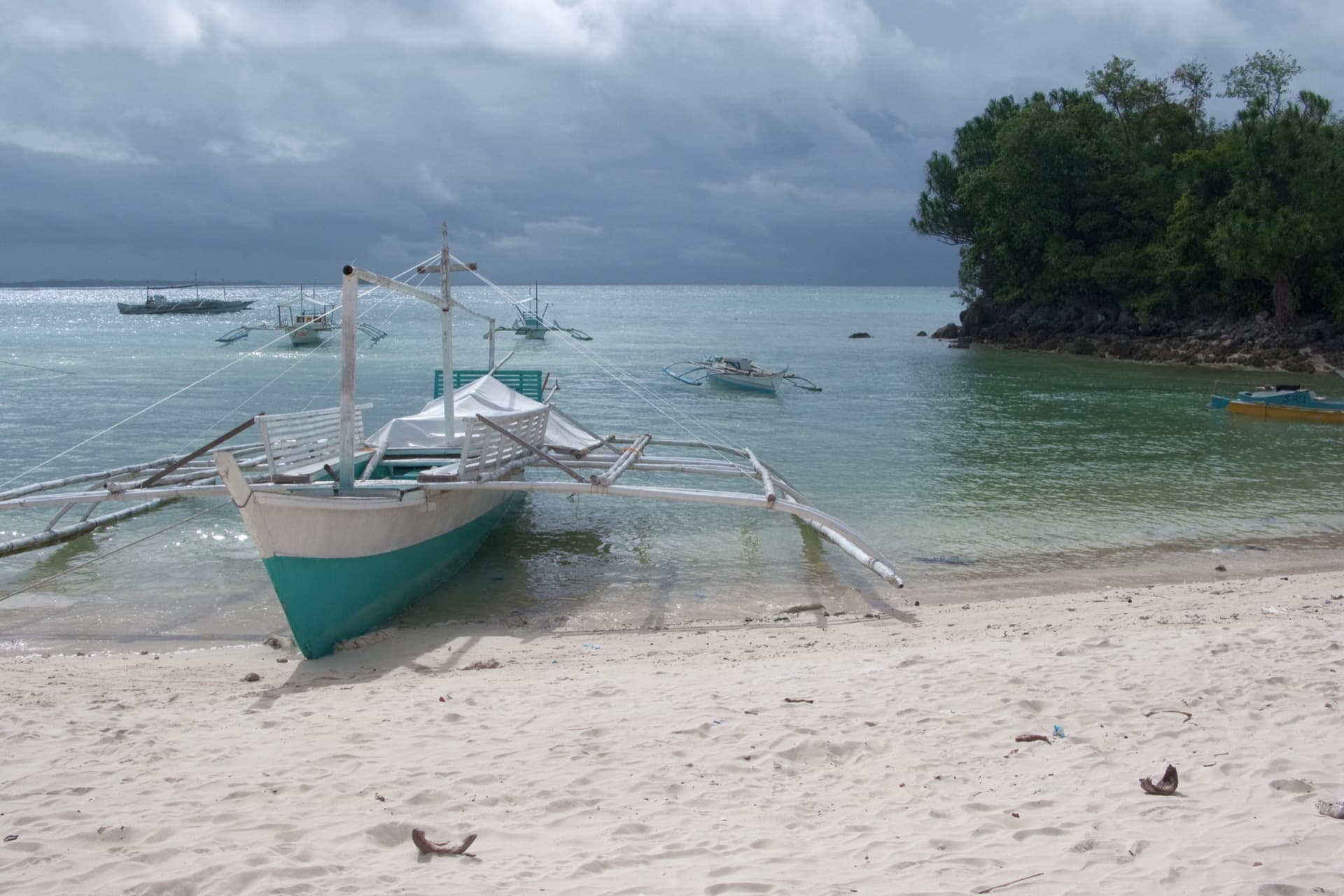
Fly into Mactan-Cebu and allow four to six hours door to door: three to four hours by road over about 130 km to Maya Port, then a 30 to 40 minute crossing. The coastguard stops crossings between about 16:30 and 17:30 depending on season and weather, so a late arrival at Maya usually means a night on the mainland. Dive shops are strung along Bounty Beach and the south coast, and the boats for every site leave from that beach. The Kimud trip is booked through one of those shops, and most run it as the first boat of the day and fill the rest with local dives, a dusk dive and a night dive.
Choose sites by level. The shallow reefs and muck sites suit Open Water divers. Ubang Bato and the Doña Marilyn are Advanced Open Water at the operators that publish a level, going inside the wreck needs wreck training, the Gato cavern is an overhead dive with a guide, and the Pioneer, at 52 to 56 metres, is for technical divers. Several operators recommend nitrox at Monad, Kimud, Deep Rock and Ubang Bato.
The nearest operational recompression chamber is a four-person unit at the TIEZA building in Mandaue City7; Malapascua has no chamber of its own to count on. Oxygen capacity on day boats differs from shop to shop, so ask, and carry dive insurance.
Geology & underwater terrain
Two flat-topped seamounts southeast of the island, with plateau tops around 15 to 25 metres that drop past 200 metres. A limestone islet at Gato, cut by caves and a tunnel under its northern half. And the island shelf, with fringing reef, flat-topped pinnacles walled to about 30 metres, and the sand and rubble slopes behind the macro reputation. The magnitude 6.9 earthquake of 30 September 2025, on the newly identified Bogo Bay Fault, struck roughly 25 km south-southeast of the island.
Dive sites in Malapascua
The diving here splits into 4 zones:
- The shoals, southeast and offshore
- — Monad Shoal 20 to 30 minutes out and Kimud Shoal about an hour, two shallow seamounts 7 km apart in the Visayan Sea. Boats leave in the dark.
- Island reefs and muck
- — Fringing reef, flat-topped pinnacles and sand slopes off the south and north coasts, 5 to 20 minutes from the beach. The macro sites, the dusk mandarinfish dive and a shallow landing-craft wreck.
- Gato Island, northwest
- — A limestone islet 40 to 45 minutes out, with walls, overhangs, a cavern, resident whitetip reef sharks and a sea krait breeding colony.
- The wrecks and the north
- — The Tapilon at 22 to 28 metres, the technical Pioneer, the Doña Marilyn ferry 90 minutes north and the current dive at Maria's Point, which is 2 to 3 hours out.
The shoals, southeast and offshore
Island reefs and muck
Chocolate Island
Shallow soft coral macro with a sheltered side in any current
Dakit Dakit
Check dives, refreshers and night dives on a shallow macro site
Deep Rock
Macro on a soft coral wall, from a 14 m plateau
Lapus Lapus
Macro divers who want a long slow dive and can handle current on the exit
North Point
Current-fed soft coral and a rocky overhang to work slowly
Gato Island, northwest
Marine life
When to dive
- Best season
- November to April
- Water temperature
- 26 to 29 C most of the year, 24 to 26 C in January and February
The Visayan Sea has a dry season from November to April and a rainy one from May to October, with visibility usually clearest from January to April and able to drop in November and December. The threshers are present year round, so the season changes comfort and clarity more than the headline dive.
Safety considerations
What can go wrong here, and what divers do about it. Conditions change - take the briefing from the operator on the day.
- Current: The seamounts sit in open water and Maria's Point is a current dive, run for advanced divers.Dive the shoals with an operator that briefs the site, stay with the group and carry an SMB.
- Overhead: Gato Island has a cavern that groups enter from its openings, and the traverse under the island has been reported closed since the 2025 earthquake on rockfall and collapse risk.Treat the cavern as an overhead dive with a qualified guide and a torch each, and take any closure of the through swim at face value.
- Depth: The Doña Marilyn runs down to about 35 metres and the Pioneer lies at 52 to 56, the Pioneer past recreational limits.Match sites to certification, plan gas conservatively and use nitrox where the operator recommends it.
- Remote location: Malapascua has no recompression chamber to count on. The nearest operational one is the four-person unit at the TIEZA building in Mandaue City, at the far end of a 3 to 4 hour road transfer plus the boat crossing, which stops at dusk.Carry dive insurance, ask what oxygen each day boat carries and keep profiles conservative.
Rules and permits
Marine reserve · Managed by Daanbantayan (Cebu) for the island, Gato and Monad Shoal; Tabango (Leyte) for Kimud Shoal · No permit required
Kimud Shoal carries an environmental fee of 300 pesos per diver per day, paid by the dive operator, plus a 500 peso annual mayor's permit the operator holds, and a Government Environmental Fee of around 140 pesos per person is collected at Maya Port, while other site and fuel charges are set out differently by each operator.
Frequently Asked Questions
Where do you see thresher sharks off Malapascua, Monad Shoal or Kimud Shoal?▾
Kimud Shoal is where the dive happens now. Most of the threshers drifted there from Monad around 2022, and a few still turn up at Monad. Kimud is about an hour out by boat, its plateau is shallower and smaller, and the sharks are usually at 12 to 15 metres. Many operator pages and guidebooks still name Monad as the thresher site, so confirm which shoal your trip is going to.
Do you need 50 logged dives to dive Kimud Shoal?▾
Open Water is the entry certification; 50 logged dives is the point below which an Open Water diver is supervised. Every Open Water diver completes a buoyancy workshop first, whatever the logbook says. Below 50 logged dives an Open Water diver also dives supervised, with an instructor at four divers per instructor or a divemaster at three or two per divemaster. Divers report that in practice many shops settle the question with a proficiency check dive for anyone under 50 dives or without Advanced Open Water, and the dive team asks to see the certification card and a logbook. One operator runs an Open Water package that puts an instructor alongside and uses Monad as the buoyancy rehearsal.
How likely is a tiger shark at Monad Shoal?▾
Uncommon on any given morning. Recent divers describe about one animal a week across the whole fleet, well below the share of dives one operator quotes. Tigers have also been reported at Kimud during thresher dives. Monad earns its place as the shallower first dive, with devil rays and whitetips around, and the plateau is mostly sand, so work the drop-off with the guide.
Is the wreck called the Pioneer the Cebu Pioneer ferry?▾
They are two different wrecks. The Cebu Pioneer is a 55 metre ferry lost in 1966, far deeper than any recreational limit and first dived in 2012. The wreck most operators call the Pioneer lies at 52 to 56 metres. One technical operator identifies it as the Mogami Maru, a 50 metre Japanese trawler completed in 1941 and later a submarine chaser, bombed on 12 September 1944. Another operator names the Oakita Maru as the alternative, so the wreck's identity is not settled. The bombing date is the one detail both readings share.
Is Gato Island open after the 2025 earthquake?▾
The island is open and the tunnel is the open question. Gato closed to diving for about a month after the 30 September 2025 earthquake, and divers have since described the walls, reef and whitetips as dived normally. The traverse under the island was still being reported closed in mid-2026, on rockfall and collapse risk, which makes that the latest report and not a posted closure. Gato has several swim-throughs, so a diver who passed through one has not necessarily been through the tunnel. Ask your operator for the tunnel's current status before booking it, and read descriptions written before October 2025 with that in mind.
Can you arrive and do the thresher dive the same morning?▾
Not on the public boat. The first public crossing from Maya Port leaves around 07:00, and the shark boats leave between 04:30 and 06:00. Divers who made it work arranged in advance, and paid extra, for a dive boat to collect them at Maya Port and take them straight onto the trip with their luggage aboard.
Can you still see hammerheads at Kimud Shoal?▾
Rarely. Kimud was once the hammerhead shoal, with schools reported from December to May, and some operator pages still list them. Recent sightings come mostly from technical dives below 30 metres, and operators that mention them caution against counting on one. Plan the trip around the threshers.
Can bad weather stop you reaching Malapascua?▾
Yes. A tropical cyclone signal can close the Maya crossing: at Signal No. 1 no ferry, public or private, is usually permitted to sail in the affected area, and the national weather service bulletin is the one divers are pointed to. The coastguard also stops crossings in the late afternoon, so a delayed transfer can cost a night on the mainland before the island diving even starts.
References
- 1.IUCN SSC Shark Specialist Group — Monad and Kimud Shoals ISRA Factsheet
- 2.PLoS ONE 6(3): e14755 — Oceanic Sharks Clean at Coastal Seamount
- 3.DOST-PHIVOLCS, November 2025 — Poster of the 30 September 2025 Magnitude 6.9 Offshore Northern Cebu Earthquake
- 4.SunStar Cebu, August 15, 2018 — Who's salvaging Doña Marilyn in Malapascua?
- 5.WWF, Project AWARE and Manta Trust — Shark & Ray Tourism, MPAs and Sustainable Financing: Monad Shoal, Philippines
- 6.Municipality of Tabango, Province of Leyte — Municipal Ordinance No. 2025-07: Kimud Shoal Marine Protected Area and Aquatic/Eco-Tourism Site Ordinance
- 7.SunStar, November 3, 2014 — DOT: New chamber buoys diving prospects in Cebu
Every dive has a story. Share yours.
Log your dives - notes, photos, conditions and the marine life you saw - and share them as one public diver profile. What you share helps the next diver, too.
Log every detail
Depth, duration, conditions, gear, buddy, notes — all in one place. Import from Suunto and other dive computers.
Track marine life
Record species sightings on each dive. Build a personal catalogue of everything you've seen underwater.
Your public dive profile
Share your dive history, stats, and experiences with a profile page you control. Show the world where you've been.