
Diving in Similan Islands
Thailand's most celebrated Andaman liveaboard route: granite boulder islands off Khao Lak, plus Koh Bon, Koh Tachai and Richelieu Rock, closed every monsoon season.
Last updated October 2026
Overview
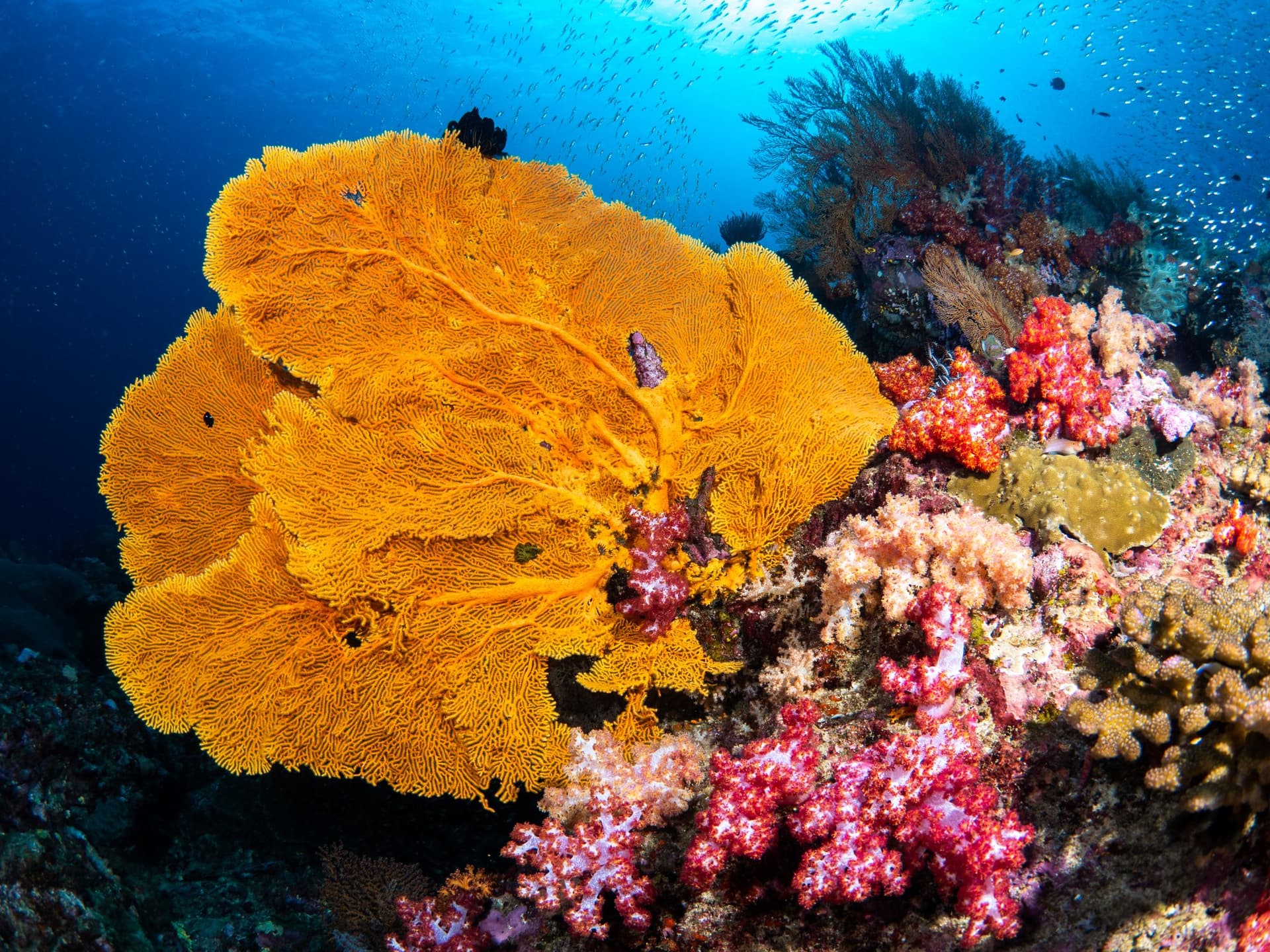
Most Similan diving happens on liveaboards, multi-day trips that mostly leave from Khao Lak's Thap Lamu Pier and work north up the park's eleven numbered granite islands. The last two, Koh Bon and Koh Tachai, and then Richelieu Rock are the three legs many divers rate above the rest. The main archipelago built its reputation on granite itself, giant boulders sculpted into swim-throughs and gorges, with gentle coral slopes on the sheltered east coasts and dramatic drop-offs on the exposed west, best seen threading the swim-through arch at Christmas Point or the boulder maze at Elephant Head Rock. Koh Bon and Koh Tachai, added to the park in 1998, bring different draws: Koh Bon is the site divers name most often for a manta, though a sighting comes down to luck, and Koh Tachai's exposed pinnacle draws schools of barracuda and trevally. Richelieu Rock, on paper inside the neighbouring Surin park,1 is the itinerary's marquee stop and the dive many divers make the trip for: a horseshoe-shaped soft-coral pinnacle thick with fish and macro life. Its whale sharks are argued over: day-trip guides reported none in the two years to early 2026, and someone who worked there in 2018 remembers weeks with one on every second dive.
Planning your visit
Liveaboards remain the only way to dive the full itinerary in one trip; most leave from Thap Lamu Pier near Khao Lak, and a few from Ranong. Day trips from Khao Lak also reach the main archipelago and the Koh Bon/Koh Tachai legs, and one operator lists a Richelieu Rock day trip, so check that it is running before you count on it. The park closes for the southwest monsoon, roughly 16 May to mid-October, reopening on a date confirmed each year, so book outside that window. Licensed dive operators may keep guests overnight inside the park, which is why a liveaboard can sleep aboard while day visitors head back to shore.2 Budget separately for the park's own entrance fee, the top tier among Thailand's national parks,3 and ask what an operator's park-fee line covers. December-February brings the most liveaboards to the same sites. Expect Advanced Open Water as the practical minimum for the current-swept pinnacle sites, and an easier standard for Breakfast Bend's warm-up reef.
Geology & underwater terrain
Ancient granite boulders on the main islands, sloping into coral on the sheltered side and dropping into pinnacles on the exposed side; Richelieu Rock, on the same itinerary, is an unrelated soft-coral pinnacle rising from a sandy plain.
Dive sites in Similan Islands
The diving here splits into 3 zones:
- The Similan archipelago
- — Islands 1 to 9 of the park's eleven numbered granite islands, with sloping coral gardens on the sheltered east coasts and dramatic boulder walls on the exposed west; most day trips and a liveaboard's opening legs stay here.
- The northern islands
- — Koh Bon and Koh Tachai, islands 10 and 11, were added to the park in 1998 and lie north of the other nine. Koh Bon is where divers most often report mantas, with luck, and Koh Tachai adds an exposed, current-swept pinnacle to the route.
- Richelieu Rock
- — A soft-coral pinnacle that sits, on paper, inside the neighbouring Surin park but is sold as this itinerary's marquee stop.
The Similan archipelago
Breakfast BendTop dive
First dive of a Similan liveaboard: a mild reef with a resident barracuda school
Christmas PointTop dive
A boulder maze around one 24 m swim-through arch, at the Similans' northern tip
Elephant Head RockTop dive
The Similans' classic granite boulder maze, swim-throughs to a 40 m sand floor
Marine life
When to dive
- Best season
- Late October to mid-May; one October trip met rain and chop, and that diver would go from November on
- Water temperature
- 26-30°C across the season; one January trip logged 28°C on most dives and 27°C in the thermocline
The park closes for the southwest monsoon, roughly 16 May to mid-October, and the reopening day is confirmed each year. One January trip found about 20 m of visibility at most sites, and the islands sit far enough offshore that coastal storm runoff does not reach them. December-February brings the most liveaboards.
Safety considerations
What can go wrong here, and what divers do about it. Conditions change - take the briefing from the operator on the day.
- Current: Exposed pinnacle sites, Elephant Head Rock, Koh Tachai Pinnacle and Richelieu Rock among them, see strong and sometimes unpredictable current that strengthens further around full and new moonDescend on a fixed reference point, stay close to your guide, and carry a surface marker buoy
- Surface and boat traffic: Richelieu Rock draws day boats and liveaboards onto the same pinnacle in peak season, and the crowding peaks when the day boats are on siteAsk your operator how it times Richelieu Rock; many schedule around the rush where they can
Rules and permits
Mu Ko Similan National Park
National park
- Closed to diving from May 16 to October 14, every year. (in some zones)
2026 park closures (Thai gazette)Overnight stay closure (Thai gazette)Sunscreen ban (Thai announcement)Checked: Oct 2026
National rules also apply: Rules and permits in Thailand
Frequently Asked Questions
Can I dive the Similan Islands outside a liveaboard?▾
Yes, for part of it. Day trips from Khao Lak run priced, scheduled products to the main archipelago and to Koh Bon and Koh Tachai. A Khao Lak operator also lists a Richelieu Rock day trip; confirm it is actually running before you build a trip around it. Covering the whole route in one trip is still a liveaboard job.
Is the park really closed for five months a year?▾
Yes. Mu Ko Similan National Park closes to tourism every year for the southwest monsoon, roughly 16 May to mid-October. The exact reopening day is confirmed each year, and the 2026 reports differ on it by a day; Surin Islands National Park, home to Richelieu Rock, closes on the same schedule.
How do liveaboards keep running when the park bans overnight stays?▾
Licensed dive operators may keep guests overnight inside the park, which is what lets a liveaboard spend several nights there; other visitors go back to shore the same day.2
Is Richelieu Rock actually part of the Similan Islands?▾
Administratively, no: it sits inside the neighbouring Mu Ko Surin National Park.1 Liveaboards still sell and dive it as the marquee stop of a Similan-departure itinerary, which is why it belongs on this route.
Can I still dive Koh Tachai?▾
Possibly the pinnacle, not the reef. The island and the coral reef around it are closed to visitors indefinitely, so the gentler Koh Tachai Reef dive is closed as well. Koh Tachai Pinnacle, a submerged peak about 500 m south of the island, is not named in the closure either way, and whether it counts as part of the closed reef is unsettled; operators still sell and run dives there. When you book, confirm the pinnacle is actually on the plan.
Are whale sharks and mantas guaranteed on a Similan trip?▾
No. Richelieu Rock is marketed hard for whale sharks, and accounts split on it: day-trip guides there reported none in the two years to early 2026, while someone who worked there in 2018 recalls weeks with a whale shark on every second dive. Mantas come down to luck too. Koh Bon is the site divers name for them, and they show up more often around February and March according to one person who worked there.
How crowded does it get at Richelieu Rock?▾
Busy in peak season, roughly December to February. One diver counted about eight other boats on site at once, one of them carrying around eighty people plus crew. The crowding peaks when the day boats from Khao Lak are on site; a liveaboard that times its Richelieu dives around them can have the pinnacle far quieter, so ask yours how it plans them.
Why are Koh Huyong, Ko Payang and Ko Payan off-limits?▾
Islands 1 to 3 of the archipelago are closed to the public to protect turtle hatching and the reef; they sit outside the standard dive and landing itinerary.
What does the park entrance fee cost?▾
The park authority's 2022 schedule sets it at 500 THB for a foreign adult and 250 THB for a foreign child, the highest tier in Thailand's national park system, shared only with the neighbouring Surin park.3 One Khao Lak operator's day-trip price table lists a 700 THB park fee per diver, so the figure in a quote may not match the official one; ask your operator what its park fee covers.
Also known as: Ko Similan, Mu Ko Similan, Mu Ko Surin, Surin Islands, The Similans
References
- 1.Department of National Parks, Wildlife and Plant Conservation (Thailand), April 7, 2025 — DNP Director-General field-visit report
- 2.Royal Thai Government Gazette, October 8, 2018 — Royal Gazette (ราชกิจจานุเบกษา), Vol. 135 Special Section 249 Ngor: closing overnight stays, Mu Ko Similan National Park
- 3.Department of National Parks, Wildlife and Plant Conservation (Thailand), June 2, 2022 — DNP fee-restructuring notice, Fee Group 4
Every dive has a story. Share yours.
Log your dives - notes, photos, conditions and the marine life you saw - and share them as one public diver profile. What you share helps the next diver, too.
Log every detail
Depth, duration, conditions, gear, buddy, notes — all in one place. Import from Suunto and other dive computers.
Track marine life
Record species sightings on each dive. Build a personal catalogue of everything you've seen underwater.
Your public dive profile
Share your dive history, stats, and experiences with a profile page you control. Show the world where you've been.