

Lanzarote Non Stop Divers
PADI 5-Star CDC in Playa Blanca with 5.0 rating across thousands of reviews, daily shore and boat dives at 30+ sites, and full IDC training pathway.
PADI6 languages
Also known as: Blue Hole, El Agujero Azul, The Blue Hole
Short volcanic lava-tube swim-through off Playa Chica, opening from a sand and garden-eel field at 18m onto a Puerto del Carmen cliff face.
Last updated May 2026
Hundreds of garden eels sway above the sand like a slow living meadow. That's the first scene of the dive, after the descent from the Playa Chica pier stairs and a short swim across the submerged dune field. The eels retreat as you pass, and at the far edge of the colony the reef wall shows a dark opening at about 18 metres.
Inside, the collapsed lava tube is short and oriented. Keep the rock wall on your left, breathe high and hover, and within a minute the tunnel exit frames open blue water. The contrast is the moment of the dive. Behind you, sand and the tube; ahead, a cliff falling away into deep ocean. Caves and overhangs step down the wall to 30 metres, each one worth a slow torch pass. A small side cave shelters dense swarms of narval shrimp; resident groupers shadow the torchbeam, using the light to hunt. The return runs back along the shallower wall to the eel field for the safety stop.
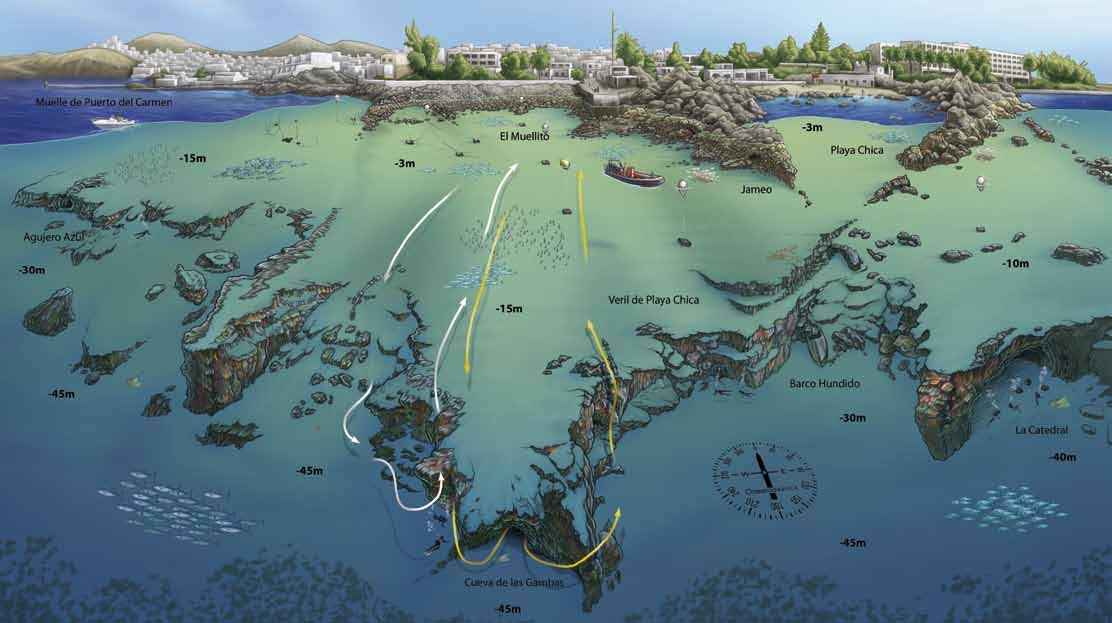
Illustration: Oceanografica / Reserva de la Biosfera de Lanzarote (2011)
"Blue hole" is a generic dive name used worldwide, and most blue holes are vertical sinkholes or long caves. Lanzarote's version is neither. It is a short collapsed lava-tube traversing the reef edge from a bright sandy zone into open cliff water, and the appeal is the staged sequence rather than a single feature. You cross a documented garden-eel field, pass through a real overhead, and emerge directly onto a deep volcanic wall, all from one shore entry. The 2011 biosphere reserve guide chose the editorial line "una ventana a las profundidades" — a window into the deep — and that frames the dive accurately: the tunnel is the window, and the dive is what's on the other side.
The grouper interaction is the other signature. Shine a torch into a cliff cave and resident dusky groupers move in around you, using your light to flush prey. Forum trip reports from regulars describe five large groupers feeding aggressively in the torchbeam at depth — an interaction the diver controls, not one that happens to you.
The tunnel is geological rather than human. Lanzarote sits on a chain of submerged Holocene volcanic features, and the reef-edge collapse that created Agujero Azul is one of many lava-tube remnants along the Puerto del Carmen coast. The site reached its current public profile through the 2011 Lanzarote Biosphere Reserve diving guide produced by SPEL and the Cabildo de Lanzarote — page 104 of the catalogue, dive 22 of 37. Most Puerto del Carmen centre pages still echo that guide's narrative spine. The Playa Chica nearshore was declared a Special Conservation Zone (ZEC, Natura 2000) in September 2011, the same year the guide was published; the designation is environmental and adds no diver permits or fees. The English alias "Blue Hole" is the form used by international operators serving the Puerto del Carmen tourist trade.
Bring a torch. The tunnel is short enough to see daylight at both ends, but the dive's payoff is the cave system along the cliff after the exit, where torchlight triggers the grouper hunting response and reveals the narval shrimp colony in the side cave.
Buoyancy discipline inside the tunnel is not optional. The space is tight enough that a single careless fin kick turns clear water into soup for everyone behind you. If you're not confident in confined spaces, a shallower variant of the dive that stays above the tunnel mouth and explores the eel field is a satisfying dive on its own.
The cliff face beyond exits past 30 metres, so plan gas and NDL around the deep portion and don't extend bottom time chasing one more cave. The local narcosis protocol is straightforward — slow descent, calm breathing, ascend a few metres if symptoms appear — and worth re-reading on briefing day. Watch for boat traffic on ascent near the Playa Chica pier, deploy an SMB on the safety stop, and arrive early at the small Playa Chica car park or use a centre with van transport.
What makes this dive site stand out.
Short volcanic swim-through traversing the reef edge from sand flat to open cliff face
Field of garden eels on the sandy run-up at 12-18m, the signature feature of the entry
Caves and overhangs along the wall beyond the exit, with narval shrimp and resident groupers
Sand-flat shallows, 18m tunnel mouth, cliff drop to 30-35m on a single shore dive
28.9191°N, 13.6691°W
Diveable year-round; angel-shark encounters peak December to March
No site-specific fees; standard Puerto del Carmen guided shore-dive rates apply
AOW recommended for the full route through the tunnel and along the cliff to 30m. OW divers can do a shallower variant that turns back at the eel field or above the tunnel mouth.
Summary
Sand and eel-field approach is easy. The tunnel is short but a true overhead. Cliff exploration beyond pushes the recreational depth limit.
Safety considerations
What can go wrong here, and what divers do about it. Conditions change - take the briefing from the operator on the day.
Book a guided dive at this site.
PADI 5-Star CDC in Playa Blanca with 5.0 rating across thousands of reviews, daily shore and boat dives at 30+ sites, and full IDC training pathway.

SSI Diamond, PADI 5-Star, and BSAC centre 100 m from Playa Chica with free Nitrox 30%, free boat dives, and a custom trimaran hard boat.

SSI Diamond ITC in Playa Blanca with 4 boats across two sectors, daily Museo Atlantico excursions, tech diving to 100m+, and Lanzarote's only Mermaid School.

PADI 5-Star Dive Resort on Playa Chica in Puerto del Carmen, one of 9 MOD ComMac-approved centres worldwide, with 40+ years on the island.

PADI 5-Star IDC in Puerto del Carmen, the only Halcyon dealer in the Canary Islands, with 5.0/5 across 386 reviews and Playa Chica shore-diving access.
Get in touch to add or claim your dive center listing on DiveCodex.
No permit, no fee. Playa Chica is within a Natura 2000 ZEC since 2011, an environmental designation without diver-specific restrictions.
No. Lanzarote's Agujero Azul is a short collapsed-lava-tube swim-through, not a vertical sinkhole. The tunnel runs roughly horizontally through the reef edge from a sandy area into the cliff face. The name comes from the blue light in the tunnel exit, not from a deep shaft.
Advanced Open Water is the recommended minimum for the full route. The tunnel mouth sits at the 18m Open Water depth limit, and the cliff face beyond drops past 30m. Open Water divers can do a shallower variant turning back at the eel field, but the through-route is an AOW dive.
It's a true overhead, but a short one. Most Puerto del Carmen centres treat it as a cavern penetration on the standard briefing because daylight stays visible at the exit. Full cave certification is not a requirement; orientation and buoyancy training are. Divers without overhead experience should follow the guide and not separate inside.
The garden-eel field on the sandy approach is the entry's defining feature, with hundreds of eels swaying above the sand. The cliff face beyond the tunnel hosts resident dusky groupers in the caves, narval shrimp swarms in a small adjacent cave, and the wider Lanzarote pelagic crew (barracuda, trumpetfish, octopus). Angel sharks are a winter possibility, not a guarantee.
Yes. The tunnel itself is short enough to swim without one, but the caves along the cliff after the exit are where the dive comes alive. Torchlight reveals the narval shrimp in the side cave and triggers the resident groupers' habit of following divers in.
Shore entry from the small pier at Playa Chica beach in Puerto del Carmen. At low tide divers use the stair entry; at high tide a giant-stride from the pier is possible. Most Puerto del Carmen dive centres include the site in their Playa Chica rotation.
Diveable year-round. Summer brings warmer water (22-24°C) and the easiest exposure-suit choice. Winter (December-March) is colder (around 18°C bottom) but is when angel sharks are most active in the area. Visibility is usually best after stable spells of low wind.
Log your dives - notes, photos, conditions and the marine life you saw - and share them as one public diver profile. What you share helps the next diver, too.
Log every detail
Depth, duration, conditions, gear, buddy, notes — all in one place. Import from Suunto and other dive computers.
Track marine life
Record species sightings on each dive. Build a personal catalogue of everything you've seen underwater.
Your public dive profile
Share your dive history, stats, and experiences with a profile page you control. Show the world where you've been.