

Blaumar
CMAS dive centre in Mataró port with 40+ years of trading, running 600+ boat outings a year on the Maresme rocky ridges, 30 minutes by train from Barcelona.
CMAS7 services3 languages
Also known as: Barreta D'en Serra, La barreta d'en Serra, La Barreta d'en Serra
Small Row 4 rocky bar at 16-18m off Mataro, a low-relief ridge with current-driven nudibranch flanks and a one-off summer holothurian-spawning record.
Last updated April 2026
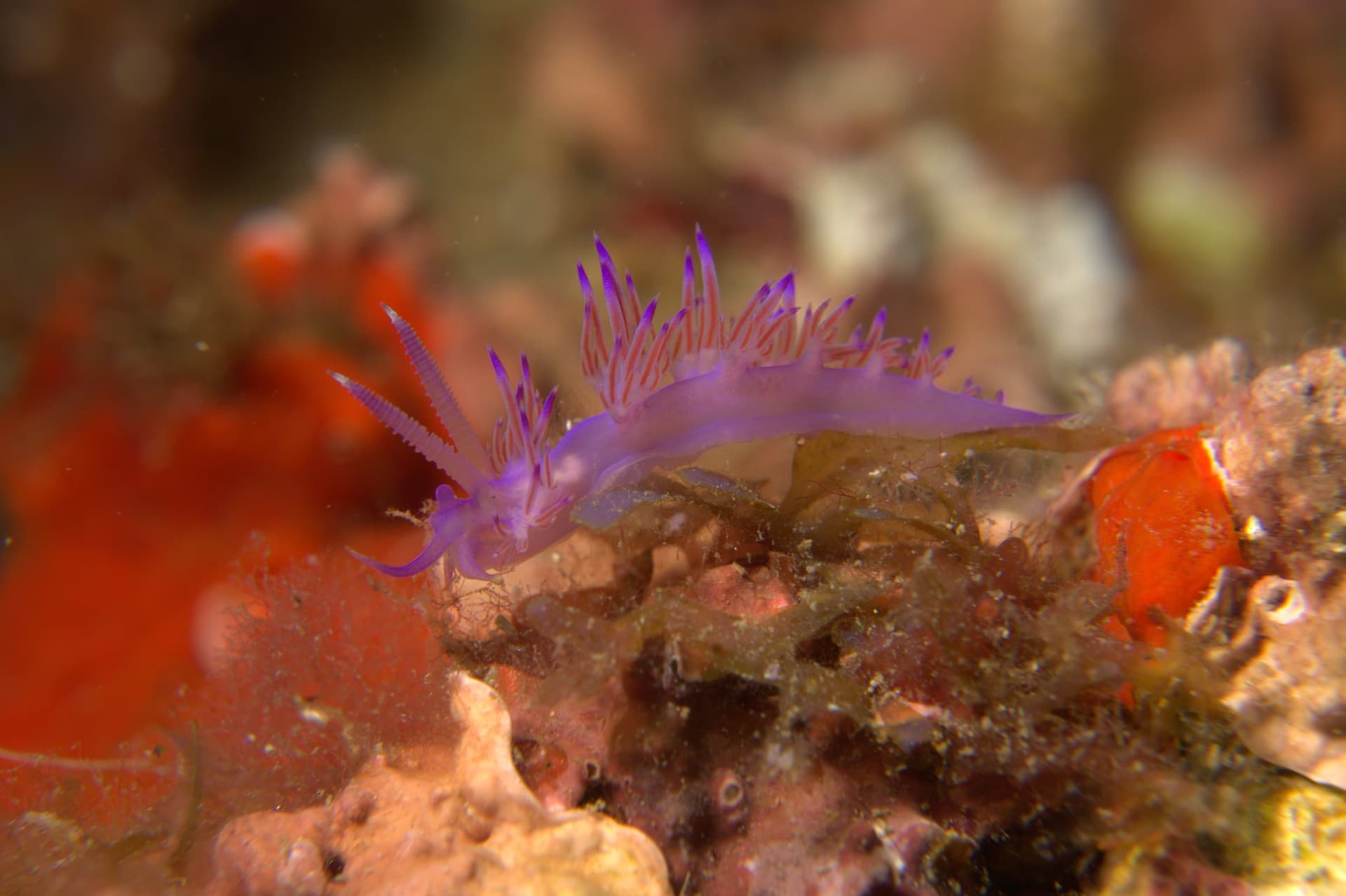
Roll back into 16 to 18 metres on the Blaumar profile and the bottom comes up fast. The barreta is a thin band of rock running roughly parallel to the coast, narrower and lower than the neighbouring Barra de l'Arbre one row over. The dive resolves into a slow patrol of the cracks on the current-exposed flank: peregrina and flabellina nudibranchs cluster on the upcurrent rocks where hydroid prey is exposed to flow, and a macro lens is the right call for the typical Row 4 dive here. Common octopus turn up between rock outcrops working the gravel; a 2012 owner dive recorded one taking a scorpionfish-sized prey on a single immersion.
Currents are sporadic but real. A July 2008 dive at this site put the diver in a notable south-west to north-east current at 20 metres on the deeper Row 4 band, and the same dive produced a one-off summer event worth flagging: a mass spawning of holothurians and three urchin species, with abalone visible in daylight. That was a once-only observation rather than a reliable annual draw, but it is the kind of thing this site can produce on a July day with the right conditions. Visibility on a calm summer day runs the area-typical 10 to 15 metres, occasionally cleaner; winter post-rain can drop to 1 to 5 at any Maresme site, this one included.
Barreta d'en Serra is the quieter Row 4 option. Centres pick it when they want a shorter, shallower outing on the same stratigraphic band as the busier Barra de l'Arbre, and the 16 to 18 metre operating profile keeps the dive comfortable on no-deco time without giving up the crevice fauna that defines this stretch of coast. The current-exposed flank is what sets it apart: the upcurrent face of the ridge concentrates nudibranch density on hydroid-bearing rock in a way the more sheltered neighbouring sites do not. The local-genitive name signals a working fisherman's spot rather than a marketed destination, and the site has surfaced only once in published first-person community accounts that name it verbatim.
Summer dives need a current plan even on calm forecasts. The standard Mataro convention applies: descend at the anchor, follow the ridge with the current at your back on the outbound leg only if you have planned the return, and carry an SMB for safety-stop ascent if the line has drifted. Compass and dive light belong on every dive here. The barreta is the only feature; the sand on both flanks has no orientation cues. Pick the suit for the deepest part of the dive. The summer thermocline can drop bottom temperature into the 15 to 18 band below 18 to 20 metres even on a 22-degree surface day, so a 5mm with hood is the working summer baseline on the deeper end of the profile. There is no permit, no fee, no concession, and no marine reserve regime at this site.
What makes this dive site stand out.
16-18m operating depth, the friendlier end of the Mataro stratigraphy on no-deco time
Peregrina and flabellina species cluster on the upcurrent rocks where hydroids are exposed to flow
Catalan fisherman-locator pattern (d'en Serra) shared with nearby barretas
Less crowded than Barra de l'Arbre one row over, on the same Row 4 band
41.5350°N, 2.4900°E
Warmer water and the seasonal nudibranch-density window. The site is dived year-round when sea state allows.
Standard Mataro-port boat-dive rate. No site-specific access fee. Verify current rates with the centre.
16-18m operating profile sits inside the Open Water 18m limit. Guides may extend to the deeper Row 4 band (18-22m) for AOW divers.
Summary
Easy on a settled day. Sporadic summer current and visibility variability can bump it to moderate when conditions go off.
Safety considerations
What can go wrong here, and what divers do about it. Conditions change - take the briefing from the operator on the day.
Book a guided dive at this site.
CMAS dive centre in Mataró port with 40+ years of trading, running 600+ boat outings a year on the Maresme rocky ridges, 30 minutes by train from Barcelona.

Port-based SSI club in Mataró, 30 km from Barcelona, running year-round boat dives on the Maresme barras with adaptive and technical training.
Get in touch to add or claim your dive center listing on DiveCodex.
Dive centres in Catalonia must require insurance from every diver on their dives, and must be able to offer a policy to anyone who has none.
Open Water is enough at the 16-18m operating profile that Blaumar runs. The site footprint extends to 22m on the deeper Row 4 band, which a guide can choose to use for AOW divers. The shallower profile sits inside the standard Open Water 18m limit.
Yes, on the right day. The current-exposed flank holds peregrina and flabellina species, which feed on hydroids that benefit from water flow. Late spring through early autumn reads best for density. Bring a macro lens and work the upcurrent edge of the ridge first.
Same row, different scale. L'Arbre is longer, topographically richer at 15-21m, and busier in local rotations. Barreta d'en Serra is a smaller ridge at 16-18m with less relief, fewer logged dives, and a quieter atmosphere. Centres pick it when they want a shorter, shallower outing on the same band.
Currents are sporadic but real. A July 2008 community dive log put the diver in notable south-west to north-east current at around 20 metres, and a 2012 dive on the same site recorded strong surface current with moderate current at the bottom. Plan the outbound leg into the current and carry an SMB. On settled days the dive is calm.
The name follows a Catalan fisherman-locator pattern. Barreta is the diminutive of barra (a long rocky ridge running parallel to the coast), and d'en Serra means 'belonging to Serra', most likely a historical fisherman associated with the spot. Other Mataro barretas use the same pattern: La Barreta de l'Arbre, La Barreta de l'Ou.
No. Barreta d'en Serra sits inside the Costes del Maresme Natura 2000 zone, which is a habitat-protection designation focused on Posidonia meadows. There is no permit, no quota, no fee, and no dive-centre authorisation for diving this site.
Log your dives - notes, photos, conditions and the marine life you saw - and share them as one public diver profile. What you share helps the next diver, too.
Log every detail
Depth, duration, conditions, gear, buddy, notes — all in one place. Import from Suunto and other dive computers.
Track marine life
Record species sightings on each dive. Build a personal catalogue of everything you've seen underwater.
Your public dive profile
Share your dive history, stats, and experiences with a profile page you control. Show the world where you've been.