
Scuba Total Cancun
Family-run dive centre in Cancun's Marina AquaFun running reefs, MUSA, the C-55 and C-58 wrecks, cenotes and Cozumel at four divers per guide.
PADI / SSI / SDI / TDI7 services3 languages
Also known as: ARM General Pedro María Anaya, ARM Oceanográfico, Cañonero C-58 Anaya, General Anaya C58, Gunboat C-58, USS Harlequin (AM-365)
A Mexican Navy gunboat sunk as an artificial reef off Cancún in May 2000, lying broken on white sand.
Last updated October 2026
The larger, stern half of the hull is the heart of the wreck, and it is open: operators describe several rooms that can be explored and openings big enough to swim through. One operator places the descent line there, though groups often go down together with no line at all, led by a guide with about four divers each. The bow section lies roughly a hundred metres down-current on its left side, with little penetration, and reaching it is a drift along the sand if gas allows.
The wreck sits on white sand, so everything that lives here gathers on the hull. Green morays and barracuda are reported in and around the steel, and nurse sharks under it. From late November or December through to February or March, spotted eagle rays pass overhead in numbers.
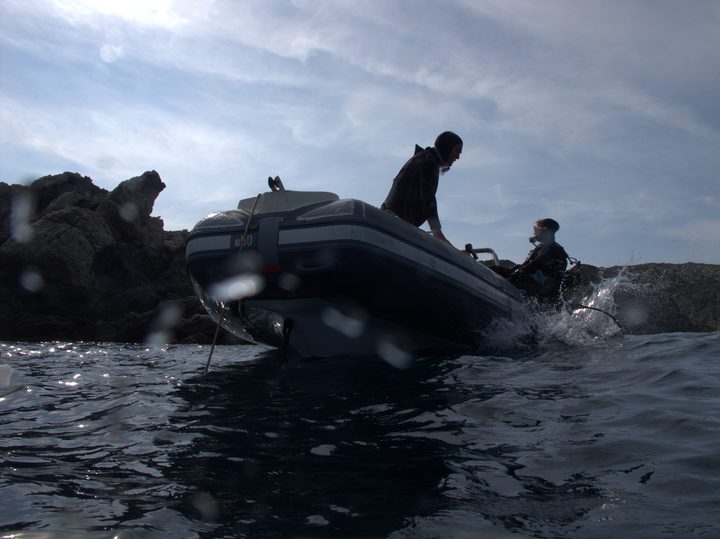
The usual dive runs 25 to 30 minutes as a drift. Entry from the boat is a coordinated backward roll straight down, and ascents are made under control.
On 28 May 2000 the Mexican Navy sank the gunboat C-58 Anaya inside the Punta Cancún polygon of the national park, on the instruction of the president of the day, to give divers somewhere other than the natural reefs to go 1. The sinking has an official date, a published coordinate and a stated purpose.
The ship you see is no longer the ship that went down. Hurricane Wilma is reported to have broken it in two in 2005, dragging one half away and tipping the stern onto its side, and that damage is what opened the hull. Operators widely describe it as a former US Navy minesweeper, but the published accounts of which ship it was contradict the park's sinking date, and the FAQ sets the question out.
The park's own verdict on the wreck zone is that its currents run strong to moderate and that beginners should not be brought here, which is why the aim of drawing divers off the natural reefs was only partly met 1. One operator goes further and calls the current very strong all year. Descend and ascend under control and stay with your leader.
Going inside means overhead diving in a hull that storms have rearranged, and how sound that hull is remains unknown. Enter only with the training and equipment overhead diving needs.
This is a drift dive, and operators call a controlled ascent with a surface marker buoy essential.
What makes this dive site stand out.
A Navy gunboat scuttled on 28 May 2000 inside the national park
Hurricane damage left openings and rooms that divers can swim through
A larger stern half and a bow section lying about 100 m down-current
The park flags strong to moderate flow and advises against beginners
21.1202°N, 86.7118°W
Eagle ray window: late November to February by one operator, December to March by another
Operators state Advanced as the level for this dive, and one adds the Wreck course. One conditions box also lists Open Water beside Advanced, and one operator screens every diver strictly. Confirm with yours; juniors wait until 15
Summary
Seabed past 18 m and strong current, with overhead rooms for those who enter
Safety considerations
What can go wrong here, and what divers do about it. Conditions change - take the briefing from the operator on the day.
Book a guided dive at this site.
Family-run dive centre in Cancun's Marina AquaFun running reefs, MUSA, the C-55 and C-58 wrecks, cenotes and Cozumel at four divers per guide.
Get in touch to add or claim your dive center listing on DiveCodex.
Operators mostly say Advanced. One recommends it for Advanced Open Water divers and divers with the Wreck course, yet it lists Advanced or Open Water in its conditions box, and it tells Open Water divers there are still ways to experience the site without naming them. A second operator states Advanced Open Water as the required level, a reseller lists the Advanced certificate as the prerequisite, and a third asks for an advanced, experienced diver and screens strictly. The park advises against beginners here. With the seabed at 24-26 m, an Open Water diver should expect to be offered something other than this dive.
It is widely described as a US-built Admirable-class minesweeper, and some pages trace it through a chain of Mexican Navy names from USS Harlequin. The chain does not hold together. It ends in a ship that a reference reports still in naval service in 2007, seven years after the park records the C-58 sinking in May 2000, and one operator says the renamings belong to sister ships and dates the sinking decades earlier. The park itself names only the ex-gunboat C-58 Anaya. Which hull lies on the sand is unresolved, so the page does not tell a ship's life story for her.
Log your dives - notes, photos, conditions and the marine life you saw - and share them as one public diver profile. What you share helps the next diver, too.
Log every detail
Depth, duration, conditions, gear, buddy, notes — all in one place. Import from Suunto and other dive computers.
Track marine life
Record species sightings on each dive. Build a personal catalogue of everything you've seen underwater.
Your public dive profile
Share your dive history, stats, and experiences with a profile page you control. Show the world where you've been.