

Aquatica Illes Medes
SSI Diamond ITC in L'Estartit since 1996, specialising in small-group, low-impact diving in the Illes Medes Marine Reserve from a campsite-based dive school.
SSI6 services5 languages
Also known as: Carai Bernat, Carall Bernat de les Medes, Cavall Bernat
Wall and large-block dive around a rock at the south-east of the Illes Medes, with gorgonians, a shallow channel toward the Tascons and a dense grouper population.
Last updated October 2026
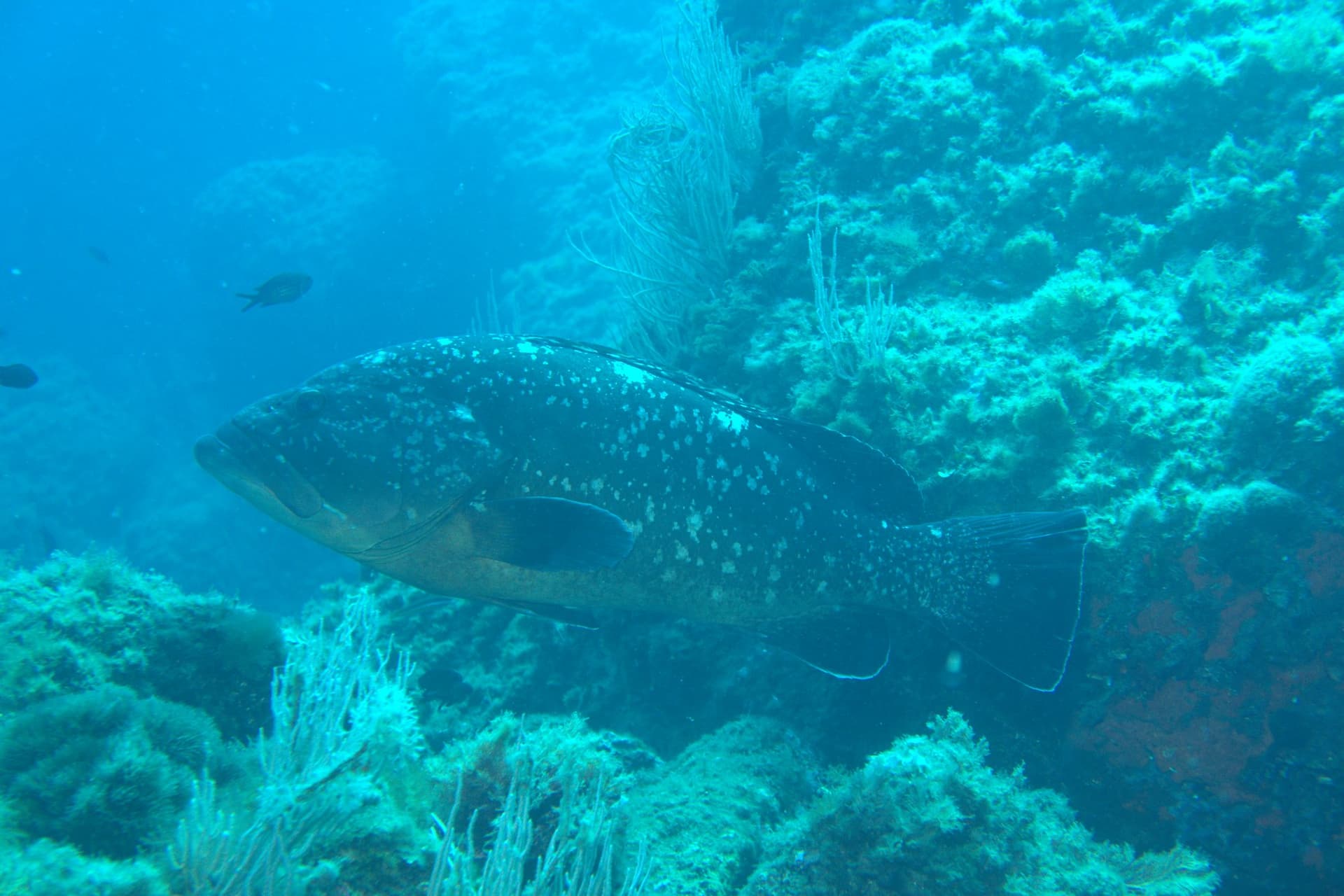
Large blocks of rock and steep walls ring this south-eastern corner of the Illes Medes, and the dive follows them from the mooring buoy. Gorgonians cover the walls, groupers sit among the blocks, and morays and sea bream work the crevices; arches break the wall in places and deeper down it gives way to platforms and canyons.
The water sets the route. With no current the whole rock can be circled, a loop that reaches about 30 m; with current, the wall and the large blocks are the place to stay, and the far side of the rock offers a shallower option at 15 to 18 m. Between the rock and Tasco Gros runs a channel only 5 m deep, where nudibranchs, groupers and everything between turn up. Looking out into the blue pays off too, since tuna, bonito, sunfish and amberjack pass.
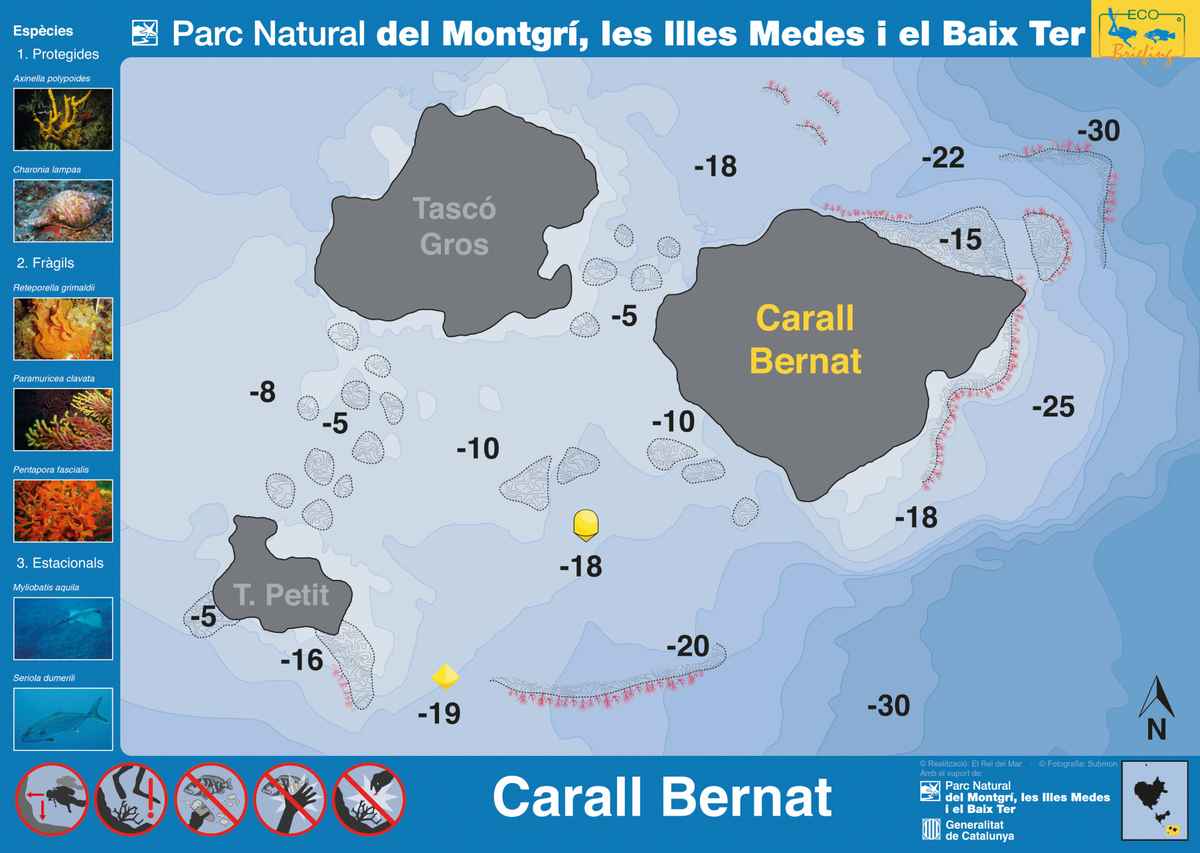
Illustration: Parc Natural del Montgrí, les Illes Medes i el Baix Ter — Generalitat de Catalunya
This southern zone of the archipelago holds the highest concentration of groupers in these waters, large resident fish close to the wall. They share it with gorgonian-covered rock where Axinella polypoides and the trumpet shell Charonia lampas are protected and the red gorgonian is fragile, so careful buoyancy matters as much as the route.
Current is the other half of the character. It carries eagle rays, barracuda and tuna past the outer part of the zone, and eagle rays are frequent there in summer. The same flow is what makes the dive demanding when it picks up.
Ask the centre at booking which route it plans for the day and what the current was doing at the buoy on the previous dives; on a strong day expect the wall and blocks, not the full circuit. Nitrox 32% suits the usual profile, and a surface marker buoy goes in the kit. Begin the return to the line early, because the flow can rise just when you head back.
What makes this dive site stand out.
Large, plentiful groupers among the blocks of the southern zone
Circle the rock when calm; on current days stay on the wall and blocks
Charted at 5 m between the rock and Tasco Gros, with life from nudibranchs to groupers
Blue and yellow sea-whip gorgonians cover the slope
Seasonal, with sightings logged June to August
Rocky pinnacle ~20m diameter with vertical walls, arches, crevices. Two routes: full circumnavigation at 25-30m or single-side wall dive at 15-18m. Platforms and canyons at the base.
42.0415°N, 3.2277°E
The ideal diving window runs April to October; eagle-ray sightings cluster in June to August.
Advanced Open Water is our working level because summer current can make the dive demanding; that is a reading of the conditions, not a regulation. The Park and several operators grade the site for every level depending on route, and one centre association recommends an advanced level for the Tascons zone, whose text names Carall Bernat.
Summary
Operators grade it for all levels in good conditions; with the summer current it becomes an advanced dive.
Safety considerations
What can go wrong here, and what divers do about it. Conditions change - take the briefing from the operator on the day.
Book a guided dive at this site.
SSI Diamond ITC in L'Estartit since 1996, specialising in small-group, low-impact diving in the Illes Medes Marine Reserve from a campsite-based dive school.
Family-run PADI centre in L'Estartit, run by Peter and Jacqueline Lane for nearly 40 years, with PADI Green Star and four other environmental credentials.

PADI 5 Star centre on L'Estartit seafront with stay-and-dive packages, four daily boat dives between Illes Medes and Montgrí, plus tec diving.

Family-run PADI 5 Star Resort and SSI centre in L'Estartit since 1990, with two 30-diver boats running hydraulic lifts to the Illes Medes reserve.
Long-running L'Estartit dive centre (founded 1969) running a four-boat fleet to the Illes Medes reserve and Montgrí coast, with SSI training and a strong family/snorkel programme.

Family-run hotel and dive centre in L'Estartit since 1985, with two dedicated boats and four daily departures to the Illes Medes reserve.

Owner-led PADI centre on Carrer Salines in L'Estartit, capping each guide at 5-6 divers across the Illes Medes, Montgrí, and Cap de Begur.
Get in touch to add or claim your dive center listing on DiveCodex.
Dive centres in Catalonia must require insurance from every diver on their dives, and must be able to offer a policy to anyone who has none.
Stated maximums differ: 50 m on the Park's page and at one operator, 45 m and 40 m elsewhere. The Park's own chart prints contours only to 30 m and marks its mooring buoys at 18 and 19 m. A reviewer describes the working dives as the opposite side of the rock at 15 to 18 m or a circuit at about 30 m, which is the band the page gives as typical.
The ratings split. The Park and several operators grade the site for every level depending on route and conditions, one of them with the proviso of good circumstances. A centre association recommends an advanced level for the Tascons zone it names together with Carall Bernat, and one reviewer rates the dive for French level 2 or SSI Advanced. The deciding variable is the current that day, so describe your experience to the centre and let it choose between the wall and the full circuit.
The Park says currents here are frequent and can get very strong in summer. One older report describes noticeable flow at the buoy and a rise on the return to the line that made finning useless. One operator advises circling the rock only when there is little current and otherwise staying on the wall and the large blocks, with a surface marker buoy on hand.
Log your dives - notes, photos, conditions and the marine life you saw - and share them as one public diver profile. What you share helps the next diver, too.
Log every detail
Depth, duration, conditions, gear, buddy, notes — all in one place. Import from Suunto and other dive computers.
Track marine life
Record species sightings on each dive. Build a personal catalogue of everything you've seen underwater.
Your public dive profile
Share your dive history, stats, and experiences with a profile page you control. Show the world where you've been.