

Lanzarote Non Stop Divers
Lanzarote / Dive Center
(3311)
PADIen es fr de +2
Volcanic lava cavern at 28-32m off Playa Chica with a sponge-vaulted dome, daylit entrance, and a rare overhead bubble garden through porous basalt.
The route begins on the shallow volcanic shelf west of Playa Chica's sand, where moray eels sit in the wall's cracks and octopus tuck into lava pockets. Heading left along the wall, the terrain steps down past small overhangs holding finger coral and shrimp, until a sandy gap interrupts the line after roughly ten minutes of swimming. Cross it and the bottom falls away toward the drop-off, where the cavern entrance opens on the wall to your left at around twenty-seven to thirty metres. Inside, the space widens into the dome itself: a sponge-encrusted ceiling, a sand floor, glassfish holding near the back wall, and daylight pouring in from the entrance behind you. Look up and the bubble garden is there, a pocket of trapped air silvering the roof. Recreational profiles spend five to ten minutes in and around the chamber before turning back along the wall at a shallower stage, shallowing further toward garden-eel sand patches on the way home.
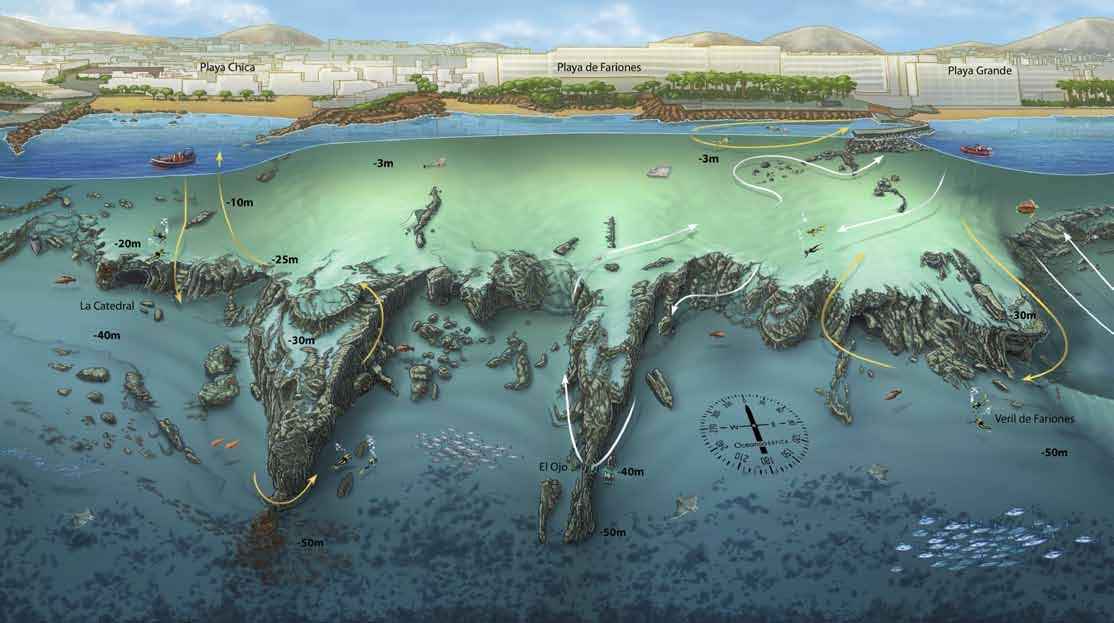
Illustration: Oceanografica / Reserva de la Biosfera de Lanzarote (2011)
Cathedral earns its name honestly. A ten-metre-wide mouth cut into the base of a volcanic wall opens into a domed chamber whose sponge-crusted ceiling genuinely recalls the inside of a cathedral, lit by daylight that reaches all the way to the back wall, never sealed into true cave darkness. Above the dome sits the site's signature curiosity, a bubble garden where divers' own exhaled air collects against the porous rock overhead. The combination of black coral, dense narwhal shrimp and resident dusky groupers makes this a defining dive on this stretch of coast; divers passing through Playa Chica often name it alongside Mala as a must-do. For years Felix was a grouper calm enough to fill a wide-angle frame; he is the reason many divers still ask for Cathedral specifically rather than just "a cavern dive." Further out along the same wall, past recreational depth, the same black coral forests continue below forty metres for anyone certified to follow them.
Cathedral takes its name from the cavern itself: the chamber's vaulted ceiling and sponge-covered walls are distinctive enough that the site was named for them outright, and for decades it was also described as home to the island's most famous resident animal. That animal was Felix, a large dusky grouper who, like every other big grouper at the site, had already changed sex: dusky groupers are born female and turn male at around 83 centimetres of body length, which is why the largest individuals here, Felix included, were all males. Local divers saved him more than once, on at least one occasion removing a fishing hook lodged in his throat, an encounter credited with his unusual trust of people. Divers who photographed him in 2007 recall Felix lingering close to the camera for several minutes, calm enough to stand out from the other resident groupers in the frame. Felix is reported to have since died, though no date is documented and it is unclear whether the grouper now holding the entrance is a successor. Large resident groupers remain a fixture of the chamber regardless.
Depth is the binding constraint. At 28-32m, expect 25-35 minutes of total dive time depending on air management and profile; nitrox extends this, and Manta Diving Lanzarote includes it free for certified divers. A torch is essential, not optional: the sponge colour on the dome is muted without artificial light, and the macro along the reef route is invisible without a beam. The cavern is daylit, a large overhang rather than a true penetration, but buoyancy still matters: ceiling contact damages sponge colonies that take years to recover, and the sand floor silts up quickly with poor finning. Standard kit applies: dive computer, SMB for the ascent on the wall return, booties for the shore entry across volcanic rock. Winter brings cooler water, around 18°C, and a credible chance of angel sharks resting on the sandy stages of the route between November and March.
10m-wide entrance opens into a domed chamber with sponge-encrusted ceiling and sand floor.
Exhaled air pools in silver patches against porous basalt above the cavern roof.
Antipathella wollastoni forests appear below 40m for those equipped for it.
Large groupers hold the cavern entrance; Felix, the named individual, lived here for years.
Reached from Playa Chica beach with a 10-minute swim to the cavern entrance at 27-30m.
28.9191°N, 13.6691°W
Also known as: La Catedral, Playa de la Barrilla
Book a guided dive at this site.
Lanzarote / Dive Center

Lanzarote / Dive Center

Lanzarote / Dive Center

Lanzarote / Dive Center

Lanzarote / Dive Center
Get in touch to add or claim your dive center listing on DiveCodex.
Diveable every month. Surface conditions dictate access more than water temperature.
Rates vary by centre and shift season to season; confirm current pricing when booking.
The cavern sits at 28-32m, beyond OW depth limits and past the 30m ceiling of a standard AOW card. OW divers may explore the shallower reef at 12-18m but will not reach the chamber.
Summary
Cavern depth and overhead environment drive the rating. The reef route alone, without descending to the cavern, is intermediate.
Safety considerations
What can go wrong here, and what divers do about it. Conditions change - take the briefing from the operator on the day.
No. Despite the name, Cathedral is a cavern, not a technical cave: the ten-metre-wide entrance stays daylit, the exit is visible from inside the chamber at all times, and the route narrows into true penetration only beyond the point recreational divers go. No cave-diving certification or guideline-and-reel protocol is needed. What the dive does demand is solid buoyancy control and comfort in an overhead space, since contact with the ceiling damages the sponge growth and stirs up the sand floor.
A patch of exhaled air trapped against the cavern roof. Divers' bubbles rise through the chamber and, instead of escaping freely, work their way up through the porous volcanic basalt above the dome and pool there in silver sheets. It only shows itself if you look up while inside the chamber, so guides often point it out directly overhead on the way past.
No. Felix was a large dusky grouper who held the cavern entrance for years and tolerated divers close enough for wide-angle photographs; he is reported to have since died, though no date is documented and it is unclear whether the grouper seen at the entrance today is a successor. Large resident groupers remain a fixture of the site regardless.
You may encounter that name in some older or informal listings, but local operators consistently call the site Cathedral or La Catedral. Treat 'Playa de la Barrilla' as a secondary, lower-confidence name, not the site's working name.
Log your dives - notes, photos, conditions and the marine life you saw - and share them as one public diver profile. What you share helps the next diver, too.
Log every detail
Depth, duration, conditions, gear, buddy, notes — all in one place. Import from Suunto and other dive computers.
Track marine life
Record species sightings on each dive. Build a personal catalogue of everything you've seen underwater.
Your public dive profile
Share your dive history, stats, and experiences with a profile page you control. Show the world where you've been.