
Calypso Diving Estartit
Family-run PADI centre in L'Estartit, run by Peter and Jacqueline Lane for nearly 40 years, with PADI Green Star and four other environmental credentials.
PADI5 services8 languages
Also known as: Cova del Dofí, Cueva del Delfín, Dolphin's Cave, El Delfín, El Dofí, Túnel del Dofí
North zone of the Dofí cavern complex on Meda Petita: a short lit tunnel, a shallow red coral wall and gorgonian-covered walls, with light effects as the signature.
Last updated October 2026
Dofí Nord is the north zone of the Dofí cavern complex on Meda Petita, reached by boat from L'Estartit and 5 to 30 metres deep. The park describes its appeal as tunnels that pierce the island and link its two sides, and a visit to the Roca del Montnegre. From the north side, divers can go through a cave whose entrance is at 5 metres, or descend to 18 metres and follow the wall toward L'Herminia, a shallow dive on a rocky, irregular bottom.
The park calls the short Dofí tunnel short and well lit. Descriptions of it give about 30 metres and a fairly wide passage, with the dolphin statue seen at about 12 metres; some of them speak of the Dofí as a single site without naming a side. A red coral wall is reported only 12 metres deep on the outer walls, and large gorgonians cover the walls at the mouth of the long tunnel.
The long tunnel runs darker and deeper than the short one and exits on the north side of the island at about 25 metres. The park's guidance for recreational dives steers away from caves where the light is lost, so what a group does here is the centre's call on the day. The complex also has an air chamber, which the park places on its Dofí Sud page.
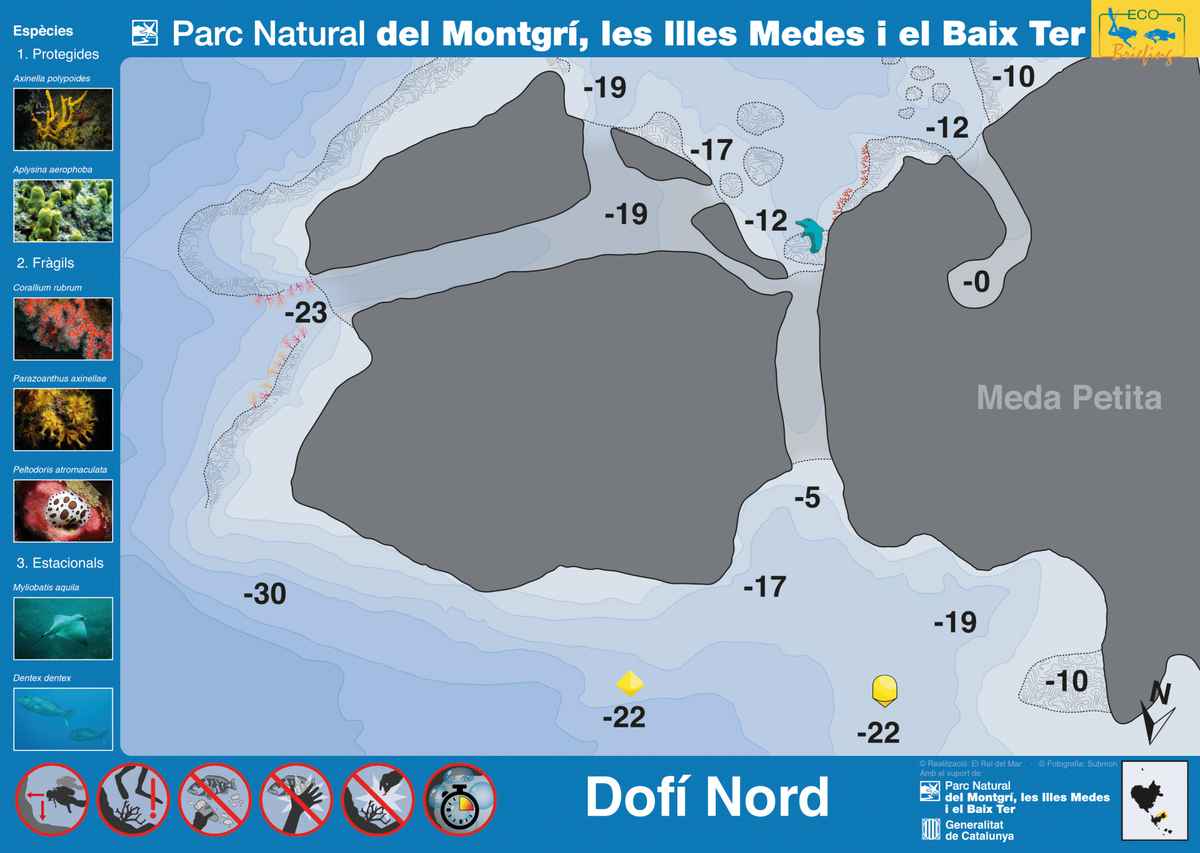
Illustration: Parc Natural del Montgrí, les Illes Medes i el Baix Ter — Generalitat de Catalunya
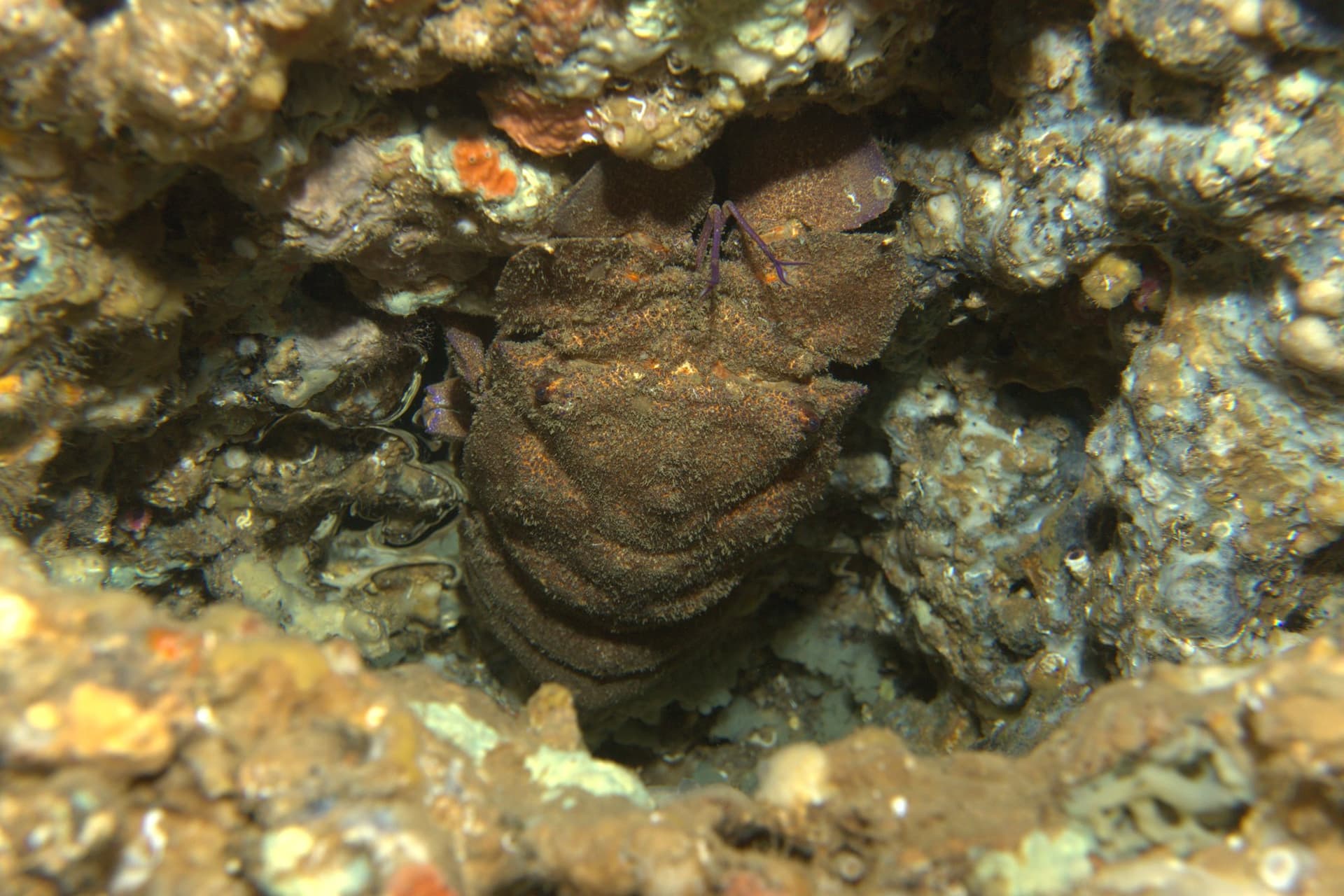
The complex takes its name from a dolphin statue on the south face of the tunnel, and operators describe the place as famous for its light effects, its cathedral and its dark tunnels, with plays of light and backlight on the calcareous rock. Inside the tunnels sit the cave residents: conger eels, greater slipper lobsters and meagres. Near the entries, schools of sea bream and giant groupers are likely, and the outer walls carry bryozoans, gorgonians and red coral, one of the most abundant colonies of the Illes Medes according to one operator.
Operators advise a light for the dark tunnels: one says one or two lights are needed and another lists a dive torch. The guide confirms what to carry. One operator asks divers not to touch the walls or ceiling of the fragile caves and to keep macro bubbles from accumulating on the ceiling. One operator recommends EAN32.
What makes this dive site stand out.
The park calls it short and well lit; descriptions give about 30 m and a fairly wide passage
A red coral wall reported only 12 m deep on the outer walls
Large gorgonians cover the walls at the mouth of the long tunnel
A cave entrance at 5 m that leads through, or a descent to 18 m and the wall toward L'Herminia
The park names a visit to this rock as part of the north zone's appeal
42.0443°N, 3.2261°E
Water temperature is reported at about 22°C in summer and 12°C in winter.
The certification field is the level the dive itself asks for: the short tunnel, the outer wall and L'Herminia. The reserve's own entry requirement is shown in the regulations module.
Summary
The short tunnels have several entries and exits, and an operator says you are always only a few metres from the big ones. One operator asks for no problem with claustrophobia. The guide confirms what light to carry.
Safety considerations
What can go wrong here, and what divers do about it. Conditions change - take the briefing from the operator on the day.
Book a guided dive at this site.
Family-run PADI centre in L'Estartit, run by Peter and Jacqueline Lane for nearly 40 years, with PADI Green Star and four other environmental credentials.

PADI 5 Star centre on L'Estartit seafront with stay-and-dive packages, four daily boat dives between Illes Medes and Montgrí, plus tec diving.

Family-run PADI 5 Star Resort and SSI centre in L'Estartit since 1990, with two 30-diver boats running hydraulic lifts to the Illes Medes reserve.
Long-running L'Estartit dive centre (founded 1969) running a four-boat fleet to the Illes Medes reserve and Montgrí coast, with SSI training and a strong family/snorkel programme.

Family-run hotel and dive centre in L'Estartit since 1985, with two dedicated boats and four daily departures to the Illes Medes reserve.

Owner-led PADI centre on Carrer Salines in L'Estartit, capping each guide at 5-6 divers across the Illes Medes, Montgrí, and Cap de Begur.

L'Estartit's oldest dive centre (est. 1965), a PADI 5 Star CDC running daily boat trips to Illes Medes and the Montgrí Coast with volume dive packages.
Get in touch to add or claim your dive center listing on DiveCodex.
Dive centres in Catalonia must require insurance from every diver on their dives, and must be able to offer a policy to anyone who has none.
The park calls the short Dofí tunnel short and well lit and suited to beginners, and says the same is not true of the visit to the Long Tunnel. Xaloc sets Open Water for the short-tunnel area and the dolphin statue and Advanced or higher for the long-tunnel route and return, as its own requirement for its dives. The reserve's own entry requirement is shown in the regulations module.
The park gives the north zone 5 to 30 m. For the caves themselves the figures differ: some descriptions put the cave system maximum at 23 m, and those place the Dofí on the south of Meda Petita, while others give the deepest point of the Túnel del Dofí as 25 m and the long-tunnel exit at about 25 m. Plan on the zone range.
Operators disagree: one gives 65 m and another 90 m. They also differ on which mouth is the entry, and the exit is placed on the north side of the island at about 25 m. The tunnel is darker and deeper than the short one, and the park says the visit is not for beginners.
The park places the air chamber on its Dofí Sud page, and an operator's Dofí Sud page grades it at advanced level. Descriptions that give it at about 10 m speak of the Dofí as one site without saying which side.
Log your dives - notes, photos, conditions and the marine life you saw - and share them as one public diver profile. What you share helps the next diver, too.
Log every detail
Depth, duration, conditions, gear, buddy, notes — all in one place. Import from Suunto and other dive computers.
Track marine life
Record species sightings on each dive. Build a personal catalogue of everything you've seen underwater.
Your public dive profile
Share your dive history, stats, and experiences with a profile page you control. Show the world where you've been.